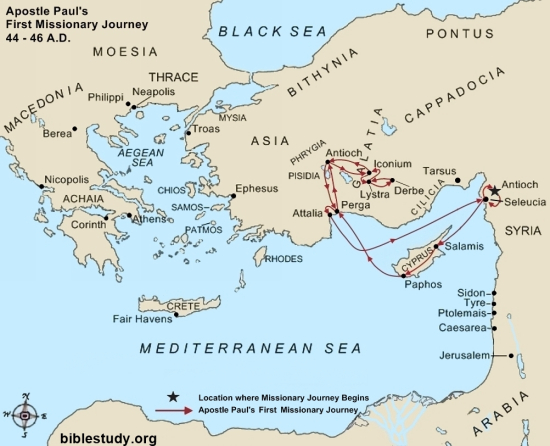
Late Spring 44 A.D. to Fall 46 A.D. Apostle Paul's first missionary journey begins In the late Spring of 44 A.D. Paul and Barnabas are ordained by the brethren as apostles (Acts 13:1-3). From Antioch they and John (surnamed Mark) begin Paul's first missionary journey (Acts 13:4-52, 14:1-25). Apostle Paul and company travel to Seleucia then sail to Salamis, the principle city and seaport of the island of Cyprus. Cyprus is where Barnabas was born and raised (Acts 4:36). In Salamis they preach the gospel in several synagogues. They then cross the island by foot and arrive at Paphos. While in Paphos the island's Roman governor requests the two evangelists meet with him so that he can personally hear the word of God. Accompanying the governor to the meeting is a sorcerer and false prophet known as Elymas the magician. Elymas resists the gospel and tries to prevent the governor from accepting the truth of God (Acts 13:6-8). The apostle Paul perceives Elymas' intentions, intently looks at him, then says: "Then Saul, who also is called Paul, filled with the Holy Spirit, looked intently at him and said, 'O full of all deceit and all fraud, you son of the devil, you enemy of all righteousness, will you not cease perverting the straight ways of the Lord? And now, indeed, the hand of the Lord is upon you, and you shall be blind, not seeing the sun for a time.'" (Acts 13:9-11, NKJV throughout)
Elymas immediately goes blind and is unable to see for a period of time. The governor, astonished at what he sees, believes the gospel (Acts 13:11-12). Mark abruptly leaves the evangelistic team Apostle Paul, Barnabas and Mark soon board a ship and sail to Perga. Mark then abruptly leaves the group and returns to Jerusalem (Acts 13:13). The issue of Mark suddenly abandoning the first missionary journey will be the catalyst for the separation of the evangelists before Paul's second missionary journey (Acts 15:36-41). They leave Perga and travel to Antioch in Pisidia (also called Pisidian Antioch, to distinguish it from the Antioch located in Syria). When did SAUL become Paul? Acts 13:9 is the last time Saul is mentioned in the New Testament and the first place where Saul is called Paul. | |
In Antioch the evangelists attend a local synagogue where the apostle preaches a powerful message (Acts 13:16-41). After the Jews leave the synagogue the Gentiles (proselytes) in the audience ask him to speak the next sabbath day. Then, after the synagogue had been dismissed, many Jews and proselytes follow him and Barnabas in order to hear more about the gospel. On the next sabbath almost the entire city comes to hear the word of God. (Acts 13:42-44). Some Jews, however, envious of the large crowd drawn by apostle Paul, begin to speak against the gospel. Their rejection of Jesus as the Messiah means that he and Barnabas will now primarily preach only to Gentiles (Acts 13:45-47). As the word of the Lord spreads through the entire region some Jews begin a campaign to convince important men and women of the city to be against him and Barnabas. Persecution soon sets in and culminates with both men expelled from the area. Arriving in Iconium Paul speaks at a local synagogue. His preaching convinces many Jews and Greeks to become believers. Jews who do not believe in what he teaches, however, stir others up against the gospel. Although signs and wonders are performed to confirm what is preached the city is divided as to whether he and Barnabas are true servants of God. In a short time some Jewish leaders, along with other Jews and Gentiles, conspire to have the two apostles stoned to death. After the threat against their lives is discovered the evangelists flee the city to Lystra (Acts 14:1-6). Worshipped like Greek gods In Lystra Paul meets a man born crippled and never able to walk. He perceives, after the man hears his message, that he has the faith to be healed. When he commands the crippled man to stand he miraculously leaps up and is able to walk (Acts 14:6-10)! The response to such a miracle was immediate and unexpected: "Now when the people saw what Paul had done, they raised their voices, saying in the Lycaonian language, 'THE GODS HAVE COME DOWN TO US IN THE LIKENESS OF MEN!' And Barnabas they called Zeus, and Paul, Hermes, because he was the chief speaker. Then the priest of Zeus, whose temple was in front of their city, brought oxen and garlands to the gates, intending to sacrifice with the multitudes." (Acts 14:11-13) The two evangelists tear their clothes in amazement! They are BARELY able to keep the crowd from offering sacrifices to them like they were Greek gods (Acts 14:14-18)! In a short time Jews from Pisidian Antioch and Iconium arrive in Lystra and succeed in turning people against the two evangelists. After being stoned Paul's dead body is dragged out of the city. Some believers find his body and as they stand around it he comes back to life! Amazingly, He re-enters the city. The next day he and Barnabas travel to Derbe (Acts 14:19-20). They preach the gospel in Derbe, then retrace their steps through Lystra, Iconium and Antioch in order to strengthen the brethren. From Pisidian Antioch they travel to Perga and then to Attalia, where they catch a ship to sail back to where their missionary journey started (Acts 14:21-26). Fall 46 A.D. to Late Summer 49 A.D. Apostle Paul and Barnabas live in Antioch Paul and Barnabas stay in Antioch for almost three years - from the Fall of 46 A.D. to the late summer of 49 A.D. (Acts 14:26-28). |