Tertullian, in the early part of the third century A.D., is believed to have been the first person to originally apply the term Pontifex Maximus (Supreme Pontiff or Pope) to the head of the Catholic Church. He used the term, however, in sarcastic rebuke of Pope Callixtus I (who had authority over the church from 217 to 222) whom he felt was exercising too much unilateral power in the church.
Where, however, did Tertullian get the term that is the basis of the title of Pope? Did it come from a lengthy doctrinal analysis of Scripture? Was it related to the Apostle Peter's status in the early church?
A Major Dogma
One of the foundational dogmas of the Catholic Church is that the current Pope, in an unbroken chain, has received their authority to rule the church directly from the apostle Peter.
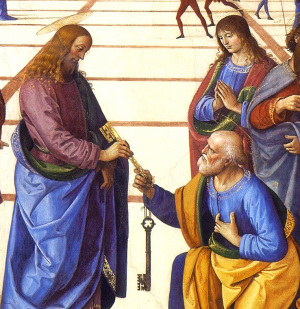
According to the 1913 Catholic Encyclopedia, there have been an unbroken line of 256 popes from 1903 A.D. back to Peter. As of 2018, this number is 266, with the current Pope beginning his reign in 2013. The problem is, you can search the New Testament in virtually any translation and you will never find Peter given or referred to by any title that even remotely acknowledges any supremacy over all Christians.
Peter Not the Final Word
Nineteen years after the death of Jesus, in 49 A.D., the early church was in turmoil. An all-out doctrinal war erupted between those who firmly believed that a person must be circumcised before they can be saved and those who felt the ritual had no bearing on a person's salvation. The discussions in the churches got so heated that it was decided that the matter needed to be settled, once and for all, through a gathering of church elders and brethren in Jerusalem.
This gathering (known as the Jerusalem conference - Acts 15), which included Jesus' original apostles (Peter, John, etc.), was also attended by the Apostles Paul and Barnabas, Titus, and many others (see Galatians 2).
If ever there was a time for Peter to assert his authority over the church and to let everyone know "who is the boss" it was now. The first century church would never again gather in the way it did in 49 A.D., with all the well-known church leaders in attendance.
After heated debates regarding the circumcision issue, and testimony from Paul, Barnabas and Peter regarding what God had done through them toward the Gentiles, a decision is arrived at.
Was it Peter that announced to the church, from a position of spiritual authority, what the church would now teach regarding the circumcision question? NO! It was JAMES, one of the other apostles, who not only renders a final decision the assembled church agrees it, but who also writes a letter summarizing the decision to be read in the churches (Acts 15:13 - 32)!
If the early church never used the exalted title of Pope for Peter, or even recognized that HE was the final authority on all church matters, where did it come from?
True Origin of the Title
The origin of the title of Pope for the head of the Catholic Church is much older than even the first century church. In ancient Rome, the term Pontifex Maximus was used well before 254 B.C. for the highest position within the Roman Republic's PAGAN religion. Over the years the position became highly politicized until, beginning with the reign of Emperor Augustus (27 B.C. to 14 A.D.), it became one of the many Imperial titles.
Today, according to the Catholic Church, the title Pontifex Maximus is the most noteworthy one used for the Pope. It is considered the distinctive mark of honor bestowed on the Bishop of Rome as head of the church worldwide.
Catholics officially and readily admit that the title of Pope bestowed on its most powerful leader came directly from paganism.
"As regards the title Pontifex Maximus, especially in its application to the pope, there was further a reminiscence of the dignity attached to that title in pagan Rome" (1913 Catholic Encyclopedia article on the Pope).