God told Noah to build an Ark that would be big enough to save his family and animals that would not otherwise be able to survive a worldwide flood. The ship was to be 300 cubits long by 50 cubits wide by 30 cubits high.
Make an ark of cypress timbers. You shall make rooms in the ark, and you shall pitch it inside and outside with pitch. And this is the way you shall make it: The length of the ark shall be three hundred cubits, the breadth of it shall be fifty cubits and its height thirty cubits (Genesis 6:14 - 15, HBFV).
How Long is a Cubit?
An ancient cubit is considered the length between the elbow of an adult male and the tip of their middle finger. Quite a few Biblical scholars, and most Biblical commentaries, believe an ancient cubit was somewhere between 17.5 to 21.5 inches long (44.4 to 54.6 centimeters). This difference of 4 inches (10.1 centimeters) means there is a bit of a range in how big was Noah's Ark and how much volume it possessed.
Size Matters
If we conservatively assume the cubit used by Noah was 18 inches (.45 meters), we end up with an Ark that was 450 feet (137 meters) long, 75 feet (22.8 meters) wide, and 45 feet (13.7 meters) high. If we assume a 19 inch (.48 meters) cubit, we end up with a 475 feet (144.8 meters) long, 79.1 feet (24.1 meters) wide, and 47.5 feet (14.4 meters) high Ark that was indeed a big ship!
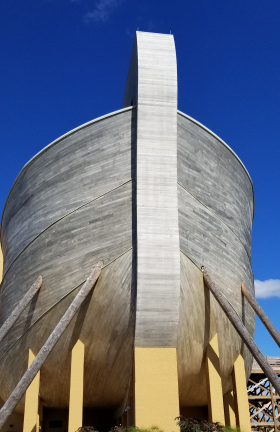
A life size replica of Noah's Ark, built from wood, exists in the U.S. at the Ark Encounter theme park in Williamstown, Kentucky. It was built under the assumption that a "long" or "royal" cubit was used that measured 20.4 inches (51.8 centimeters). The huge replica stretches 510 feet (155.4 meters) long by 85 feet (25.9 meters) wide and 51 feet (15.5 meters) high. According to the park, their attraction is so big that it is the width of two U.S. school buses and has a height equal to three giraffes stacked on top of each other!
Assuming the more conservative cubit length of 18 inches, Noah's ark was constructed on a 1:6 ratio. Naval architecture reveals that this is the most stable ratio for an ocean-going vessel. It could have easily survived even big ocean waves and would be next to impossible to capsize. The amount of water the ship would displace, given a draught of 15 cubits, exceeds 22,000 tons.
Volume of the Ark
The total volume of Noah's Ark, with an 18 inch cubit, was roughly 1.5 million cubic feet (42,475 cubic meters). This is equal to the total capacity of more than 570 standard stock cars used on a typical railroad. Its floor space, divided over three decks, would total over 101,000 square feet (9,383 square meters). This is more floor space than twenty-one standard college basketball courts!
The Ark God had Noah make was truly big! In fact, this giant ship was the largest one produced by man from the time of Adam until vessels that are even more colossal were built in the late 1800's A.D.!