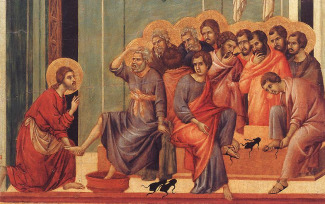
Why did Jesus wash the disciples feet?

Submit YOUR questions, through our easy to use form,
to our team of mature Christians known as the Email Evangelists!

What is the meaning of Jesus washing the feet of the disciples? What washes us clean SPIRITUALLY? Which of the apostles REFUSED to have his feet washed? In the thirteenth chapter of the book of John, we find recorded an unusual but simple ceremony Jesus performed during his last Passover observance with his disciples. This ceremony revealed the attitude and character he had and those who say they believe in Him MUST possess. The profound spiritual lessons Jesus' actions teach are so IMPORTANT that He commanded ALL those who choose to follow him to do what he did.

Interestingly, John is the only one of the four gospel writers to record Jesus humbly washing the feet of his disciples during Passover. John, the last gospel writer, may have wanted to include information Matthew, Mark and Luke left out.

Washing another's feet is an act of humility when we perform it as Christ instructs us. After this study of Jesus' instructions concerning this service, we will find a more meaningful reason why it is important we do it correctly. This meaning will help us realize how important Christ's example is to us today.

The foot washing ceremony, recorded in John 13:1-17, allows us a window into the character of our Savior. When we apply the lessons of this unique and instructive ritual in our lives, it gives us a better understanding of why some people struggle to find happiness yet never fully achieve it, and why others are brimful and running over with joy.

How did Jesus serve?

Immediately upon reading the account, we notice that Christ performs a menial task generally done by the lowliest servant in the household. Jesus says of this in John 13:

"You call Me Teacher and Lord, and you say well, for so I am. If I then, your Lord and Teacher, have washed your feet, you also ought to wash one another’s feet. For I have given you an example, that you should do as I have done to you. Most assuredly, I say to you, a servant is not greater than his master; nor is he who is sent greater than he who sent him. " (John 13:13-16, NKJV throughout)
This last statement by Jesus gives us a little insight into His mind. What He says can apply both to earthly relationships of masters and servants as well as to a human's relationship to Christ. We can see in the pages of the gospels that it also describes how Jesus approached His relationship with God the Father. He was always submissive to the Father in everything. Beyond this, God the Father is the greatest servant in the universe. In our behalf, He sustains everything we depend on for our very lives.

Luke probably alludes to the same statement in his account of that Passover evening:

"Now there was also a dispute among them, as to which of them should be considered the greatest. And He said to them, 'The kings of the Gentiles exercise lordship over them, and those who exercise authority over them are called ‘benefactors.’ But not so among you; on the contrary, he who is greatest among you, let him be as the younger, and he who governs as he who serves. For who is greater, he who sits at the table, or he who serves? Is it not he who sits at the table? Yet I am among you as the One who serves.' " (Luke 22:24-27)

Christ, by His actions, made it very clear that He would not expect anything from us that He was not willing to do Himself. He, our Elder Brother, though others should serve him, served them. Undoubtedly, service is the essence of godly leadership.

What does it mean to be CLEAN?

Notice Peter's objection in John 13:

"Then He came to Simon Peter. And Peter said to Him, 'Lord, are You washing my feet?'" (John 13:6)

The translation does not do Peter's reaction justice. Kenneth N. Taylor, in his Living Gospels: The Paraphrased Gospels, puts it this way: "Master, You shouldn't be washing our feet like this!" Christ responds, "What I am doing you do not understand now, but you will know after this" (verse 7).

Peter, still not convinced, flatly states,

"You shall never wash my feet" (John 13:8)

Christ's next words, however, finally cause him to give in:

"If I do not wash you, you have no part with Me." (John 13:8)

Jesus' response - whatever His tone of voice - struck the disciple squarely between the eyes: Peter's eternal life was on the line! This time, his response is quite different:

"Lord, not my feet only, but also my hands and my head!" (John 13:9).

This sounds a little like Psalm 51:2, where David prays:

"Wash me thoroughly from my iniquity, and cleanse me from my sin." (Psalm 51:2)

Our Savior's answer to this request is not what some would expect:

"He who is bathed needs only to wash his feet, but is completely clean" (John 13:10).

The New International Version's translation of this verse makes His thought clear: "A person who has had a bath needs only to wash his feet; his whole body is clean." Obviously, the disciples had bathed before coming to eat the Passover meal. However, having to walk along dusty roads in sandals, they collected a small amount of dirt on their feet. Thus, Christ explains that to be perfectly clean again, all He needed to do was to wash their feet.

Upon repentance, baptism, and receiving God's Holy Spirit, we are at that point perfectly clean in God's eyes. The blood of Jesus Christ symbolically washes away all our past sins, and we stand before Him sinless. However, as we all know, our human nature has certainly not departed from us, and it is not very long until the fact that we have sinned again stares us in the face. The old self has not really gone away. Our lives are much as they were with some important exceptions. We now have the Holy Spirit and God’s grace.

Begotten by God through His Spirit that He has given us, we have entered a unique relationship with God the Father. Torn away is the veil that once separated us from having access to Him through the sacrifice of Jesus Christ (Matthew 27:51; Hebrews 6:19-20; 10:19-22). Through Him, we can communicate with the Father to seek mercy and forgiveness for our sins and weaknesses. Upon repentance, God applies again the sacrifice of Christ to us and forgives us by His grace.

Although washed completely clean at baptism, we will occasionally sin as we walk through this life. We will spiritually get our feet dirty, and we will need Christ to wash our feet to make us completely clean again. Thus, He tells Peter, if He did not wash his feet, he would have no part with Him. This points out why it is so imperative that we seek His mercy and help to repent each day. When we do this, He can symbolically wash our feet and make us clean again. Each year at the Passover service, we reenact this to remind us how important it is.

What does foot washing SYMBOLIZE?

In John 13 Christ says,

"If I then, your Lord and Teacher, have washed your feet, you also ought to wash one another’s feet. " (John 13:14)

This act teaches us to learn humility by helping others, by doing acts of service or kindness for our brethren. This is certainly a good lesson that we can take from Christ's example, but we can perhaps derive another from it.

In John's account, what did Jesus suggest that the washing of feet symbolized? He tells Peter that the washing of his feet symbolizes forgiveness of his sin to return him to a "clean" relationship with God. It is only logical to deduce that God expects nothing less from us in response to the sins of our brethren. In the section of the Sermon on the Mount on prayer, Jesus says:

"For if you forgive men their trespasses, your heavenly Father will also forgive you. But if you do not forgive men their trespasses, neither will your Father forgive your trespasses." (Matthew 6:14-15)

No doubt, God puts a very great emphasis on our relationships since our lives are to reflect His character. If we have begun to "put on Christ" (Galatians 3:27), would we be a good example of His love for us if we held grudges, hated our brother, or would not forgive another? No, we would not. Putting on Christ demands that we "put off" these carnal destroyers of relationships and replace them with Christian virtues.

Peter asks Christ,

"Lord, how often shall my brother sin against me, and I forgive him? Up to seven times?" (Matthew 18:21)

Jesus' answer should give us a clue to how He feels about this issue. Peter had ventured a number he thought would be sufficient to establish his forbearance. Christ, though, pulls out all the stops, telling him that there is no set limit:

"'I do not say to you, up to seven times, but up to seventy times seven. . . .'" (Matthew 18:22)

We are indeed fortunate and can be thankful that same unlimited forgiveness applies to us when we need God's mercy.

The following verses, Matthew 18:23-35, is the Parable of the Unforgiving Servant. The servant was deeply in debt to his master, and when he sought relief, his master forgave him his gargantuan debt. Then the tables turn. Another man owed him a small amount and could not repay it. Instead of following his master's example, the servant forgot the mercy he had just received and had the man thrown into prison!

Verses 34-35 sum up the story:

"'And his master was angry, and delivered him to the torturers until he should pay all that was due to him. So My heavenly Father also will do to you if each of you, from his heart, does not forgive his brother his trespasses.'" (Matthew 18:34-35)

The language Jesus uses leaves little room for exclusions. He Himself, in the agony of crucifixion, says without reservation,

"Father, forgive them, for they do not know what they do." (Luke 23:34).

Jesus’ request applies not only to those who wanted him dead and nailed to the cross, but to all those who would ever live and find themselves in need of God's forgiveness.

Will we be happy and blessed if we OBEY?

Finally, we must notice John 13 where Jesus concludes His comments on foot washing:

"If you know these things, blessed are you if you do them." (John 13:17)

Observe that His emphasis is on their application, not on whether we know about them or even understand them. In this verse, Jesus makes a very positive statement. Blessing will come if we put his teachings into practice. He knew that grudges, hate, anger, and lack of forgiveness do nothing but shackle us and hinder our spiritual growth. If we let them hang around, they will eventually destroy us. Forgiving even those who have done things spitefully against us (Matthew 6:44) unlocks our shackles and releases us from feelings of animosity. When we rid ourselves of these burdens, we can find inner peace and true happiness. The foot washing ceremony conducted during the Christian Passover is important. It shows the depth of Jesus' love in making Himself a sacrifice so that the forgiveness of sins, salvation, and eternal life can come to ALL.

"'Greater love has no one than this, than to lay down one’s life for his friends.'" (John 15:13)

Meditate on these things during the next foot washing ceremony. It may still be humbling, but it should also make us happy that we are following the example of Jesus in serving one another by forgiving one another.

Additional Study Materials
Timeline of
Jesus' last week
Pictures related to the last days of Jesus
Mount of Olives  -  The Last Supper


Bible Answers to Questions  -  Basic Articles  -  Beginners Studies  -  Pictures  -  In-Depth Articles  -  Life of Paul
Maps and Timelines  -  Prophecy  -  Reference Materials  -  Roman Empire  -  The Sabbath  -  Study by Topic
Homeschool links  -  Discount Bookstore  -  FREE books