The first fossils of Neanderthal man were unearthed in 1856 A.D. Since humans are evolving, which implies that they are improving, Neanderthals look very primitive and apish looking. Early humans looked brutish because he was further back on the evolutionary scale. Modern humans, according to evolution, were more refined.
These suppositions do not rest on morphology and hard science; but rather on slanting the data to fit preconceived notions of how early man, especially Neanderthal man, was supposed to look.
As any forensic practitioner knows, it is impossible, from a skeleton (especially one from a Neanderthal man), to identify; extent of hair covering, hair color, nose shape, lip shape, skin color and race. Often it is not even possible to identify the sex of the individual. Consider that most anthropologists only have fragments of bones to work with, especially in regard to a Neanderthal. It is very easy to see that their presuppositions can influence their findings.
What are the morphological (form and structure) facts about Neanderthal man? Have these facts been properly utilized by those who claim to follow the evolutionary scenario? Is it possible to construct another picture that better fits these facts? Yes. They are fully human, a bona fide member of the Homo sapiens family. He was not an apish creature. These facts and findings coincide with the Biblical record.
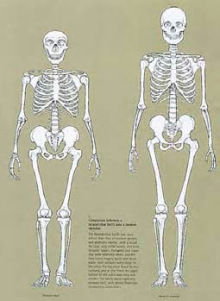
The following are recent facts discovered about Neanderthals found through fossil remains in various parts of Europe and the Middle East. Skeletons have been unearthed with the voice box intact (hyoid bones). The hyoid bones of a Neanderthal man are identical to those we have. They had the ability to speak and were shorter than modern human beings. Although they are shorter than us they are nevertheless powerful.
The average brain size for this early man is larger than the brain of modern humans. According to the evolutionary theory, they should have a smaller braincase. They were extremely muscular and strong. In the figure below, notice how much more surface area the knee socket on the skeleton has. This allowed for a greater attachment of ligament, tendons, and muscles. It also allowed carrying heavier loads with less strain. They also had extremely thick bones. The rest of the skeleton exhibits similar traits.
The average brain size for Neanderthal man is larger than the brain of modern humans. According to the evolutionary theory, they should have a smaller braincase. They were extremely muscular and strong.
Notice the following quotes about Neanderthals.
"One of the most characteristic features of the Neanderthals is the exaggerated massiveness of their trunk and limb bones. All of the preserved bones suggest a strength seldom attained by modern humans.
"Furthermore, not only is their robustness present among the adult males, as one might expect, but it is also evident in the adult females, adolescents, and even children." (Trinkaus, E. Hard Times among the Neanderthals. Natural History. 87:10, 1978)
"Neanderthal was far more powerful than modern humans. Whereas archeologist can experimentally duplicate the wear pattern on tools such as were used by people form the Upper Paleolithic, the wear patterns on Neanderthal's tools cannot be duplicated." (Geist, V. Neanderthal the Hunter. Natural History. 90:1:30, 1981)
"The evidence indicates that Neanderthals were people of incredible power and strength - far superior to all but the most avid bodybuilders of today." (Lubenow, Marvin. Bones of Contention. Baker Books. Grand Rapids, MI. 1992)
"The vertebral columns of the Shanidar Neanderthals are similar to those of modern man but with a marked tendency to robustness. The ribs are thick. The upper limb bones disclose a pattern of morphology close to that of other Neanderthals of the Near East and of Europe. This pattern includes powerful shoulders, arms, and hands built for grasping, pulling, and lifting. The lower limb remains conforms to the pattern of Neanderthal man in that they are robust, powerfully muscled and in keeping with upright posture and bipedal gait.
"In addition it seems that the distribution of muscularity is such that powerful acceleration would have been possible in running, jumping or climbing." (Day, M. Guide to Fossil Man 4th ed. University of Chicago Press. Chicago, IL. 1993).
Facts from the Fossil Record
The skull of a Neanderthal was very thick. It had prominent brow ridges. It was flatter, wider, but longer. The longer cranial cavity had an occipital bun or pointed end. This allowed more room for a larger brain. The teeth were larger. The mandible was more massive and did not protrude as much as the modern version.
Culturally, Neanderthal was fully human. He buried his dead. He drew paintings on cave walls. He used fire and tools. He played the flute. He worshipped bears. He was cannibalistic. He cared for the injured and elderly. In essence he did the things that other humans have done down through history.
In summary, a Neanderthal was more muscular, more agile, and stronger with a greater bone density than a modern human was. He also had a bigger brain. He could easily overpower most modern day humans. When archeologists describe him, they often use the word "robust." This is a fancy way of saying bigger, thicker, or larger.
Are Neanderthals in the Bible?
The people who lived before the flood, and for some time after it, lived a very long time! This had a profound physiological effect upon their body systems. This would especially affect the growth of bones. The average age of the people mentioned in Genesis 5 (the ten generations from Adam to Noah) was 857 years. After the flood, from Shem to Abraham (ten generations), the average age was 323. Today the average life expectancy is about 78 years in the United States.
Man's nature had deteriorated. The world was extremely violent (Genesis 6:5, 13). Any fossils bone of the antediluvians would show signs of this violence in the form of broken bones, scars, and healed over bone growths. The Bible says that these men accomplished great deeds and that they were "men of renown." (Genesis 6:4)
The ecological systems of the Earth underwent catastrophic changes with the coming of Noah's flood. These included a restructuring of the atmosphere, changes in the magnetic field, great mountain building episodes and volcanic activity.
It included the start of the ice age(s), the beginning of a meteorological cycle based on rain and wind systems (Genesis 2:5 - 6, 9:16), and a geological restructuring of the earth with great sedimentary deposition of water borne particles. It also had the deepening of the ocean basins to collect flood waters (Psalm 104:5 - 9).
The nature of animals was changed. In the Garden of Eden, Adam was able to name all the animals. They apparently had no fear of man. After the flood, this changed. Some animals would kill people because God allowed man to avenge himself on any animal that killed a human (Genesis 9:5). The rise of Nimrod as a world leader was made possible by his skill as a hunter. He protected people from the beast of the earth and their newly acquired ferocious nature (Genesis 10:8 - 10).
The Bible says that God was going to destroy not only man but also the Earth (Genesis 6:13). When Noah disembarked from the ark, the world was a completely different world than the one he had been living in.
Are they fully human?
What caused the unique facial and skeletal characteristics of a Neanderthal? Evolutionists will tell you that since they are an ancestor of modern humans the morphological differences are due to the evolutionary changes that are constantly remolding our features. Is evolution the only mechanism by which these changes could have been produced?
Many scientists disagree with the theory of evolution. If there is a simpler answer, does it not make sense to examine the evidence? Below is a summarization of research, and the research of others, that shows that non-evolutionary factors and forces could have produced a Neanderthal's unique anatomical differences.

Neanderthal man was not a combination half-man half-ape. He was fully human and was a full-fledged member of the human family. Although he carried this distinction, there were some slight anatomical differences. These differences are explainable in the context of the events that occurred in the opening chapters of the book of Genesis. This included the events before Noah's flood and after.
Noah's flood was a major catastrophe that affected the earth. As we have seen, these factors affected all of the earth's ecological system. These changes in the ecological system affected the physiological systems of the humans that lived on the earth. Most modern day geologist and evolutionist do not fully comprehend the ramifications of the flood.
The vast majority of these scientists follow the uniformitarianism principle as it relates to the events of the earth's prehistory. They believe that the "present is the key to the past." They will only accept as possible what is happening today. They have blinded their eyes to divine revelation.
Since no one can prove with certainty what has happened in the past they refuse to consider any other position except their own. The earth's geologic structures and the biological system that we see today are explainable in the context of Biblical revelation.
What were some of the physiological and environmental factors that produced Neanderthal man? Before we address this topic certain groundwork must be laid. As humans we tend to view things from our own perspective. We consider it normal to die at about 72 years of age. We consider it normal to be in a constant state of battle with various debilitating diseases. We consider it normal to age the way we do.
It is normal for us to experience puberty in our teenage years then soon afterward be married. We consider it normal to retire at 65 because our bodies are too old to continue to function. We consider all these things normal because this is the only way of life that we have known.
But consider the facts as outlined in the Bible. Think about how different life would be if we had lived in the world before the flood. It would be normal to have good health. It would be normal to eat foods that actually helped retard or slow the aging process. It would also be normal to go through puberty at around 30 or 40 years of age.
What if women could conceive and bear children at the age of 100, or 200, or 300? What would it be like with a well-muscled and healthy body, a body that could do massive amounts of physical work and do this type of work for centuries?
We need to completely change our Neanderthal thinking. We are on a downward path as a species. This goes contrary to the theory of evolution, but it fits nicely within the framework of biblical knowledge about our ancestry and our current path as a society.
A descendant of Adam?
Did Neanderthals descend from Adam? What would happen to a human baby that was born into the antediluvian world? Would it age and develop the way babies do today? Neanderthal characteristics were a physiological response to a human being living under the conditions as described in the early chapters of Genesis. We will examine several factors in order to understand his unique morphology.
Neanderthal man is a direct descendant of Adam. He was therefore closer to the creation than we are. Adam and Eve did not suffer from genetic loading. Genetic loading is the devolution of our genetic material via mutations and alterations in our chromosomes.
The Bible states that after Adam and Eve were created that God pronounced his creation very good (Genesis 1:31). Adam and Eve had perfect genetics. They would not suffer from many of the genetic diseases that we have today because of genetic imperfection.
After the sin of Adam and Eve, death and decay appeared. Where did Adam's descendants get their spouses? The answer is that they intermarried among themselves. This would not have caused any physical problems because there would have been no genetic loading. When a genetic mutation occurs, it is usually recessive. In other words, it does not manifest itself unless matched with another recessive gene from the other parent. Adam's closer descendants did not have these mutated recessive genes.
Abraham married his half-sister. This caused no genetic problems. As man progressed, God had to institute marriage laws. By this time, humanity had built up a number of genetic mutations and marriage among close relatives would have caused defects and diseases.
What caused these genetic mutations? Many factors cause mutations. Some include ionizing radiation, non-ionizing radiation, and chemical carcinogens. Atmospheric radiation reaches us from the sun and some naturally occurs in the rocks of the earth. Mutations occur when we eat, absorb, or breathe carcinogens.
What could have lessened Neanderthal mutations in the past? There are many theories. One concerns atmospheric and magnetic changes. According to the proponents of this scenario an increase in the strength of the earth's magnetic field, through its increased shielding effect, would have kept excessive solar radiation from entering the earth's atmosphere. This solar radiation has been implicated in many chromosomal mutations. But the sun is not the only source of radiation.
The rocks of the earth give off natural radiation. Radon-222 (Radon for short) is a radioactive decay product of uranium-238 and radum-226. Radon causes cancer in humans. Buried below the surface of the earth is radioactive rock. The flood of Noah cause large-scale massive tectonic activity. There were great earthquakes and volcanoes. This brought the deeply buried radioactive elements to the surface of the earth.
After the flood, there was an increase in the background radiation from both the sun and the new volcanic deposits. It is interesting to note that the life span of the people mentioned in the Bible dropped dramatically after the flood. The cause of this drop was due to the increase in the genetic malformations linked to atmospheric and geologic radiation.
Let us now turn our attention to carcinogens. Carcinogens are chemicals that we are expose to that cause cancer. In the pre-flood world, the transport of carcinogens would have occurred at a different rate. The book of Genesis states that the earth at this time did not have a rain-evaporation cycle. The dew process (Genesis 2:6) deposited all of the moisture. This would retard the spread of any chemical. These carcinogens would not have a transport mechanism and would therefore remain outside of the diet of the people before the flood. In recent times, the carcinogenic effect of chemicals has appeared due to chemicals that are concentrated and widespread.
After the flood, the meteorological conditions of the earth changed. Rain was now a transport mechanism. This allowed man to ingest more chemicals and trace element than before. These newly ingested carcinogens would have had effects on the rates of cancer and disease. It would also have shortened the life span of people after the flood.
These shortened life spans would have cause vast morphological changes in human and animal anatomical systems as compared to organism that lived longer. Once again, we must consider that God's intention was for humans to live a long time. We are living in a world cursed by God (Genesis 3:17; 5:29).
The cursing of the earth affected the production of increased solar and ground radiation, carcinogens, hostile environmental conditions, a change in fauna and therefore lessened nutrition, less oxygen and reduced atmospheric pressure. All of these factors tended to lessen the life span of post diluvium man.
Did he have a long life?
Much scientific literature addresses the subject of skeletal and cranial shape changes that would occur as a person aged. This research presents a convincing case that accounts for the unique Neanderthal morphology to the cranium and skeletal features.
The main thrust of this Neanderthal research states that as humans age, the skull flattens, it becomes wider, and it lengthens. The cause of pronounced brow ridges is due to the long term and greater pressure that the chewing would place on the teeth and face. Since they were more muscular and heavier boned, the brow ridges grew in order to allow the greater stress to be absorbed. All of these features would occur to modern man if he lived longer and had a heavier musculature like that of a Neanderthal.
Another factor to consider is the nutritional factor. Some Neanderthal skeletons exhibit skeletal changes that are consistent with rickets. Rickets is a vitamin D deficiency. The body's skin tissue produces vitamin D when exposed to ultraviolet sunlight. People that do not have the proper amount of vitamin D develop rickets, which is a bending and thickening of some of the skeletal bones.
Neanderthals lived during the Pleistocene Epoch, sometimes called the ice ages. They would spend most of their time in caves. They would tend to wear fur clothing, which covered most of the skin. All of these factors would not allow enough exposure to the sun and would therefore produce rickets. The first skeletons that were analyzed all show features characteristic with rickets - showing a non-evolutionary explanation for the features of this early man.
Conclusion
Neanderthal man was a descendant of Adam and Eve. They were larger brained, more muscular, extremely strong, and longer-lived than we do today. We must not let our preconceived notions about supposed prehistoric humans cloud our picture of the proper understanding of this early ancestor. Only when we consider all the facts can we see the complete picture. Neanderthal man was not a product of evolution. All of the evidence, properly understood, supports the Genesis account of the creation of humans.