The Bible tell us that men who existed before the flood such as Adam lived 930 years, Jared lived to 962, and Jared's grandson Methuselah lived the longest in history at 969 years! While the average age at death before the deluge was high, it averaged only 317 years for the ten generations following it.
Many who refuse to believe in the Bible say that the ages upon death found in the first several chapters of Genesis (which records information before the flood) are nothing but fabrications and tall tales. Several things could have contributed to the shorter lifespans of man after the flood. Scripture denotes that the waters God brought on the earth would destroy not only animals by the earth itself.
And God said to Noah, 'The end of all flesh has come before Me, for the earth is filled with violence through them. And, behold, I will destroy them with the earth . . . And I will establish My covenant with you . . . Neither shall there any more be a flood to destroy the earth (Genesis 6:13, 9:11, HBFV throughout).
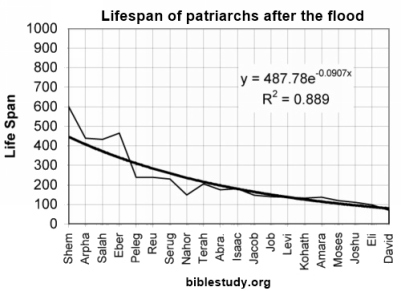
The earth after the flood was dramatically different than it was before it. The differences included the altering of the climate, atmospheric changes, changes in the hydrologic cycle, geologic features, a significant increase in harmful radiation reaching ground level, man's dietary habits went from solely plant-based to one where meat was eaten, and so on. These and many other factors led to man's much shorter lifespans.
Historical Proof
The first century historian Josephus asserts that man, at one time, did live very long lifespans. He attributes their longevity to God's mercy and the fact that the food they ate was much better at extending their years on earth than it was after the deluge.
"But let no one, upon comparing the lives of the ancients with our lives, and with the few years which we now live, think that what we have said of them is false; or make the shortness of our lives at present an argument, that neither did they attain to so long a duration of life, for those ancients were beloved of God, and [lately] made by God himself;
"and because their food was then fitter for the prolongation of life, might well live so great a number of years . . ." (Antiquities of the Jews, Book 1, Chapter 3, Section 9).
The long pre-flood lifespans delineated in the book of Genesis are not myths. Proof of this fact can be found by understanding nature's exponential decay rate. All things fall apart or decay at a given rate. If a container of organisms is exposed to a substance that is radioactive, they will die at a speed called a natural decay rate. This graph curve is the same even if the organisms are exposed to deadly doses of gas or other substances.
If you take the points of the population in question and graph them you can see how close the actual and exponential decay rates compare. This yields an equation and a value called the coefficient of determination. This math ratio tells us how close our graph correlates to the decay curve. This coefficient will be a number somewhere between the range of 0 and 1. A coefficient of 1 is a perfect match.
The pre-flood Biblical patriarchs lived incredibly long lives compared to today. After it the life expectancy of a person dropped to the modern average lifespan of a person of around 70 to 80 years.
Plotting the lifespans of the patriarchs on a graph can show us their decay curve, which can then be compared to the perfect exponential decay curve (which has a 1 for its coefficient of determination). With this information it can be reasonably proven that the stated number of years lived for the people found in Genesis is literally true.
The coefficient of determination in the above graph (labeled as R2) is almost .89. The decay rate of the Biblical patriarchs listed in the graph is only 11% away from matching the exponential (natural) decay curve. The average lifespan before the flood was 857 years. Note from the above graph that it took several generations after the deluge for a new average lifespan of 70 years to be reached!