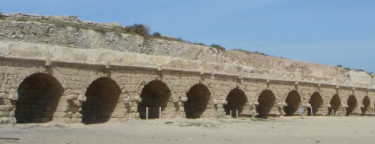
The other city, named Caesarea Maritima, can be found on the shores of the Mediterranean. It is where the prophet Agabus prophesied (Acts 21:10) that Paul would be arrested and the place where the the apostle was left to languish in prison for more than two years. This Caesarea was also where a Roman Centurion named Cornelius lived and became the first non-Jewish convert to Christianity (Acts 10).
Caesarea Maritima was built around 25 to 13 B.C. and named by Herod the Great in honor of Roman emperor Caesar Augustus. Jewish historian Josephus wrote about the building and completion of the city. In 13 B.C. it became the Roman civilian and military capital of Judea and the official residence of Roman procurators (governors) such as Pontius Pilate and Antonius Felix.
Journey to Caesarea
At the end of his third missionary journey the apostle Paul travels to Jerusalem. After arriving in the city he goes to the temple with four Jewish converts (Acts 21:23 - 26). Jews from Asia, assuming he brought Gentiles into a Temple area where they were not allowed, cause a riot.
Roman troops soon arrive to arrest him (which saves him from a certain death). Paul is soon escorted out of the city by Roman soldiers when one of his relatives discovers a murder plot against him. It is in Caesarea Maritima, which is roughly 60 miles from Jerusalem, that Roman governor Felix will hear the case against Paul made by the Jews.
And when it was day, some of the Jews banded together and put themselves under a curse, declaring that they would neither eat nor drink until they had killed Paul. And there were more than forty who had made this conspiracy . . .
But the son of Paul's sister heard of their plan to lie in wait; and he came and entered inside the fortress and reported it to Paul. And Paul called one of the centurions and said, "Take this young man to the chief captain, for he has something to report to him." . . .
Then the chief captain dismissed the young man, having charged him to tell no one those things that he had reported to him. And he called two certain centurions and said, "Prepare two hundred soldiers, and seventy horsemen, and two hundred spearmen for the third hour of the night, that they may go as far as Caesarea.
And have beasts of burden ready, that they may set Paul on them, and may carry him safely through to Felix the governor" (Acts 23:12 - 13, 16 - 17, 22 - 24, HBFV).
Paul the Prisoner
The Jews, before Felix, accuse apostle Paul of various crimes which they cannot prove (Acts 25:7). Governor Felix, in spite of his innocence, keeps Paul a prisoner in the hope that a bribe will be offered to secure his release (Acts 24:26 - 27).
Felix, to facilitate the possibility of a bribe, gives Paul liberties in Caesarea such as not being bound and the right to have people visit him or provide for his needs. A bribe, however, never comes. Paul is kept a prisoner under Felix from early Summer 58 A.D. to early Autumn 60 A.D. until Festus is named the new governor.
It is before Festus that Paul, as a Roman citizen, requests in Caesarea that his case be heard by Caesar himself. His request is granted and he is taken to Rome by a Centurion. His travel to Rome is considered his fourth missionary journey.