A Capital City
Ephesus, founded primarily by those from the city of Athens, was the capital of both Ionia and proconsular Asia. The city was originally called Arsinoe after the second wife of one of its governors.
Multiple Advantages
The advantageous location of Ephesus made it the chief city of Asia Minor. It maintained an artificial harbor accessible to the largest ships. The city stood at the entrance of a valley that reached far into the province. It was also connected via highways to other important cities in the region. The ease of traveling to the city, either by land or sea, made it the most accessible populated destination in Asia.
The populous city had a plethora of the most eminent orators and speakers in the world and contained many beautiful buildings. It was world famous for its large temple to the pagan goddess Diana (in the New Testament, Diana's name is a translation of the Greek word Artemis).
The city was also known for building the largest outdoor theater in the world, capable of containing 50,000 spectators. For many years Ephesus was the largest city in the Roman Empire next to Rome and boasted a population of more than a quarter million inhabitants.
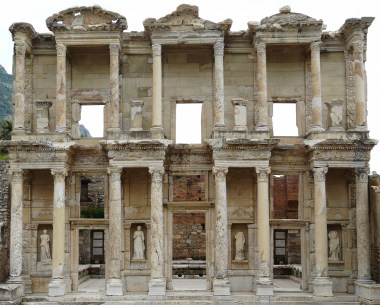
The church at the city was not started by the apostle John but was founded by the Apostle Paul.
Paul traveled through the upper parts (of Asia Minor) and came to Ephesus; and when he found certain disciples, He said to them, "Did you receive the Holy Spirit after you believed?" And they said to him, "We have not even heard that there is a Holy Spirit" . . . And after hearing this, they were baptized . . . (Acts 19:1 - 2, 5).
Although Paul visited the city briefly during his second missionary journey, he returned during his third missionary journey and stayed for a little more than three years.
Revelation's Warning
The church in Ephesus is the first of seven churches in Asia Minor who receive a spiritual evaluation directly from God through Jesus Christ.
To the angel of the Ephesian (Ephesus) church, write: These things says He Who holds the seven stars in His right hand . . .
I know your works, and your labor, and your endurance, and that you cannot bear those who are evil; and that you did test those who proclaim themselves to be apostles, but are not, and did find them liars; And that you have borne much and have endured, and for My name's sake have labored and have not grown weary;
Nevertheless, I have this against you, that you have left your first love. Therefore, remember from where you have fallen, and repent, and do the first works; for if you do not, I will come to you quickly; and I will remove your lampstand out of its place unless you repent. But this you have: that you hate the works of the Nicolaitans, which I also hate.
To the one who overcomes I will give the right to eat of the tree of life that is in the midst of the paradise of God. (Revelation 2:1 - 7, HBFV).
Tradition states the apostle John lived in the city after being released from Patmos. A marked tomb in Ephesus is believed by some to be that of John.