Pergamos, after King Attalus died, was given to the Roman Empire in the hope of preventing civil unrest. His son attempted to seize the kingdom for himself but was defeated. The Roman province of Asia was then formed with the city as its capital.
What Made It Famous?
Pergamos is the birthplace of the well-known Roman physician, surgeon and philosopher named Galen. Plutarch, a Greek historian and writer, started a library in the city. It soon grew to over 200,000 volumes and became the Greek's second best ancient library.
The city and its library were so highly regarded that Marc Antony, upon his marriage to Cleopatra, gifted it to her as a present. Pergamos was also popular for the creation of a papyrus replacement (named pergaminus or parchment) using calfskin.
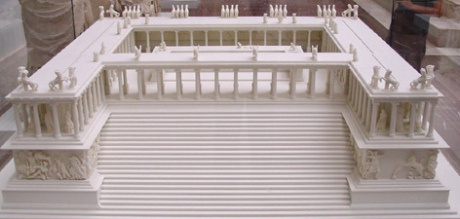
Satan's Seat
The Great Altar at Pergamos, which was constructed in the early part of the 2nd century, is now located in a Berlin, Germany museum. The altar's base shows a epic war between a race of giants and the pagan gods of Olympus.
A picture of the pagan god Zeus, believed to be the ruler of all things, adorns the altar's frieze. This gigantic altar was likely the one referenced in Revelation 2 when God said he knew his church in the city resided "where Satan's throne is" (Revelation 2:13).
Revelation's Warning
God's message to the church at Pergamos both commends them and calls them to repent of entrenched sins.
And to the angel of the church in Pergamos, write: These things says He Who has the sharp two-edged sword.
I know your works and where you dwell, where the throne of Satan is; but you are holding fast My name, and did not deny My faith, even in the days in which Antipas (the first Christian to be put to death by the Roman state) was My faithful witness, who was killed among you, where Satan dwells.
But I have a few things against you because you have there those who hold the teaching of Balaam, who taught Balak to cast a stumbling block before the children of Israel, to eat things sacrificed to idols and to commit fornication. Moreover, you also have those who hold the doctrine of the Nicolaitans, which thing I hate.
Repent! For if you (those in Pergamos) do not repent, I will come to you quickly, and will make war against them with the sword of My mouth. The one who has an ear, let him hear what the Spirit says to the churches . . . (Revelation 2:12 - 17, HBFV).