Although Smyrna was settled in the 11th century B.C., it did not begin to reach its height of importance until after Alexander the Great laid the foundation for a new city. The actual enlargement and fortification of the city was carried out under Antigonus (316 - 301 B.C.) and Lysimachus (301 - 281 B.C.).
Meaning of the Name
The name Smyrna means "myrrh," which is a resin obtained from the Commiphora myrrha tree. Myrrh was a critical ingredient used to embalm bodies because one of its major properties was its ability to retard the putrefaction of dead flesh. This type of embalming was used in Egypt and Judea. Myrrh is often remembered as one of the three expensive gifts the Magi gave to Jesus after he was born.
A Well Known City
The city was known for its schools of science and medicine. It boasted of, on the slope of Mount Pagus, a theater that could seat up to 20,000 spectators. The city also celebrated Olympian games that were very popular with the local populace.
In 197 B.C., after the city severed its relationship with the Pergamos ruler King Eumenes, it asked the Roman Empire for aid. The people of the city, because they had never established any ties to the Roman Empire, sought to create a bond by creating a Roman based cult. The 'Rome cult' of Smyrna soon spread to other locations and may have led to the worship of the pagan goddess Roma.
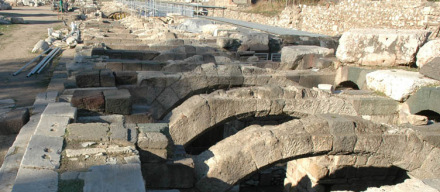
On the ground floor of the marketplace (Agora) in Smyrna existed twenty-eight businesses, all of which faced toward the north. The market's second floor contained rows of columns between which galleries existed. As such, the Agora was the largest marketplace in the ancient world.
Revelation's Warning
Smyrna is the second of seven churches in Asia Minor who receive a spiritual evaluation directly from God through Jesus Christ.
And to the angel of the church of the Smyrneans write: These things says the First and the Last, Who was dead but is alive . . .
I know your works and tribulation (trials and difficulties) and poverty (but you are rich), and the blasphemy (speaking against God) of those who declare themselves to be Jews (they state that they are true believers in God) and are not but are a synagogue of Satan . . .
Do not fear any of the things that you are about to suffer. Behold, the devil is about to cast some of you into prison, that you may be tried (Revelation 2:8 - 10, HBFV)
Paul the apostle likely began the Christian church in the city. One of apostle John's students, Polycarp (who lived from 69 to 155 A.D.), is thought to have played a major role in leading the church in Ephesus during the second century. Tradition states that he was killed as a martyr in Smyrna.