Michelangelo began his work on the Last Judgment fresco, which was to be located in the Sistine Chapel, in 1537. The fresco was commissioned by Pope Clement VII, who died three years before work commenced. At the age of 62 Michelangelo returned to the chapel where, twenty-five years prior, he had finished his well-known painting of its ceiling. When he completed his work in 1541, his monumental effort became the largest single fresco of the 16th century.
The fresco created by Michelangelo depicts the Second Coming of Jesus Christ (standing in the top middle of fresco with his mother Mary next to him) and God's final judgment of humanity. It is based on the Roman Catholic belief that God will judge the soul of every human, in a single resurrection, to determine his or her eternal fate.
The left half of Michelangelo's work shows those deemed worthy to ascend into heaven while the right half depicts those unworthy of salvation. Jesus is shown casting the damned toward Charon (standing in boat near bottom of picture), who is the mythological ferryman of Hell. Charon's job is to transport the condemned to Minos, the mythical judge of the underworld, who then directs the dead to Hell's deeper regions. Interestingly, evidence suggests that the self-portrait of Michelangelo also appears twice in the fresco.
What was the controversy?
Michelangelo's original fresco contained many completely naked characters including Christ and his mother Mary. A Roman Catholic Cardinal named Carafa saw them and accused the artist of immorality and obscenity. He then enlisted the aid of a Monsignor Sernini to begin a campaign to have the work removed or censored.
Over time, even the Pope's own Master of Ceremonies named Biagio da Cesena joined in condemning Michelangelo's work for it nudity. Biagio went so far as to state that the fresco was better suited for a tavern or public bath than a church chapel!
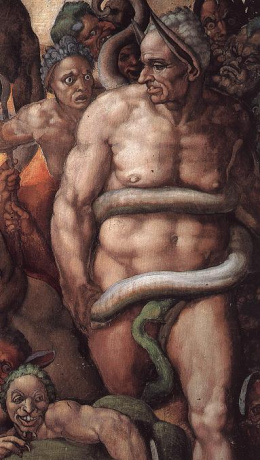
Michelangelo, not doubt angered by Biagio's criticisms, used his face for Minos, the god of the underworld! Donkey ears were also added to Mino's image to represent foolishness. When Biagio complained directly to the Pope about what Michelangelo had done, he was jokingly told that since the Pontiff's jurisdiction did not extend to hell the portrait would have to remain!
The Council of Trent, who condemned nudity in religious art, after Michelangelo died in 1564 commissioned an artist to cover up the nude characters in the Last Judgment fresco. It was not until a 1993 restoration of the fresco that half of the censorship placed over the characters was removed. It was also discovered, during the restoration process, that Minos (with the face of his critic Biagio) had a snake wrapped around himself and his genitals covered by the snake's head biting him in the groin!
A masterpiece with mistakes
Although a masterpiece of art expression, Michelangelo's fresco portrays and implies several misunderstandings of the Bible that were, and still are, promoted by the Catholic Church. These include the teachings that humans have immortal souls, that there exists only one resurrection, and that the only chance to receive salvation is before Jesus' Second Coming. The fresco also promotes the false beliefs that Mary has been given a special reward above other humans and that less people will receive salvation than those who do not. It lastly supports the unbiblical teachings that the reward of the righteous is heaven and that the unrighteous will be eternally tortured in an ever-burning Hell.
Michelangelo, in the Last Judgment fresco, created something that it still considered one of the crowning artistic achievements of human civilization. The event his work depicts, however, and the teachings it promotes, contradicts sound Biblical doctrine.