Make an ark of cyprus timbers ('gopher wood' in the KJV and other translations) . . . you (Noah) shall pitch it inside and outside with pitch. And this is the way you shall make it: The length of the ark shall be three hundred cubits, the breadth of it shall be fifty cubits and its height thirty cubits.
You shall make a window . . . and you shall finish it to a cubit from above; and you shall set the door of the ark in the side of it. You shall make it with lower, second and third stories. (Genesis 6:14 - 16, HBFV)
The below model of Noah's ship was created at a scale of 1/75. The other vessel shown in the photo (Columbus' ship named the Pinta) and the railroad car have also been created on a 1/75 scale.
The actual length of the stockcar is 44 feet (13.4 meters) and has a capacity of 2,670 cubic feet (75.6 cubic meters). The volume of Noah's Ark was 1,518,000 cubic feet (42,985 cubic meters), which would be equal to 569 of the above pictured cars. Strung together, they would stretch an amazing five and one-half miles (8.85 kilometers) long!
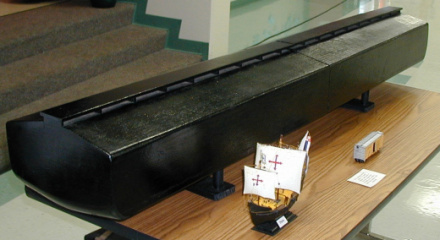
The above model is based on the assumption that the Biblical cubit was, using our modern system, 18 inches (45.7 centimeters). If a larger cubit is assumed the model would be proportionally larger.
God was quite particular in how he wanted his ship built. He told Noah what its dimensions should be, the wood to use, how to seal it so that it was water tight, where to put a window and so on. Two critical components, however, are not mentioned at all in the planning or construction of the Ark.
No Rudder or Sails!
A rudder is a vertical object added to the back or stern of a boat that can be manipulated such that it steers the vessel. The Bible does not record its was suggested, or that God stated, that Noah needed to build a rudder. While the absence of any steering capabilities on the ship is far from definitive, the inability of humans to be able to navigate it could easily be symbolic of great spiritual principles.
Without the ability to steer the ship, it would be left to roam wherever the wind, weather and water currents decided to take it. Noah, of himself, was powerless to direct the Ark away from any perceived dangers or obstacles like trees, rocks, waterfalls, swift currents, hills, mountains, and so on as the flood waters rose and fell.
The second critical component of all other ships that this giant boat lacked was a sail! Not only was the ark incapable of being steered, it possessed nothing that could be used to propel it on the water!
The operation of the Ark required a person to possess absolute faith in God. It required faith to believe the Lord would be the ship's rudder and provide all the power necessary to steer it from danger and lead it to safety. Noah not only was a pillar of great faith and an example we should follow (Hebrews 11:7) he was considerd by the Eternal as one of the most righteous humans to have ever lived (Ezekiel 14:14, 20)!