| | Where did JUDAS sit at the Last Passover? Why was he the MOST HONORED guest?How CLOSE did Jesus sit to his betrayer Judas? WHY did Jesus give Judas the meal's ceremonial piece of choice food (the sop)? Did the disciples sit on CHAIRS at a table during Jesus' last Passover? Where was the place of MOST HONORED guest located? Which of the disciples sat as MOST HONORED guest? Did Peter sit in the HUMBLIEST spot at the table? Who prompted Jesus to NAME his betrayer? Why didn't Jesus tell ALL the disciples that Judas would betray him? Who was the FIRST disciple to have their feet washed by Jesus? The answers to the above questions will shed light as to how and why several pivotal events, many of which center around Judas, took place during Jesus' last Passover (last supper). Did the disciples sit on CHAIRS at the last Passover?The most reproduced religious painting in history, Leonardo da Vinci's famous depiction of the Last Supper, shows Jesus and the disciples sitting upright at a table as people do today. The truth, however, is that chairs (which were no doubt expensive) for sitting were not used AT ALL all during Jesus' last Passover meal with his disciples. Based on Jewish law and tradition, those who observed the Passover reclined around a low, long oval table. Each person would be lying on their left side and leaning on their left arm, with their feet behind them and their heads facing the table. This would mean that all those located on the left side of the table would have the front of their bodies somewhat facing the end of the table. Each of the disciples would have been given a pillow to place under their left arm. This eating position allowed the right arm to be free to use for eating. Where was the place of MOST HONORED guest located?Jesus was the host of this very special observance of the Passover. Many Bible students and reference works state that the person considered the most honored or chief guest at a formal meal like the Passover sat to the RIGHT of the meal's host. According to Alfred Edersheim in his book The Life and Times of Jesus the Messiah, however, this most prized location was on the host's LEFT hand side. |
|
|
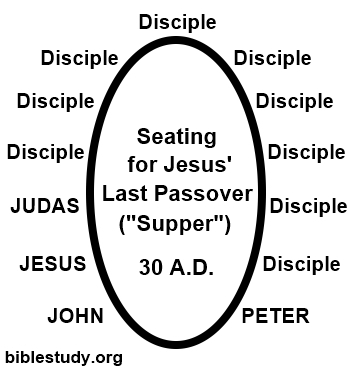
| | | | The Last Supper by Leonardo da VinciSitting on Jesus' right hand side is the apostle John. Sitting on John's right hand side is Judas. | | | Where were the disciples located during the Passover?The Bible does not directly state the seating arrangement used for the last Passover. We can, however, deduce where Judas, Jesus, Peter and John HAD to have sat based on traditions in use during the time and the Bible's record of what occurred at this solemn gathering. | | | In the above diagram, Judas is sitting to the left of Jesus (the host), in the place designated for the most honored guest. Although traditionally the host would choose who would be the honored guest (see Luke 14:7-11) the Bible does not state that Jesus asked Judas to sit next to him. Judas may have felt in his own mind he DESERVED to be honored and, according to Edersheim, did what was necessary to secure the seat for himself: "There is, we believe, ample evidence that he (Judas) not only claimed, but actually obtained, the chief seat at the table next to the Lord." (The Life and Times of Jesus the Messiah, Book 5, Chapter 10) Judas' exalted opinion of himself as the "greatest" disciple, deserving of honor, could have easily been encouraged and fed by Satan (see Luke 22:1-4) whose chief sin is vanity (Isaiah 14:12-14). Peter, in the seating diagram, is located across from John in what was considered the lowest (most humble) place at the table. Why is the last Passover seating diagram CORRECT? The above seating diagram is correct because it explains how and why certain events, most of which centered around Judas Iscariot, occurred at the Passover: The Bible states that Peter somehow got John's attention, during the Passover, to ask him to ask Jesus who it was that would betray him: "When Jesus had said these things, He was troubled in spirit, and testified and said, 'Most assuredly, I say to you, one of you will betray Me.' . . . Simon Peter therefore motioned to him (John) to ask (Jesus) who it was of whom He spoke." (John 13:21, 24, NKJV throughout unless stated) Peter, because he was sitting on the opposite side of the table, was able to not only get John's attention but also lean over the table to request John ask Jesus who among them was the betrayer. The Bible states that John was close enough to Jesus to lean against his chest and ask him what Peter wanted to know: "Simon Peter therefore motioned to him (John) to ask (Jesus) who it was of whom He spoke. Then, leaning back on Jesus’ breast, he (John) said to Him (Jesus) , 'Lord, who is it?'" (John 13:23-25) First, John HAD to be sitting next to Jesus for him to be able to lean back and ask a question. But, how can we determine if John was reclining to the left or right of Jesus? As stated previously, Jesus and the disciples leaned on their left side and arm, with their head close to the table and their feet behind them. This freed their right arm for eating. In this position anyone who leaned BACK would be moving toward the person on their left. This means that Jesus HAD to be to the left of John (or, from Jesus' vantage point, John was on his right) for John to LEAN BACK and place his head on Jesus' chest! Peter's request to John, John's question to Jesus, and Jesus' response to John had to have been quiet enough such that the other disciples at the table had NO IDEA why Judas left the room: "Simon Peter therefore motioned to him (John) to ask (Jesus) who it was of whom He spoke. Then, leaning back on Jesus’ breast, he (John) said to Him (Jesus), 'Lord, who is it?' Jesus answered, 'It is he to whom I shall give a piece of bread (the sop) when I have dipped it.' . . . "Now after the piece of bread, Satan entered him (Judas). Then Jesus said to him, 'What you do, do quickly.' BUT NO ONE AT THE TABLE KNEW FOR WHAT REASON HE SAID THIS TO HIM. For some thought, because Judas had the money box, that Jesus had said to him, 'Buy those things we need for the feast,' or that he should give something to the poor. "Having received the piece of bread, he (Judas) then went out immediately." (John 13:23-30)
As the seating diagram shows, Peter was close enough to John, and John was close enough to Jesus for them to quietly communicate without the other disciples hearing. This meant the other disciples DID NOT KNOW Jesus was signifying who his betrayer was by giving him a piece of bread (the "sop"). The ONLY words loud enough for all the disciples to hear, in the entire exchange between Peter, John, Jesus and Judas (see # 5 below also), was Jesus' statement to Judas that "What you do, do quickly." Traditionally, the host of a formal meal would give the chief or honored guest at the table the first "sop." The sop was a piece of bread or other small amount of choice food that is dipped in a sauce. The host, once he had the sop, would place it INTO the mouth of the honored guest. The Bible is clear as to the name of the honored guest that received the sop from Jesus: "When Jesus had thus said, he was troubled in spirit, and testified, and said, 'Verily, verily, I say unto you, that one of you shall betray me.' . . . He (John) then lying on Jesus' breast saith unto him, 'Lord, who is it?' "Jesus answered, 'He it is, to whom I shall give a SOP, when I have dipped [it].' And when he had dipped the SOP, he gave [it] to Judas Iscariot, [the son] of Simon." (John 13:21, 25-26, KJV)
The honored guest of a formal meal, who received the sop, sat to the LEFT of the host. Judas asked Jesus, after he received the sop, if it was HIM who was the betrayer: "He (Jesus) answered (John) and said, 'He who dipped his hand with Me in the dish will betray Me. The Son of Man indeed goes just as it is written of Him, but woe to that man by whom the Son of Man is betrayed! It would have been good for that man if he had not been born.' "Then Judas, who was betraying Him, answered and said, 'RABBI, IS IT I?' He said to him, 'You have said it.' " (Matthew 26:23-25)
As mentioned previously, the disciples were completely unaware of any of the conversations regarding who was to betray Jesus. Judas had to be sitting next to Jesus in order for his question, and Jesus' answer, to be whispered such that the other disciples would not hear it. In fact, Judas did not even hear Jesus tell John that the person he gave the sop to would betray him or else Judas would not have asked if it was him! - After Judas left the room where the Passover was held Jesus began to do something that caught the disciples entirely by surprise --- especially Peter:
"Jesus, knowing that the Father had given all things into His hands, and that He had come from God and was going to God, rose from supper and laid aside His garments, took a towel and girded Himself. After that, He poured water into a basin and began to wash the disciples’ feet, and to wipe them with the towel with which He was girded. "Then He came to Simon Peter. And Peter said to Him, 'LORD, ARE YOU WASHING MY FEET?' Jesus answered and said to him, 'What I am doing you do not understand now, but you will know after this.' "Peter said to Him, 'YOU SHALL NEVER WASH MY FEET!' " (John 13:3-8)
Peter's location at the end of the table helps explain some of the circumstances behind his impulsive rejection of Jesus' request. As Edersheim states: "From the position which . . . Peter occupied at the end of the table, it was natural that the Lord should BEGIN WITH HIM the act of footwashing. Besides, had He first turned to others, Peter must either have remonstrated (objected) before, or else his later expostulation (protest) would have been tardy (late), and an act either of self-righteousness or of needless voluntary humility. As it was, the surprise with which he and the others had witnessed the preparation of the Lord burst into characteristic language (for Peter!) when Jesus approached him to wash his feet." (The Life and Times of Jesus the Messiah, Book 5, Chapter 10)
| | Written by: BibleStudy.org | | |
|
|