When was the Exodus? After more than a century of slavery the children of Israel are freed from Egyptian bondage by God using Moses and Aaron. It was only after a series of plagues that Pharaoh Thutmose III finally agreed to give the Hebrew slaves their freedom in 1445 B.C. After the Exodus the twelve tribes of Israel are made to wander the wilderness for forty years as punishment for the sins they committed after leaving Egypt (Deuteronomy 8:2). Joshua leads a new generation, in 1405 B.C., into the land God promised to Abraham. Seven years later, in 1398 B.C., the land of Canaan is divided by lot among the tribes (Joshua 14). How were they governed? After taking possession of their God-given inheritance the children of Israel were governed and lead, for select periods in their early history, by individuals known as Judges. The Judges were God's response (usually) to his people crying out to be freed from those He allowed to oppress them because of their sins. For example, because of their collective sins, God allowed the Midianites to oppress his chosen nation for seven years (Judges 6:1). It was only after the people cried out to God for help that He inspired and used Gideon to free them from Midianite oppression (Judges 6-8). After they were freed Gideon served as their Judge for forty years (1145-1105 B.C.). Another well-known person God inspired to save his people was Sampson. God, in response to the disobedience of Israel and Judah, allowed the Philistines to harass and oppress them for forty years (Judges 13:1) . He then inspired and gave miraculous strength to Sampson in order to free the people. Sampson was a Judge for the last twenty years of his life (1085-1065 B.C.). The time period of the Judges ran from 1398 to 1050 B.C. (348 years). How did they get a HUMAN king? The prophet Samuel began his service as Judge in 1085 B.C. Thirty-two years later, in his old age, Samuel decides to make his sons Joel and Abiah Judges over the people (1Samuel 8). Unfortunately, they soon begin to take bribes and pervert justice. Their corruption becomes so evident that it motivates the elders to make a special request of Samuel: "'Look, you are old, and your sons do not walk in your ways. Now make us a king to judge us LIKE ALL THE NATIONS.'" (1Samuel 8:5, NKJV throughout).
Samuel takes what he is told as a personal rejection of his leadership. God, however, soon lets Samuel know the REAL meaning of what was said to him: "And the Lord said to Samuel, 'Heed the voice of the people in all that they say to you; for they have not rejected you, BUT THEY HAVE REJECTED ME, that I should not REIGN over them. . . .'" (1Samuel 8:7).
God rightfully asserts that HE has been King since the day they came into the land. It is only after the people openly reject him as King that God allows a human to reign over them. Samuel is very soon led to anoint Saul as the first human king over Israel (1Samuel 9:15-17). Saul's reign lasts for forty years (1050-1010 B.C.). However, because as king he refuses to obey God's commandments (1Samuel 15:10-11), God rejects him (and his descendants) as rulers over His people. Samuel is sent to anoint a young man of the tribe of Judah, named David, as the new king. David is first made king of Judah before becoming ruler of all the people. Him and his son Solomon each reign for forty years. The total length of time a united kingdom is ruled by a human king is only 120 years (1050 - 930 B.C.). What caused the kingdom to split in two? After Solomon dies his son Rehoboam is set to be the new king. The people, however, make a special request of Rehoboam before they are willing to accept his rule over them: "And Rehoboam went to Shechem, for all Israel had gone to Shechem to make him king . . . Then Jeroboam and the whole assembly of Israel came and spoke to Rehoboam, saying, 'Your father made our YOKE HEAVY; now therefore, lighten the burdensome service of your father, and his heavy yoke which he put on us, and we will serve you.' " (1Kings 12:1, 3-4)
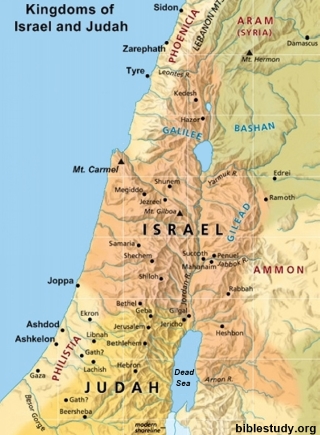
Part of King Solomon's vast wealth came from heavily taxing the people. After his death the Israelites are willing to recognize Solomon's son Rehoboam as their king but only IF he lowers their taxes! Rehoboam is willing to consider their proposal and seeks advice as to what to do next. Elders who also counseled his father advise him to humbly speak to the people and be kind and fair with them. The young men who grew up with Rehoboam, however, tell him to be even harsher and HARDER on the people (e.g. raise their taxes even more) than his dad (1Kings 12:1-11)! Rehoboam accepts the counsel of his young friends and harshly tells the people that he rejects their offer and will make their burden heavier than it was in the past. Jeroboam and the people, upon hearing the king's answer, rebel against him and form a new kingdom. The new nation, known as the Northern Kingdom, is composed of ten tribes. They make Jeroboam their king with Samaria eventually becoming their capital. Three of the tribes, Judah, Benjamin and the priestly tribe of Levi, stay loyal to Rehoboam and form what is known as the Kingdom of Judah. They keep Jerusalem as their capital. The Northern Kingdom lasts from 930 to 723 B.C. when its capital is conquered by the Assyrian empire and its people are carried away as prisoners. The Kingdom of Judah lasts from 930 to 586 B.C. until it also has its capital conquered by a foreign power (King Nebuchadnezzar of Babylon) and most of its citizens taken as prisoners out of the land. |