175 - An aggressive campaign to force Greek culture (Hellenizing) into the lives of those in Judea (Israel) is undertaken by Seleucid ruler Antiochus IV Epiphanes. Jewish religious practices are forbidden. Antiochus' actions will soon give rise to the Maccabees and their revolt that will fight for Judea's independence.
167 - Mattathias, a Jewish priest serving in Israel, starts a revolt against the Seleucid overlords by refusing to worship Greek gods. He is joined in his effort by his five sons - Judas Maccabeus (Maccabee), Eleazar Avaran, Simon Thassi, John Gaddi, and Jonathan Apphus. Their efforts are considered the beginning of the Maccabean revolt.
166 - Mattathias dies. His son Judas immediately becomes the military chief of the rebellion. Judas would later be known as Judas (Judah) the Maccabee, which means "Judah the Hammer." Judas is called this as recognition of his ferocity in battle.
164 - Judas Maccabeus battles and gains the independence of Jerusalem. He enters Jerusalem and religiously cleanses the Temple. On the twenty-fifth day of Kislev, the Temple is re-dedicated, giving birth to the yearly Jewish celebration known as Hanukkah.
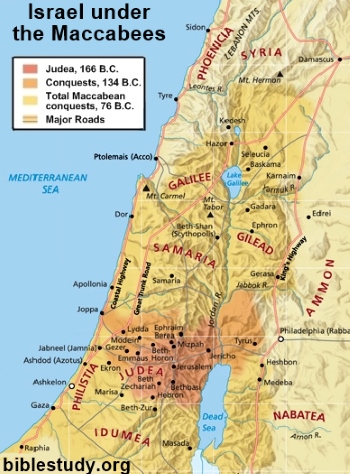
160 - Judas Maccabeus (Judas Maccabee) dies in battle. Jonathan Apphus, Judas' brother, continues the fight for Judea's independence
143 - Jonathan Apphus (Maccabee), who is Jerusalem's High Priest, is taken prisoner and put to death by the Selecuid king Diodotus Tryphon.
142 - Another son of Mattahias, Simon Thassi, continues the efforts of the Maccabean revolt as its new leader and High Priest. He pursues, and is granted, freedom from taxation by the Seleucid king. The granting of this request is believed to be a recognition of Judea's independence.
141 - The Hasmonean dynasty of rule is officially recognized when a resolution, passed among Jerusalem's priests and elders, recognizes Simon Thassi as the Prince of Judea.
139 - The Roman Republic officially recognizes the Hasmonean ruling dynasty.
135 - Simon Thassi is assassinated by Ptolemy, son of Abubus. Simon's son John Hyrcanus I becomes the new High Priest and Ethnarch (national leader) over Judea.
104 - Judah Aristobulus I, son of John Hyrcanus I, becomes both High Priest and King of Judea.
103 - Alexander Jannaeus, another son of John Hyrcanus I, becomes King of Judea.
76 - Salome Alexandra, wife of both Judah Aristobulus I and Alexander Jannaeus, becomes Queen of Judea.
67 - John Hyrcanus II, eldest son of Alexander Jannaeus and Salome Alexandra, becomes King of Judea.
66 - Aristobulus II, brother of John Hyrcanus II, defeats him in battle and becomes King of Judea.
63 - Roman general Pompey defeats, several times, the Jewish army and captures Aristobulus II along with his two sons.
47 - John Hyrcanus II has some of his political authority restored by Julius Caesar. He is appointed ethnarch, but not king, of Judea.
40 - Antigonus II Mattathias, son of Aristobulus II, is installed as a puppet king over Judea. He becomes the last Judean king in the Hasmonean ruling dynasty and the last ruler related to the Maccabees.
39 - Herod the Great, after being named the new King of Judea in 40 B.C., arrives in Judea and attacks Jerusalem.
37 - Herod takes the city of Jerusalem and becomes the unquestioned Judean king. Antigonus II Mattathias is taken prisoner and killed. Herod, eager to add legitimacy to his rule, marries the Hasmonean princess Mariamne I.