The book of Numbers opens with God commanding, in the spring of 1444 B.C. (Iyar 2), that Moses take a census of the people. He was to count all the males that were at least 20 years old and able to fight.
Take the sum of all the congregation of the children of Israel, according to their families, by their fathers' house, with the number of names, every male by their heads, from twenty years old and upward, all that are able to go forth to war in Israel. (Numbers 1:2 - 3, HBFV throughout).
Those who were not counted in the census were women, children (anyone under 20), those who were not Israelites, elderly men (those who couldn't fight) and the tribe of Levi.
But the Levites, according to the tribe of their fathers, were not numbered among them. For the Lord had spoken to Moses saying, "Only you shall not number the tribe of Levi, neither take the sum of them among the children of Israel.
"But you shall set the Levites over the tabernacle of testimony, and over all its vessels, and over all its things. They shall carry the tabernacle and all its vessels. And they shall serve it, and shall camp around the tabernacle." (Numbers 1:47 - 50).
The Bible does state, at a later date, how many Levites existed. Thirty-eight years after the first census another one was taken just before the Israelites entered the Promised Land under Joshua. It was during this second census that 23,000 males, one month old or older, were counted among the tribe.
And these are the numbered ones of the Levites according to their families . . .
And those who were numbered were twenty-three thousand, all males from a month old and upward, for they were not numbered among the children of Israel because there was no inheritance given them among the children of Israel. (Numbers 26:57, 62).
Why Important?
Why are the census numbers important? It is because, in Numbers 2, they will be used to determine the total number of fighting men available on each of the four sides of the wilderness camp. This census showed that there were 603,550 total fighting men in Israel at this time (Numbers 1:46). Numbers 1 also tells us that the setting up of Israel's wilderness camp took place immediately after the census.
Camp Layout
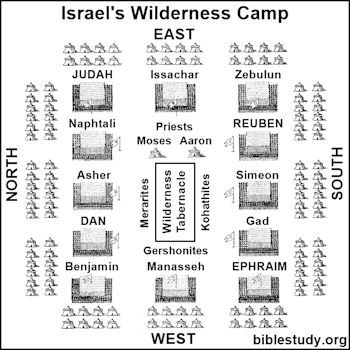
It is in Numbers 2 that we come to how the wilderness camp was arranged. The children of Israel were placed in four groups of three tribes each. God determined who was in each group, where each tribe was located within it, and which one was considered the group's leader. It was also God who determined which side of the wilderness tabernacle each group was placed.
God also commanded that each family in Israel have a banner to identify who they were. It also seems that each tribe was also to have a banner to represent themselves with each grouping of three to have a unique standard as well.
Every man of the children of Israel shall pitch by his own banner, with the banner of their father’s house. They shall pitch far off, around the tabernacle of the congregation. And those who pitch on the east side toward the rising of the sun shall be those of the banner of the camp of Judah, throughout their armies. (Numbers 2:2 - 3).
The Center
The Levites were commanded to camp near the tabernacle since they were the ones to set up, tear down, and maintain it (Numbers 1:50 - 51). The three sons of Levi were Gershon, Kohath and Merari (Numbers 3:17). The Gershonites were to place their tents on the western side of the tabernacle (v. 23). The Kohathites were to locate their tents on the southern side while the Merarites were placed on the northern side (verses 29, 35).
The tents of Moses and Aaron were also located near the tabernacle. They were placed in front of its eastern entrance along with the sons of Aaron.
And those who camp before the tabernacle toward the east, before the tabernacle of the congregation eastward, shall be Moses, and Aaron and his sons, keeping the charge of the sanctuary for the charge of the children of Israel . . . (Numbers 3:38).
The Levities left the camp after the southern grouping of the tribes but before the western grouping. They ended up marching in the middle of all the tribes with two divisions in front and two in back as they carried the Tent of Meeting or wilderness tabernacle.
And the tabernacle of the congregation shall go forward with the camp of the Levites in the midst of the camp. As they camp, so they shall go forward, each man in his place, by their banners (Numbers 2:17).
The Eastern Grouping
The first grouping of tribes in the wilderness encampment would face east toward the rising sun (which was the general direction they were traveling in - Numbers 2:3). They would be the first to leave the camp. Next in line to leave would be the tribes on the South side, then the Levites who serviced the tabernacle, then those on the West and finally those facing north.
The wilderness tents from the tribes of Judah, Issachar and Zebulun were placed together on the eastern side of the tabernacle and were collectively under Judah's banner. Judah, Issachar, and Zebulun were the three youngest sons of Jacob's (Israel's) wife Leah.
And those who pitch on the east side toward the rising of the sun shall be those of the banner of the camp of Judah, throughout their armies . . . And those that pitch next to him shall be the tribe of Issachar . . . And the tribe of Zebulun . . . (Numbers 2:3, 5, 7).
Judah was chosen to lead this first set of Israelites out of their wilderness camp not only because it was the most numerous tribe of Jacob (Numbers 2:4), but also because it was prophesied that the scepter of rule would never leave them (Genesis 49:10). Christ, in the New Testament, is called "the Lion of the tribe of Judah" (Revelation 5:5). The number of fighting men on this side of the camp totals 186,400 (Numbers 2:9).
The Southern Grouping
The tribal camps of Reuben, Simeon and Gad were placed together on the southern side of the tabernacle and were collectively under Reuben's banner. Reuben, born through Leah, was the oldest son of all Jacob's children, with Simeon being the second oldest. Gad was born from Jacob and Leah's handmaid Zilpah. All together, they totaled 151,450 fighting men.
On the south side shall be the standard of the camp of Reuben, according to their armies . . . And those who pitch beside him shall be the tribe of Simeon . . . Then the tribe of Gad . . . (Numbers 2:10, 12, 14).
The Western Grouping
The Western side of the wilderness encampment contained the tribes of Ephraim, Manasseh and Benjamin. They were collectively under the banner of Ephraim. Benjamin was born of Jacob's favorite wife Rachel. Ephraim and Manasseh were the product of Rachel' son Joseph. They were "adopted" by Jacob as full tribes (see Genesis 48). This group of Israelites contained 108,100 fighting men.
On the west side shall be the banner of the camp of Ephraim, according to their armies . . . And beside him shall be the tribe of Manasseh . . . And the tribe of Benjamin . . . (Numbers 2:18, 20, 22).
The Northern Grouping
The wilderness camps of Dan, Asher and Naphtali, collectively under Dan's banner, were placed together on the northern side of the tabernacle. Dan is the oldest son of Jacob and Bilhah (one of Rachel's slaves). They totaled 157,600 men who could fight and were the last group in the wilderness to leave.
The banner of the camp of Dan shall be on the north side of their armies . . . And those that camp beside him shall be the tribe of Asher . . . Then the tribe of Naphtali . . . (Numbers 2:25, 27, 29).