You Have Questions.  The Bible Has Answers.

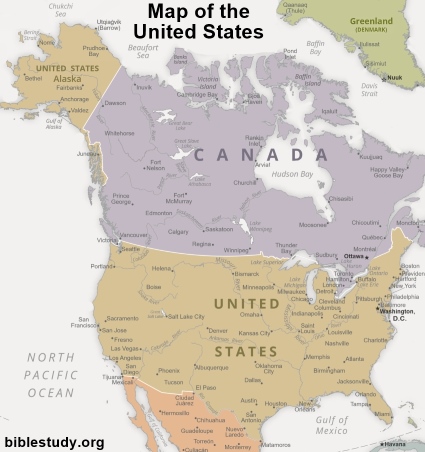
Map of the
United States of America


Map of the
United States of America


Map of the United States of America
 
Facts about the United States of America
Historical Background

Britain's American colonies broke with the mother country in 1776 and were recognized as the new nation of the United States of America following the Treaty of Paris in 1783.

During the 19th and 20th centuries, 37 new states were added to the original 13 as the nation expanded across the North American continent and acquired a number of overseas possessions.

The two most traumatic experiences in the nation's history were the Civil War (1861-65), in which a northern Union of states defeated a secessionist Confederacy of 11 southern slave states, and the Great Depression of the 1930s, an economic downturn during which about a quarter of the labor force lost its jobs.

Buoyed by victories in World Wars I and II and the end of the Cold War in 1991, the United States remains the world's most powerful nation state.

 
Total Area
 
Population
(July 2009 estimate)
 
Industries
Land:  9,161,923 sq km
Water:  664,707 sq km
Total:  9,826,630 sq km
 
(includes only the 50 states and the District of Columbia)
 
307,212,123

The U.S.A. is the third largest country in terms of population (after China and India).

 
Leading industrial power in the world, highly diversified and technologically advanced; petroleum, steel, motor vehicles, aerospace, telecommunications, chemicals, electronics, food processing, consumer goods, lumber, mining.
         
Total Area - Comparative   Age Structure
(2009 estimate)
  Agriculture Products
The United States is about half the size of Russia; about three-tenths the size of Africa; about half the size of South America (or slightly larger than Brazil); slightly larger than China; and more than twice the size of the European Union.
 
0-14 years: 20.2%
15-64 years: 67%
65 years and over: 12.8%
 
Wheat, corn, other grains, fruits, vegetables, cotton; beef, pork, poultry, dairy products; fish; forest products
 
OIL *
Oil Production
(2007 estimate)
Oil Consumption
(2007 estimate)
8.457 million bbl/day 20.68 million bbl/day
Oil Imports
(2005)
Oil Exports
(2005)
Proved Reserves of Oil
(January 2008 estimate)
13.71 million bbl/day 1.165 million bbl/day 20.97 billion bbl
* bbl = barrels
 
Coastline   Median age
(2009 estimate)
  Exports of Commodities
(2003)
19,924 km
 
Male: 36.4 years
Female: 38 years
Total: 36.7 years
 
Capital goods - 49.0%
(transistors, aircraft, motor vehicle parts, computers, telecommunications equipment)
Industrial supplies - 26.8%
(organic chemicals)
Consumer goods - 15.0%
(automobiles, medicines)
Agricultural products - 9.2%
(soybeans, fruit, corn)
         
Elevation extremes   Life expectancy at birth
(2008 estimate)
  Export Partners
(2007)
Lowest point:
Death Valley -86 m
Highest point:
Mount McKinley 6,198 m
 
Male: 75.29 years
Female: 81.13 years
Total: 78.14 years
 
Canada - 21.4%
Mexico - 11.7%
China - 5.6%
Japan - 5.4%
United Kingdom - 4.3%
Germany - 4.3%
 
Natural resources   Languages
(2000 census)
  Imports of Commodities
(2003)
Coal, copper, lead, molybdenum, phosphates, uranium, bauxite, gold, iron, mercury, nickel, potash, silver, tungsten, zinc, petroleum, natural gas, timber
 
English - 82.1%
Spanish - 10.7%
Other Indo-European - 3.8%
Asian and Pacific island - 2.7%
Other - 0.7%
 
Industrial supplies - 32.9%
Consumer goods - 31.8% (automobiles, clothing, medicines, furniture, toys)
Capital goods - 30.4%
(computers, telecommunications equipment, motor vehicle parts, office machines, electric power machinery)
Crude oil - 8.2%
Agricultural products - 4.9%
         
Religions
(2007 estimate)
  Ethnic groups
(July 2007 estimate)
  Import Partners
(2007)
Protestant - 51.3%
Roman Catholic - 23.9%
Jewish - 1.7%
Mormon - 1.7%
Other Christian - 1.6%
Buddhist - 0.7%
Muslim - 0.6%
 
White - 79.96%
Black - 12.85%
Asian - 4.43%
Amerindian / Alaska native - .97%
Native Hawaiian, Pacific islanders - 0.18%
 
China - 16.9%
Canada - 15.7%
Mexico - 10.6%
Japan - 7.4%
Germany - 4.8%
Population below poverty line
(2004 estimate)
12%
 
Illicit drugs
World's largest consumer of cocaine, shipped from Colombia through Mexico and the Caribbean. Consumer of ecstasy and of Mexican heroin, marijuana and methamphetamine.  Minor consumer of high-quality Southeast Asian heroin.  Illicit producer of cannabis, marijuana, depressants, stimulants, hallucinogens, and methamphetamine. Money-laundering center.
 
Information extracted from: CIA - The World Factbook
 
World Maps and Study Materials
Political Map of the World   -   Physical Map of the World
Time Zones of the World
Ancient Empires and Bible Prophecy
What is America's DESTINY?


Visit the BEST Web Sites!


THE Bible Study Web Site at BibleStudy.org
You Have Questions.  The Bible Has Answers!