John the Baptist, the son of Zacharias and Elizabeth, was Jesus' cousin through Mary (Luke 1:36). His life was planned to be unusual, even before his conception, as God had declared he would be a Nazarite all his days. Prior to his conception, an angel was sent to Zacharias to announce that he would soon bear a son.
But the angel said to him, "Fear not, Zacharias, because your supplication has been heard; and your wife Elizabeth shall bear a son to you, and you shall call his name John . . . For he shall be great before the Lord. And he shall never drink wine or strong drink in any form, but he shall be filled with the Holy Spirit even from his mother’s womb . . ." (Luke 1:13, 15, HBFV).
As the Baptist grew into manhood, he began to live in the wilderness that was away from the cities (Luke 1:80). His clothing was rough, and his diet was strict (Matthew 3:4; Mark 1:6).
Jesus is baptized
John baptizes Jesus in the fall of 26 A.D. Before performing this righteous act he did not know who was the Messiah (Jn. 1:31, 33). God, however, had to provide him with the sign of the Holy Spirit coming down from heaven to denote who was His one and only Son (Matthew 3:16, Mark 1:10).
John, after he spoke out against Herod's marriage to his sister-in-law (Mark 6:17 - 18), was arrested and put in prison sometime after Passover in 27 A.D. In was during his period of imprisonment that doubts about Jesus began to take root.
Understandable doubts
What few people who study the Bible realize is that, although the Baptist had proclaimed Jesus as the Lamb of God, he had not personally witnessed any of his miracles.
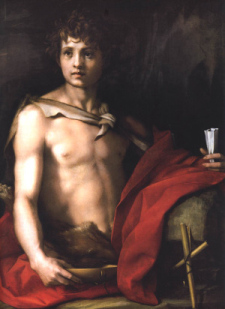
The Jews in the first century were expecting a Messiah who would free them from Roman control. Jesus' mission had nothing to do with gaining Judea's independence so, in prison, John had time to think and entertain a doubt or two. As He began to hear about the works of Christ, he must have wondered why he was not miraculously freed from prison.
A need to know
John's unresolved doubts finally led him to send two of his disciples to ask a few questions (Matthew 11:1 - 3) of Jesus. The answer they took back with them was to-the-point.
". . . tell him what you hear and have seen for yourself, that the blind and lame and lepers and deaf are healed, the dead are raised up, and the poor hear the good news of God's kingdom. Happy is he who has no doubts about me" (Matthew 11:4 - 6).
Christ asked the crowd what they went out into the wilderness to see. Did they go to see a weak, spineless person shaken by every wind of doctrine? Or a man in soft clothing? If that is what they expected, they were mistaken. One has to wonder whether Jesus' next statement was a jab at Herod. He said, "Those who wear silks and satins are in kings' houses" (Matthew 11:7 - 8).
Realizing that some of the people went to see a prophet, Jesus removed any doubt they might have by stating John the Baptist was far more than the average prophet (Matthew 11:9). He was the one Malachi spoke about (Malachi 3:1) who would prepare the way for the Savior.