According to the Bible, several people have cast lots (Leviticus 16:8, Proverbs 16:33, 18:18, Acts 1:24 - 26, etc.) for things that did not involve Jesus' clothes. Its main use was to render a decision not biased and based on human choice but letting God decide the matter (e.g. the selection of a replacement for Judas through casting lots, see Acts 1:24 - 26).
And they prayed, saying, "You, Lord, the Knower of the hearts of all, show which one of these two You have personally chosen . . ." Then they cast their lots; and the lot fell on Matthias, and he was numbered with the eleven apostles (Acts 1:24, 26, HBFV throughout)
The use of the cast in public, however, determined an impartial decision based on time and chance.
Interestingly, though not commanded in the Bible, lots were cast to determine which of the priests at Jerusalem's temple carried out a certain function like cleansing the altar or offering incense to God (The Temple at the Time of Christ, Chapter 7). They were common in games and gambling. Some of the things thrown were, depending upon the time and location, polished sticks, coins, cards, dice, bones, stones, and so on.
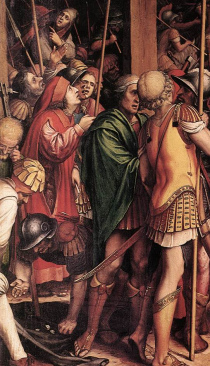
Mocked and Tortured
Herod, before Jesus' clothes are divided up and lots cast for them, has his soldiers force a gorgeous robe on him in order to mock him.
Then Herod and his soldiers treated Him with contempt; and after mocking Him, he put a splendid robe on Him and sent Him back to Pilate (Luke 23:8 - 11).
After Jesus went to Pontius Pilate, he again was forced to wear expensive clothing, a purple (or scarlet) robe in mockery. The Bible is unclear whether or not this was the same garment previously used to mock him. He received his own clothes back after his torture by the Roman military (John 19:5, Matthew 27:31).
It was after they hung him on the cross that four Roman soldiers sought to divide the quality clothes Christ wore by lots. Though they almost certainly were not aware of it, they were fulfilling the prophecy found in Psalm 22:18 where David wrote they would part his clothes and cast something to see who won which piece.
. . . (the Roman soldiers) took His garments and made four parts, a part for each soldier, and the coat also. But the coat was seamless . . . For this reason, they said to one another, 'Let us not tear it . . . ' They divided My garments among them, and they cast lots for My vesture (John 19:23 - 24).
Quality Clothing
When the soldiers sought to divide the coat or tunic of Jesus, they saw it was not a patchwork of pieces sewn together. It had no seams, which meant it was a quality garment that took extra time to make. This is why lots were used so that only one of the soldiers would receive this "prize." The garment was the same quality of clothing, woven from top to bottom in one piece, worn by the high priest in Jerusalem's temple.
The first century Jewish historian Josephus stated in his book "Antiquities (History) of the Jews" that the temple's high priest had to wear clothes (a vestment) colored blue. This clothing was not made by pieces of cloth sewn together, or even two large pieces. It was, instead, one long vestment that was parted along the breast and back.
Unlike clothing made from pieces and thus easier to tear up, the coat worn by Jesus would have been harder to separate into pieces.
Additionally, the act of trying to divide such a seamless coat would likely make any pieces frayed and useless. The soldiers knew these facts and therefore decided to cast lots to leave it to time and chance to determine who got the entire garment.