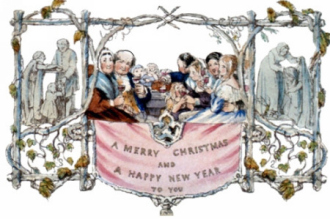
Is it possible that we may not have gone back far enough? How about 200 years earlier, in the 1600's?: [A writer in 1633 said,] "If we compare our Bacchanalian Christmases and New Year's Tides [seasons] with these Saturnalia and Feasts of Janus, we shall find such near affinity between them both in regard of time (they both being in the end of December and on the first of January), and in their manner of solemnizing [celebration] (both of them being spent in reveling, epicurism [gluttony], wantonness, idleness, dancing, drinking, stage plays and such other Christmas disorders now in use with Christians, were derived from these Roman Saturnalia and Bacchanalian [after Bacchus, god of wine and revelry] Festivals; which should cause all pious Christians eternally to abominate them." [Ashton p. 6] This was back in the time of the Puritans, a group which had much influence in the early years of the American colonies. Let's read more about the holiday in their time: "It was, probably, the exceeding license of Christ-tide that made the sour Puritans look upon its being kept in remembrance, as vain and superstitious; at all events, whenever in their power, they did their best to crush it..." [Ashton p. 21] "Oliver Cromwell, the Lord Protector of England in 1655, and a Puritan, tried his best to eliminate the revelries, claiming them to be of pagan origin and therefore, 'unacceptable to all God-fearing people and an abomination to the Church of Christ.' The Puritans took some of these beliefs to the New Americas with them, and for a time the same stringent rules applied there. However, when Charles II was restored to the throne of England in 1660, yuletide feasting soon became customary once again; and it still is." [The Origins of Christmas, Bush, Roger © 1982; Frederick Muller Ltd.; London, page 22] "...the popular love of Christmas could not be done away with by restrictive legislation... its keeping was inbred in the people, and they hated this sour puritanical feeling, and the doing away with their accustomed festivities." [As one member of the House of Commons commented at the time,] "These poor simple creatures are mad after superstitious festivals, after unholy holidays." [Ashton pp. 27-28] First commercially produced cardEvidently we still haven't gone back far enough to find our pure holiday. So let's make a big jump, back to the 700's: "There exists a letter from the year 742, in which St. Boniface, the "Apostle to the Germans," complains to Pope Zacharias that his labors to convert the heathen Franks and Alemans, Germanic tribes, were being handicapped by the escapades of the Christian Romans back home. The Franks and the Alemans were on the threshold of becoming Christians, but their conversion was retarded by their enjoyment of lurid carnivals. When Boniface tried to turn them away from such customs, they argued that they had seen them celebrated under the very shadow of St. Peter's at Rome [the cathedral that was the central headquarters of the Pope and the Roman Catholic Church]. Embarrassed and sorry, Pope Zacharias replied to Boniface, admitting that the people of the city of Rome misbehaved very badly at Christmas time. There was very little he could do about it; however, the following year he succeeded in inducing the Holy Synod of Rome to forbid the Romans, under penalty of law, from setting such bad examples. Alas for human frailty! The ban had to be repeated over and over, for centuries." [4000 Years of Christmas, Count, Earl W. [Professor of Anthropology, Hamilton College] © 1948; Henry Schuman Pub.; New York, pages 43-44] These kinds of quotations may be puzzling to you, as they would be to many sincere Christians. Just when was CHRIST in CHRISTMAS? The full answer to that question may surprise you. What is its true origin? "Although the Christmas story centers in the Christ Child of Bethlehem, it begins so long before His coming that we find its hero arriving on the scene after more than half of the time of the story has gone by." [Count p.11] That statement sounds self-contradictory! How can there be a no "Christ" in the holiday? Let's find out: "Mesopotamia [land of the Tigris and Euphrates Rivers] is the very ancient Mother of Civilization... Christmas began there, over 4,000 years ago, as the festival which renewed the world for another year. The 'twelve days' of Christmas; the bright fires and probably the Yule log; the giving of presents; the carnivals with their floats, their merrymakings and clownings, the mummers who sing and play from house to house [common customs in England and other parts of Europe ]; the church processions with their lights and song, all these and more began there CENTURIES before Christ was born. And they celebrated the arrival of a New Year . . ."The New Year's festival lasted twelve days, as our Christmas season is supposed to do; in it the king repaired to Marduk's temple, to the court of the gods. The chief priest stripped from him his insignia of rank; thus dispossessed of his power, he knelt before Marduk's image and swore that he had done nothing against the god's will. The chief priest, now speaking for Marduk, said comforting words; and in the name of the god he reinvested the king, in token that the kingdom was restored to him by the grace of the god... "In Greece there was an old God, Kronos, about whom we know little, even though it is not hard to recognize that his festival was the old Sacaea gone westward. The figures in the drama changed, the incidents also; but the plot remained. In ancient Babylonia, it was Marduk who conquered the monsters that lived before our world was created; in Greece, it was Zeus who fought and overcame Kronos and his Titans." (4,000 Years of Christmas) In earlier centuries, the connections between Xmas and pre-Christ pagan holidays was even more obvious. Let's take a look at this description of the holiday in the mid-fifteenth century in northern Europe: "Holly, ivy and evergreens were up, candles and torches were lit, and mummers clowned in the streets. There were singers, Christmas presents, fortune telling and much feasting and drinking. The people chose, not a mock king, but a 'Lord of Misrule,' an 'Abbot of Unreason,' a 'King of Bean,' a 'Pope' who presided over the 'Feast of the Fools' or the 'Feast of the Asses.' They made him a bald-headed, red-nosed clown, and set him on a donkey. He had a retinue; like hoboes on a spree, these ancestors of ours squawked an 'anthem,' danced about the donkey, and hied themselves to the church where they performed a slapstick mass. The choir was vested in tattered robes turned inside out; they wore orange peels for spectacle rims; they held their music sheets upside down and jangled a gibberish response to the 'bishop' who read the service. They rang the bells, they hop-skip-jumped through the church." [Count p. 18-23, 44]
However, the story didn't just jump from Mesopotamia to Europe. There was a connection through pagan Greece and Rome: "The Romans believed in an ancient god of seed time, Saturn, who had ruled their country ages before their own day, before he was overthrown by Jupiter. Whenever the Romans thought that one of their gods resembled a Greek god, they concluded that the two were the same; then they took over the forms of worship which the Greeks already had observed. So Kronos came to Rome; the SACAEA entered into the SATURNALIA . The first day of the Saturnalia shifted during the lifetime of Rome; at all events, it began around the middle of December... and continued until January first. In its midst was December 25, the day, as the Romans calculated, when the sun was at its lowest ebb, ready to increase again and impart its strength to the growing things of the earth. Hard upon this day came the Calendae of January, January 1. The word itself has become the name which the Slavic and Baltic peoples use for the days of Christmas festivities: Koleda, Kolyada, Koledos, etc.. . ." [Count pp. 24] Here are descriptions of the origins of a few specific customs and words: Where did we get the Yule and Yule Log? "The Anglo-Saxons and early English knew not the words either of Christmas or Christ-tide. To them it was the season of Yule. The author of an article titled 'Paganism in Modern Christianity' in 1882 wrote, 'The ancient name (Yule) for Christmas is still used throughout Scandinavia. The Swedes, Danes and Norwegians wish each other a 'glad Yule' as we say 'Merry Christmas'... the twelfth name of Odin, the Father of the Gods, or Allfather [was] Ialg or Ialkr. . . . trees, introduced into Russia by the Scandinavians, are called elka (pronounced yolka), and in the times just preceding, and just after, the conquest of Britain by the English, this high feast of Odin was held in mid-winter, under the name of Ialka tid, or Yule-tide. It was celebrated at this season, because the Vikings, being then unable to go to sea, could assemble in their great halls and temples to drink to the gods they served so well.'" [Ashton pp. 6-7] What is the history of Evergreens Trees? "Box, bay, ivy, holly, yew, larch, juniper, pine, spruce, fir, all are shields against the witches and the demons. The spines of the holly-leaves become thickets to catch and hold the hags; juniper-smoke is a demon-chasing incense. In the Tyrol [Austria] even city people smoke misfortune out of their houses, while the farmer carries smouldering sprigs in a brazier, along with a bowl of holy water, into every room and crevice, into the stalls of the cattle, onto the threshing floor. Every animal is censed and besprinkled; so, too, the beds of the girls and the doors to their chambers. As the houseman makes his rounds, he keeps saying, 'In with the good luck, out with the bad.' "Finally, all the people of the household gather in a circle, and each receives from the master a 'smoke blessing'... Weapons against the weird and ghostly vermin were not only greenery, evergreen incense and lights, but noise; shouts, horns, bells, even banging guns, especially on New Year's Day. During the twelve days of Christmas... you must avoid heavy work as much as possible, lest you be tripped up by one of these invisible evil-doers... As in Rome and Babylon, the Twelve Days are full of augury [fortune telling] for the twelve months of the coming year, to each of the twelve days its month of the same order... you may also learn of your own fortune . . . The green boughs can bring you luck, too, if someone switches you with them. Thus it is a good time among Slavs as well as Germanics for the children to collect gifts from the neighbors by going around and switching them with green boughs and reciting good luck ditties." [Count pp. 64-66] Even the idea of a special "being" bringing gifts to little children at Christmas time is not limited to the American Santa Claus. In Denmark it is a "sprite" named Nisse. In Italy it is an "elderly [male] fairy" named Beffania. In Spain it is the Wise Men. In Mexico it is the Sun God, the feathered serpent named Huitzilopochtli. And children in Switzerland are assured by their parents that the Baby Jesus himself (evidently He never grows up) sneaks in at night and leaves gifts. [Bush, pp. 37-46] So just where is Jesus in all of this? Where did we get the Mother and Child? Doesn't it seem a little odd that when people claim to be celebrating the birthday of Christ they focus only on Him as an INFANT? Most people who celebrate birthdays of your own children, do not spend the day just talking about their birth, they have a party with games they enjoy now and with gifts appropriate to their age now. If you celebrate your boss's birthday, you certainly don't just drag out his baby pictures, you have a dinner to honor his accomplishments as an adult. Why is Jesus "frozen in time" as a baby? "The earliest Christians were not interested in Jesus' birthday, but by the fourth century they had become very much interested. How this came about is the story of a soil growing. Christmas is a seed which sprouted in that soil. It sprouted when the Christians at last turned their eyes upon Jesus the infant and Mary His mother. There never would have been a Christmas as we know it without the Madonna and Child. " [Count p. 30] "Over the years that followed Jesus' death, the Christians tended to lose sight of Him as the refuge of those who labor and are heavy-laden. What mattered the most to them was that, at any moment, He would reappear to be the stern but righteous judge of all mankind. The world was to begin anew with a day of wrathful judgment. To people who thought this way, the date of Jesus' physical birth could not matter. To celebrate it would have seemed at best pointless, and at worst an evil thing... in 245 A.D. the great Church Father, Origen, declared it to be a sin even to think of keeping the birthday of Christ, 'as though he were a king Pharaoh.'" [Count p. 31] But by the fourth century... "The thoughts of people had been changing. This is the same century in which we find Christians regarding Mary the mother of Jesus in a new light. She had long been revered, along with the other saints and apostles; but only along with them. But now, in this same fourth century, we see her emerging as the Queen of Heaven. The Divine Christ had been born both human and divine. Mary had done a thing which certainly no other woman had done. This in itself set her off from all other humanity; but there is something deeper than this bald fact. Mary represented something which the human heart ached for, and the ache was not being solaced." [Count, pp. 34] What does trimming the tree symbolize? We do find a description in the Bible that might be a Christmas tree. "For the customs of the peoples are futile . . . one cuts a tree from the forest, the work of the hands of the workman, with the ax. They decorate it with silver and gold; They fasten it with nails and hammers so that it will not topple." (Jeremiah 10:3-4, NKJV) There is debate as to whether this verse is talking about a decorated tree, or a carved idol. But in either case, WHAT DOES GOD THINK ABOUT IT? Verse 3 tells us: "the customs of the peoples are futile; ." (verse 3) After all this, perhaps you are thinking, "Well, maybe others didn't have Christ as the focal point of Christmas. But I can! I'll trim out the tree and the pagan symbols (don't even buy them or set them up), and just keep the holiday as it was intended. Let's consider that concept. Can we take all the TRUE parts and leave out all the paganism? The first demand would be to find those true parts. How about the date of His birth? "When was Jesus born? No one knows. December 25 is no more the historical date of His birth than any other. The Christians chose it to be His birthday only several centuries after He lived and died." [Count, p. 30] "Titus Flavius Clemens, known as Clemens of Alexandria, lived exactly at this time [third century A.D.], and was a contemporary of Origen. He speaks plainly on the subject, and shows the uncertainty, even at that early epoch of Christianity, of fixing the date: 'There are those who, with an overbusy curiosity, attempt to fix not only the year, but the date of our Saviour's birth, who they say, was born in the 28th year of Augustus, on the 25th of the month Pachon [May 20]... Some say He was born on the 24th or the 25th of the month Pharmuthi [April 19 or 20].'" [Ashton pp. 1-2] But how about some of the straightforward Bible details? Unfortunately, even those have become garbled. The angels DIDN'T announce to the shepherds "Peace on earth, good will to men," as the King James translation puts it. As an adult, Jesus said, "Do not think that I came to bring peace on earth. I did not come to bring peace but a sword. " (Matthew 10:34, NKJV) What, then, did the angels say? The more accurate modern translations clarify it: "Glory to God in the highest, and on earth peace to men on whom His favor rests." It is those who please God who will have the true peace. And then there are the Three Kings or the Three Wise Men who show up next to the shepherds in all the nativity scenes. There is nothing in the scripture that says there were three of them.(The mention of threee different gifts in Matthew 2:11 is the only supporting evidence, but it does not say that one person gave each a gift or that everyone that came gave a gift). There is nothing that says they were kings, they are called simply MAGI . There is no real agreement by Biblical scholars on exactly what is meant by that term. It is clear from the scripture that they did not arrive on the birth night with the shepherds. They visit the Christ Child in a house [Matthew 2:11]. Immediately after their visit, Joseph takes Jesus and Mary and flees to Egypt. Yet, according to Luke 2:22, Jesus is presented at the temple in Jerusalem 40 days or more after his birth. So the Magi visited AT LEAST 40 days after the birth, and perhaps up to TWO YEARS later. What is there left of the story that is emphasized so much at Christmas? Don't we at least exchange gifts in memory of the gifts the Magi gave Jesus? No, not even that makes sense. They didn't exchange gifts with one another, they gave them to Jesus! And they gave the gifts not as birthday presents, but because they were visiting a king, and it is customary to offer fine gifts when visiting a king. Christmas as a word is not understood by most Christians, especially Protestants. It is a shortened form of "Christ-mass": that is, the Catholic ceremony of the Mass held in honor of Christ. And what is the mass? It is not just a "memorial communion," as most Protestants consider the partaking of the bread and cup. The Catholics consider that, in the mass, the priest has the authority to change the bread and wine so that they actually become the flesh and blood of Christ, and the priest then offers this flesh and blood again and again. The ceremony is actually called a "sacrifice." Does the Bible tell us HOW we should worship? Perhaps, even after all of this information about the origins of Christmas, you are STILL wondering if there is some way to keep it "Holy" in your heart. After all, you don't think of pagan gods when you participate. And the lights are so pretty. And the spirit of giving seems so right. Surely, God looks on the heart. Can't He be pleased with the holiday if our intentions are pure? Wouldn't Christ be happy if we want to have a special day to honor His birth? Since Scripture does not contain a date, wouldn't it be acceptable to use a date that is commonly recognized by others as His birthdate? This brings us to the ultimate question after all, the only question that REALLY makes any difference: What is GOD'S WILL in this matter? Does God care what customs we use to honor Him? Let's look at the scriptures and see. "When the Lord your God cuts off from before you the nations which you go to dispossess, and you displace them and dwell in their land, take heed to yourself that you are not ensnared to follow them, after they are destroyed from before you, and that you do not inquire after their gods, saying, 'How did these nations serve their gods? I also will do likewise.'
"You shall not worship the Lord your God in that way; for every abomination to the Lord which He hates they have done to their gods; for they burn even their sons and daughters in the fire to their gods. Whatever I command you, be careful to observe it; you shall not add to it nor take away from it. " (Deuteronomy 12:29-32, NKJV) Note that the issue in this passage is NOT the worship of other gods. The warning is to not adopt CUSTOMS used to worship other gods, in order to worship the true God. At first you might think that this just applies to the abominable customs such as child sacrifice. Wouldn't it be all right to use the harmless customs, since they don't make you think of pagan gods? The problem with that approach is that you have forgotten that God's memory goes back a lot further than yours! While you are looking at a pretty custom that makes you nostalgic for your childhood, God may look down at the same custom and remember the horrible rites that accompanied it in ancient Babylon or Rome. There is a profound principle involved in religious symbolism and symbolic acts, which is what "customs" actually are: Your desire should be that the SYMBOL or act evoke in you the SAME understanding and emotions that it evokes in your Creator! But does God REALLY care that much about detail?: "They [earthly Israelite priests] serve at a sanctuary that is a copy and a shadow of what is in heaven. This is why Moses was warned when he was about to build the tabernacle: `See to it that you make everything according to the pattern shown you on the mountain.'" (Hebrews 8:5) "Make an altar of acacia wood for burning incense . . . Aaron must burn fragrant incense on the altar every morning when he tends the lamps. He must burn incense again when he lights the lamps at twilight so incense will burn regularly before the LORD for the generations to come. Do not offer on this altar ANY OTHER INCENSE or any burnt offering or grain offering." (Exodus 30:1, 7-9) "Aaron's sons Nadab and Abihu took their censers, put fire in them, and added incense; and they offered unauthorized fire before the LORD, contrary to His command. So fire came out from the presence of the LORD and consumed them, and they died before the LORD." (Leviticus 10:1-2) We would like to think that this kind of immediate retributio is only an "Old Testament" response of God. But consider the story of Ananias and Sapphira in the New Testament: "All the believers were one in heart and mind. No one claimed that any of his possessions was his own, but they shared everything they had . . . There were no needy persons among them . . . from time to time those who owned lands or houses sold them, brought the money from the sales and put it at the apostle's feet, and it was distributed to anyone as he had need . . . Now a man named Ananias, together with his wife Sapphira also sold a piece of property. With his wife's full knowledge he kept back part of the money for himself, but brought the rest and put it at the apostle's feet." (Acts 4:32, 34-35; 5:1-2) The problem was not that Ananias kept some of the money, but, as the story unfolds, that he lied, and tried to pretend that he was generously giving the full proceeds of the sale, evidently to receive the praise of men. "[Peter said to Ananias] What made you think of doing such a thing? You have not lied to men but to God. When Ananias heard this, he fell down and died . . . " (Acts 5:4-5) And three hours later, Sapphira came to see Peter, lied about the same incident, and received the same rebuke. She also fell down dead immediately. "Great fear seized the whole church and all who heard about these events." (Acts 5:11) Thus we see that, even in the "time of grace" under the New Covenant, serious consequences can sometimes result from what, on the surface, seem minor matters. Not everything labelled a "tradition" is necessarily bad. We can have family traditions such as family reunions at the park every summer. It is when we start using traditions in worship of God that they can be a problem. God knew that traditions can get a hold on our emotions that is even stronger than the hold that truth can have on our minds. But if we are to be worshippers of the one God, we MUST worship in Spirit and in Truth, not in Traditions of men. We MUST grow up: "When I was a child, I talked like a child, I thought like a child, I reasoned like a child. When I became a man, I put childish ways behind me." (1Corinthians 13:11) It is high time God's people to begin to think as adults. Christmas and its origin have been given to you. Now, what will you do? |