Although King David did not write all of the Psalms, he is its most prolific author with eighty of them credited to him. Other writers include Moses, Heman the Ezrahite, Ethan the Ezrahite, Solomon, Asaph, and the sons of Korah. Several of them do not come with any credit.
Collectively, all 150 chapters of the Psalms constitute the largest book in the entire Bible. The New Testament quotes it more than 75 times. The epistle to the Romans, written by Paul, quotes or references it more than fourteen times.
The book of Psalms not only contains the shortest and longest chapters of Scripture, but also the very center of the Bible. Many of the Psalms are prophetic in nature. Jesus told his disciples, after his resurrection, that what happened to him was prophecied to occur (in part) in the writings of this popular book.
And He said to them, "These are the words that I spoke to you when I was yet with you, that all the things which were written concerning Me in the Law of Moses and in the Prophets and in the Psalms must be fulfilled." (Luke 24:44, HBFV).
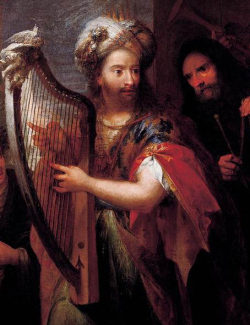
Division of Songs
No overt structure of the Psalms, other than numbering, exists in almost all modern Bible translations. In the original Hebrew manuscripts, however, there are five major sections of the book.
Section (or book) 1 contains Psalm 1 to 41, Section 2 has songs 42 to 72, Section 3 has songs 73 to 89, Section 4 contains songs 90 to 106 and Section 5 has 107 to 150.
The purpose of many of the Psalms is public worship in Israel's temple, although some are more suited for private devotion. They all, however, ultimately lead people to worship the Eternal. They passionately record a person's response to God given their situation and circumstances at the time.
Some of the Psalms cry out to God during a trial and others seek his intervention in their (and others) affairs. Some focus on his blessings or curses, while others sing his praises.
A prophetic theme exists within the five-folder original structure of the Psalms. Section 1 (1 to 41) refers to the Passover, the beginning of Israel as a nation, and the start of the New Testament plan of salvation centering around Jesus.
Section 2 (42 to 72) shows Israel as a single body in the land of Israel and pictures the creation of the New Testament Church.
Section 3 (73 to 89) describes the destruction of Jerusalem and the Temple. In many ways, this section parallels the prophecies of the coming Great Tribulation.
Section 4 (90 to 106) revolves around the Millennial reign of Christ and shows Israel re-gathered after their ruin. Section 5 (107 to 150) pictures a time when Judah (all Israel) shall again be delivered as they were in the time of Esther.
The Psalms also offer prophecies centered on Jesus Christ. They predict his birth (2:7), Deity (45:6 - 7), ministry (69:9), priesthood (110:1, 4), care for the needy (72:13) and the use of parables to convey his teachings (78:1 - 2). They also accurately predict his rejection (35:19, 118:22), betrayal (41:9), his crucifixion and the words he would speak (22), resurrection (2 and 16), ascension into heaven (68:18) and everlasting reign (102:26).
There are numerous ways in which to divide the book of Psalms other than by section. For example, royal songs concern the spiritual role of kings in the worship of God. They emphasize his role as Creator, Savior, and so on. Psalm 20 and 21 are in this category.
Repentant songs are those in which the composer confesses their sins to the Lord and asks for forgiveness. Psalm 51 is a very good example of this type of song.
Songs of wisdom and teaching focus on the contrast between both the righteous and the wicked and God's blessings and curses. Psalm 1 is in this category.
Conclusion
Those who wrote the book of Psalms created songs that run the gamut of human emotion from cries for help while suffering in a severe trial to exalting God's name and praising him for his many wonderful works. It is a part of the Bible worthy to be read, studied and sung again and again.