Roman Emperor Julius Caesar (who reigned from 49 to 44 B.C.) enlarged the Circus Maximus around 50 B.C. After its enlargement the track area was roughly 1,968 feet (1/3 of a mile or 600 meters) long by 738 feet (225 meters) wide. At capacity the stadium could hold upwards of one hundred and fifty thousand seated visitors.
According to Roman historian Tacitus (56 to 117 A.D.) the famous fire of Rome, which Emperor Nero blamed on Christians, was believed to have started near the Circus in July of 64 A.D.
In 81 A.D., the Roman Senate had constructed an arch to honor Emperor Titus on the closed East end of the Circus Maximus. Domitian (who ruled from 81 to 96 A.D. and who was the Emperor who banished the apostle John to Patmos) had his new Palatine palace joined to the building so that he would have a better view of the races.
Trajan (who ruled from 98 to 117) added another 5,000 seats to the circus and enlarged his seating area so that he could increase his popularity among the masses.
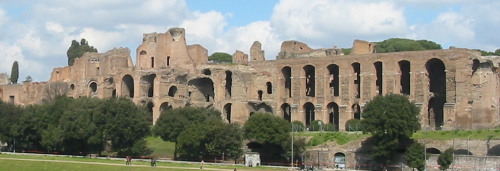
The event that proved to be the most popular in the circus was the chariot races. Twelve chariots could race at the same time. A median in the middle held various statues of gods as well as an obelisk from Egypt installed by Augustus.
Not much remains of the Circus Maximus except for the ancient track now covered with grass. Some gates used for starting the races still remain although the majority of the seating not longer exists. Over the years, building materials have been taken from the area and used for other structures.
The Egyptian obelisk that was placed in the middle of the Circus Maximus' track by Augustus was taken by a Pope in the sixteenth century. Site excavation was started sometime in the 19th century, which was then followed by some restoration of the area. There has yet to have been major excavations or restoration of the circus grounds.
Although the Circus may well be the most well-known of Rome's arenas, others were also built such as the Flaminius (located near the Tiber River) and the Maxentius (which was built on the Appian Way). It is believed that the majority of Christian martyrdom in Rome took place at the Maximus.
The apostle Paul may have alluded to this large circus venue when he wrote the following to the Corinthinans.
For a great and effective door has been opened to me (to preach the gospel in Ephesus), and there are many adversaries. (1Corinthians 16:9, HBFV)
Adam Clarke's Commentary on the above verse states that Paul may be alluding to "the throwing open of the great doors of the Circus Maximus before the chariot races began" and that the phrase "many adversaries" could also allude to the numerous competitors in such races.