The Egyptians
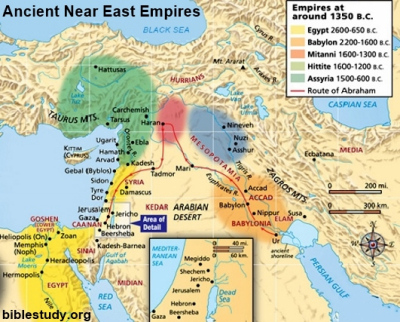
The New Kingdom of Egypt, also called the Egyptian Empire, was extant from roughly between 1550 - 1069 B.C. It was ancient Egypt’s most prosperous time and marked the peak of its power. This period contains some of Egypt's most well-known rulers, such as Ahmose I (considered the first Pharaoh), Hatshepsut and Tutankhamun (King Tut).
Under the reign of Queen Hatshepsut, ancient Egypt's trading of goods was expanded when a business expedition was sent to Punt. Later, the Egyptian army was enlarged under the Pharaoh known as 'Napoleon of Egypt' - Thutmose III. He used his newly expanded army to consolidate his power. This ultimately led to the empire's peak period of wealth and power under Amenhotep III.
Moses (1525 - 1405 B.C.) lived at a time when Amenhotep I (1526 - 1506), Thutmose I (1506 - 1493) and II (1493 - 1479), Hatshepsut (1479 - 1458) and Thutmose III (co-regent from 1479 - 1458 and sole ruler 1457 - 1425) reigned as Pharaohs of Egypt. It was under Thutmose III, in 1445 B.C., that the Exodus occurred. It was not until 1405 B.C. that Israel, under the command of Joshua (1490 - 1380), entered the Promised Land of Palestine.
The Babylonians
It was the near east Babylonian Empire that broke the power of Assyria and, in its westward sweep, destroyed Judah and conquered Egypt. Babylonia emerged as a powerful nation when the Amorite king Hammurabi created a short-lived power out of the territories of the former Akkadian Empire. It lasted from 612 B.C. to 536 B.C. Cyrus, king of Persia, conquered Babylon in 539 B.C.
The Mitannis
The Mitannis, who were loosely organized, came into power after Kassite Babylon was destroyed by the Hittites. Egypt was the major regional rival to the Mitanni. As the Hittites, however, grew in power the Egyptians and the Mitannis agreed to a pact in order to protect their interest against any Hittite threat.
The ancient near east Mitannis, at their peak power, maintained outposts that circled their capital city of Washukanni. Over time, however, the empire was greatly weakened by the Hittites then later the Assyrians.
The Hittites
The Hittites were a Bronze Age people of Anatolia who reached the height of power around the 14th century B.C., in part due to the Hittite military's successful use of chariots. Civil war and rivaling claims to the throne, combined with the external threat of a confederacy of seafaring raiders, eventually weakened the Hittites. Hittite power, by 1160 B.C., had collapsed.
The Assyrians
Babylonian colonists started Assyria. For many centuries, those in Assyria were subject to, or in conflict with, Babylon. The ancient near east empire of the Assyrians were a major world power from around 884 B.C. to the fall of its capital Nineveh in 612 B.C.