Late Summer 49 A.D. to Late Autumn
Pharisaic Judaizers come down to Antioch (Acts 15:1, 5) in the late summer of 49 A.D. and teach that circumcision is necessary before a person can be saved. Paul, Barnabas, Titus and certain others (Galatians 2:1 - 2) are sent to Jerusalem to confer with other apostles, elders and brethren concerning the relationship between circumcision and salvation.
The gathering of Paul and countless others to discuss this huge controversy in the early church is commonly referred to as the Jerusalem Conference. This conference occurs in the Fall of 49 A.D. around the time of the Feast of Tabernacles (Acts 15:2).
Paul and Barnabas have a private meeting with the apostles James, Peter and John about the circumcision question (Galatians 2:4 - 10). They agree that circumcision is not required for Gentiles to be saved. The ministry of Paul and Barnabas is confirmed.
The Question of Circumcision
The circumcision question is discussed further among the conference attendees. Peter offers his judgment then Paul and Barnabas tell the conference about the miracles and wonders God has wrought among the Gentiles through them (Acts 15:12). James then renders his judgment (Acts 15:13 - 21).
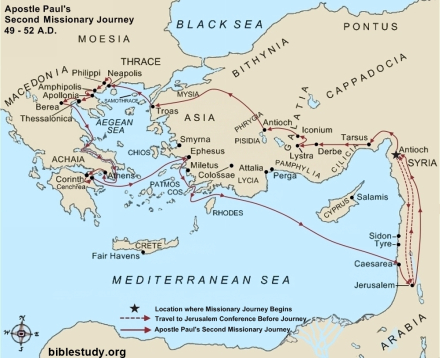
The apostles, elders and the whole church agree with James that the Gentiles do not need to be circumcised in order to become a believer and receive salvation. The conference has Judas (Barsabas) and Silas travel with the two evangelists to Antioch to deliver a letter, written by James, summarizing what was decided in Jerusalem regarding the circumcision question (Acts 15:30 - 32).
Late Autumn 49 A.D.
Paul and Barnabas stay in Antioch a certain number of days until they have a sharp disagreement over whether to take John Mark with them on another missionary journey. The argument becomes so heated that they separate (Acts 15:36 - 41).
Late Autumn 49 to Late Summer 50
Paul takes Silas with him to Tarsus. From there they travel to Derbe and Lystra. It is in Lystra that he meets Timothy, who would become his frequent traveling companion, fellow laborer in spreading the gospel and his best friend (Acts 16:1; 1Timothy 1:2, 4:14).
The apostle has Timothy circumcised (Acts 16:3). He then takes him and Silas to churches in the regions of Galatia (Iconium) and Phrygia (Antioch) to deliver the decision rendered at the Jerusalem conference.
Forbidden to Preach
Paul, as he journeys to the northwest of Antioch, desires to preach the gospel in western Asia. God's spirit, however, forbids him to do so (Acts 16:6). The apostle and his group continues to travel north toward the region of Mysia. He wants to travel East to the province of Bithynia but again is forbidden to do so (Acts 16:7). Him and his companions then decide to go to the port city of Troas on the Aegean Sea.
It is in Troas that Luke, the writer of the book of Acts, joins Paul and company. God then gives him a vision of a man in Macedonia (Greece) begging him for help (Acts 16:8 - 9). The group then immediately boards a ship, which sails near the island of Samothrace (Samothracia), then arrives at Neapolis (Acts 16:10 - 11).
First European Convert
From Neapolis the group goes to Philippi, where a woman named Lydia hears Paul's preaching. On Pentecost in 50 A.D. Lydia is baptized along with her entire household (Acts 16:12 - 15).
Paul, while in Philippi, casts a demon out of a female slave (Acts 16:16 - 18). Her masters, however, angry that they have lost the ability to make more money from the slave's demonic divination, stir up the city against him and Silas. The two evangelists are arrested, beaten and put in prison (Acts 16:19 - 24).
Soon after the evangelists arrive in jail a miraculous earthquake causes all the cell doors to open and the bonds of all prisoners to be loosed. This event leads to the conversion of the prison guard.
Evangelizing Thessalonica
A freed Paul and Silas, along with Timothy and Luke, travel through the cities of Amphipolis and Apollonia and arrive in Thessalonica (Acts 17:1). In Thessalonica Paul visits a Jewish synagogue and for three consecutive Sabbaths (Saturdays) explains why Jesus is the Old Testament prophesied Savior of Mankind (Acts 17:2 - 4).
Although many believe what is said certain Jews, envious of the Gospel's success, form a mob and start a riot (Acts 17:4 - 5). The riotous crowd go to the house of Jason seeking him and Silas. When they are not found, the crowd drags Jason and some brethren to the local civil magistrates and accuses them of wrongdoing (Acts 17:5 - 8). In a short time, however, Jason and the brethren are let go.
The Noble Bereans
Paul and Silas preach in a synagogue in Berea. The Bereans are not only willing to listen to what they have to say they also verify what is preached against the Old Testament scriptures (Acts 17:11 - 12). Many Bereans come to believe the Gospel. Unfortunately, Jews from Thessalonica arrive in the city seeking to cause more trouble for him (Acts 17:13).
Paul immediately leaves for the coast and sets sail for Athens while the rest of his party stay in Berea (Acts 17:14). In Athens he requests Timothy and Silas come to the city (Acts 17:15).
Debate in Athens
The apostle, while waiting in Athens for his traveling companions, preaches the Gospel to any Athenian who would listen. Some who hear his message are Jews and devout people. Others are Epicureans (followers of Epicurus) who believe the highest aim of man is to seek a pleasant life while other are Stoics. The Stoics believe that man's happiness consists of bringing himself into harmony with the universe.
After hearing some of Paul's message the Epicureans and Stoics take him to the Areopagus (or Mars Hill as the Romans call it) to further explain what he teaches (Acts 17:16 - 19).
On Mars Hill Paul uses an altar he saw dedicated to "an unknown god" as a springboard for teaching the crowd about the real God that can be known (Acts 17:19, 22 - 23).
Late Summer 50 to Autumn 52 A.D.
Paul leaves Athens and travels to Corinth. It is in Corinth that he first meets Priscilla and Aquila. Since both he and the couple make a living as tentmakers he stays at their house. He preaches the gospel every Sabbath in the synagogue. Silas and Timothy join him in Corinth. (Acts 18:1 - 5). The synagogue eventually splits and a new church is formed. After the split he stays and teaches in Corinth for a year and a half.
In the winter of 51 A.D. Paul is brought before the judgment seat of Gallio (Acts 18:12 - 18) and is released. He remains in Corinth until the Spring of 52 A.D. when he then travels to the port city of Cenchrea. In the city he has his head shaved due to a vow he took (Acts 18:18). He soon boards a ship and travels to Ephesus with Priscilla and Aquila.
In Ephesus Paul preaches in a synagogue but soon leaves the couple behind so that he can be in Jerusalem to celebrate the Feast of Tabernacles (Acts 18:19 - 21). He sails from Ephesus to Caesarea, then travels to Jerusalem. After keeping the Feast he returns to Antioch (Acts 18:21 - 22).