Late Spring 44 A.D. to Fall 46 A.D.
The apostle Paul and Barnabas are considered prophets (teachers) in the early New Testament church like several others. The brethren of Syrian Antioch, moved by God's spirit, lay hands on both men and ordain them as apostles.
Now there were certain prophets and teachers in the church that was at Antioch, including Barnabas, and Simeon who was called Niger, and Lucius the Cyrenian, and Manaen (who had been brought up with Herod the tetrarch), and Saul.
And as they were ministering and fasting to the Lord, the Holy Spirit said, "Separate both Barnabas and Saul to Me for the work to which I have called them." And when they had fasted and prayed, they laid hands on them and sent them out. (Acts 13:1 - 3).
From Antioch, the two apostles and John (surnamed Mark) begin Paul's first missionary journey (Acts 13:4 - 52, 14:1 - 25). The men travel to Seleucia then sail to Salamis, the principal city and seaport of the island of Cyprus.
Why Choose An Island?
Why did Paul choose, as the first place he would evangelize on his initial missionary journey, to travel to the island of Cyprus? There are a few factors that make evangelizing Cyprus a good choice for first preaching the gospel.
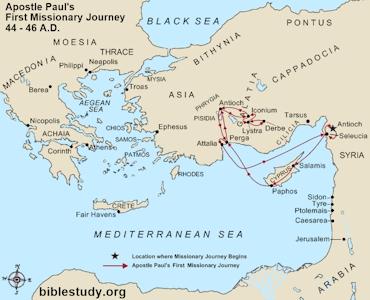
1) The island, the third largest in the Mediterranean, was fairly close to the mainland. Cyprus, at its nearest point, is only about 63 miles (101 kilometers) from mainland Syria.
2) Cyprus' proximity to the mainland made it a good migration destination for Jews, who had probably begun to settle there even before the time of Alexander the Great. When Paul visited he was able to preach the gospel in not just one but several synagogues (Acts 13:5).
3) The island was the home of fellow traveling companion and apostle Barnabas (Acts 4:36).
Evangelizing Cyprus
In Salamis, the men preach the gospel in several synagogues. They then cross the island by foot and arrive at Paphos.
While in Paphos the island's Roman governor requests Barnabas and Paul meet with him so that he can personally hear the word of God. Accompanying the governor to the meeting is a sorcerer and false prophet known as Elymas the magician. Elymas resists the gospel and tries to prevent the governor from accepting the truth of God.
And when they had gone through the island as far as Paphos, they found a certain sorcerer, a false prophet, a Jew whose name was Bar-jesus.
He was with the proconsul Sergius Paulus, an intelligent man, who called Barnabas and Saul to him, desiring to hear the Word of God. But Elymas the sorcerer (for so was his name interpreted) withstood them, seeking to turn away the proconsul from the faith. (Acts 13:6 - 8).
The Apostle Paul perceives Elymas' intentions and responds immediately. After intently looking at him he strikes the magician blind!
But Saul, who was also called Paul, being filled with the Holy Spirit, fixed his eyes on him, and said, "O full of all guile and all craftiness, you son of the devil and enemy of all righteousness, will you not cease to pervert the straight ways of the Lord?
"And now behold, the hand of the Lord is upon you, and you shall be blind, not seeing the sun for a season." And immediately a mist and darkness fell upon him, and he went about seeking someone to lead him by the hand. (Acts 13:9 - 11).
Elymas is miraculously rendered blind and is unable to see for a period. The governor, astonished at what he sees, believes the gospel (Acts 13:12).
Importance of Acts 13
Acts 13 marks a critical transition in the history of the New Testament church. It records the first miracle ever performed by Paul. It also, in verse 9, marks Luke's change from using the name Saul to Paul. The chapter lastly shifts the New Testament focus from a general history of people and events to one that is primarily centered on the Apostle Paul and his writings.
Mark Leaves the Team
Apostle Paul, Barnabas, and Mark soon board a ship and sail to Perga. Mark then abruptly leaves the group and returns to Jerusalem.
Then Paul and his company sailed away from Paphos and came to Perga of Pamphylia; but John departed from them and returned to Jerusalem. (Acts 13:13).
The issue of Mark suddenly abandoning the first missionary journey will be the catalyst for the separation of the evangelists before Paul's next journey (Acts 15:36 - 41). Paul and Barnabas leave Perga and travel to Antioch in Pisidia (also called Pisidian Antioch, to distinguish it from the Antioch located in Syria).
Rejection and Success in Antioch
The two evangelists, In Pisidian Antioch, visit a local synagogue where the apostle preaches a powerful message (Acts 13:16 - 41). After the Jews leave the synagogue, the Gentiles (proselytes) in the audience ask him to speak the next Sabbath day. Then, after the dismissal of the synagogue, many Jews and proselytes follow him and Barnabas in order to hear more about the gospel. On the next Sabbath, almost the entire city comes to hear the word of God.
And when the Jews had gone out of the synagogue, the Gentiles entreated him that these words might be spoken to them on the next Sabbath.
Now after the synagogue had been dismissed, many of the Jews and the proselytes who worshiped there followed Paul and Barnabas, who, speaking to them, persuaded them to continue in the grace of God. And on the coming Sabbath, almost the whole city was gathered together to hear the Word of God. (Acts 13:42 - 44).
Some Jews, however, envious of the large crowd drawn by apostle Paul, begin to speak against the gospel. Their rejection of Jesus as the Messiah means that he and Barnabas will now primarily preach only to Gentiles.
But Paul and Barnabas spoke boldly, saying, "It was necessary for the Word of God to be spoken to you first; but since you reject it and do not judge yourselves worthy of eternal life, behold, we turn to the Gentiles . . ." (Acts 13:46).
Success Brings Persecution
As the word of the Lord spreads through the entire region, some Jews begin a campaign to convince important men and women of the city to be against Paul and Barnabas. Persecution soon sets in and culminates with both men expelled from the area (Acts 13:50).
Death Threat in Iconium
Paul, after arriving in Iconium, speaks at a local synagogue. His preaching convinces many Jews and Greeks to become believers. Jews who do not believe in what he teaches, however, stir others up against the gospel. Although Paul performs signs and wonders to confirm what he says, the city still wonders whether he and Barnabas are true servants of God.
In a short time, some Jewish leaders, along with other Jews and Gentiles, conspire to have the two apostles stoned to death. After discovering a threat against their lives, the evangelists flee the city to Lystra.
But the unbelieving Jews stirred up the Gentiles and poisoned their minds against the brethren. For this reason, they (Paul and Barnabas) stayed a long time, speaking boldly in the Lord, Who bore witness to the message of His grace . . .
But the multitude of the city was divided; and some were with the Jews, and some were with the apostles. And when an assault was about to be made by both the Gentiles and the Jews with their rulers to insult and stone them, they became aware of it; so they fled to Lyconia . . . (Acts 14:2 - 6, HBFV).
Worshipped Like Gods
In Lystra Paul meets a man born crippled and never able to walk. He perceives, after the man hears his message, that he has enough faith for God to heal him. When Paul commands the crippled man to stand, he miraculously leaps up and is able to walk!
Now in Lystra, a certain man was sitting who had never walked; he was impotent in the feet, having been crippled from his mother’s womb.
This man heard Paul speaking; who, after looking intently at him, and seeing that he had faith to be healed, said with a loud voice, "Stand upright on your feet." And he leaped up and walked. (Acts 14:8 - 10).
The response to Paul's amazing miracle was both immediate and unexpected!
And when the multitude saw what Paul had done, they lifted up their voices in Lyconian, saying, "The gods have become like men and have come down to us."
And Barnabas they called Zeus; and Paul, Hermes, because he was the principal speaker. Then the priest of Zeus, who officiated before their city, brought oxen and garlands to the gates, desiring to sacrifice with the multitudes. (Acts 14:11 - 13).
The two apostles are barely able to keep the crowd from sacrificing to them as if they were Greek gods!
"Men, why are you doing these things? We also are men, with the same nature as you, and we have been preaching the gospel to you, so that you will turn from these vanities to the living God, Who made heaven and earth, and the sea, and all the things in them . . . "
And even by saying these things, they could hardly keep the multitudes from sacrificing to them (Acts 14:15, 18).
Surviving a Stoning
In a short time, Jews from Pisidian Antioch and Iconium arrive in Lystra and succeed in turning people against the two evangelists. After being stoned, some people drag Paul's dead body out of the city. Some believers find his body and as they stand around it, he comes back to life! Amazingly, He re-enters the city.
Then Jews from Antioch and Iconium came there; and after persuading the multitudes, they stoned Paul and dragged him outside the city, supposing that he was dead.
But while the disciples were standing around him, he arose; and he went into the city with them. And the next day, he departed with Barnabas to Derbe (Acts 14:19 - 20, HBFV).
Continuing to Preach
After leaving Lystra Paul and Barnabas travel to Derbe where they preach the gospel. They then retrace their steps through Lystra, Iconium, and Antioch in order to strengthen the brethren. From Pisidian Antioch they travel to Perga and then to Attalia, where they catch a ship to sail back to where their missionary journey started.
Fall 46 A.D. to Late Summer 49 A.D.
Paul and Barnabas stay in Antioch for almost three years, from the Fall of 46 A.D. to the late summer of 49 A.D..
And from there (Attalia) they sailed to Antioch, where they had been committed to the grace of God for the work which they had fulfilled.
And when they arrived, they gathered the church together and declared all that God had done with them, and how He had opened a door of faith to the Gentiles. And they stayed there with the disciples for a long time. (Acts 14:26 - 28).