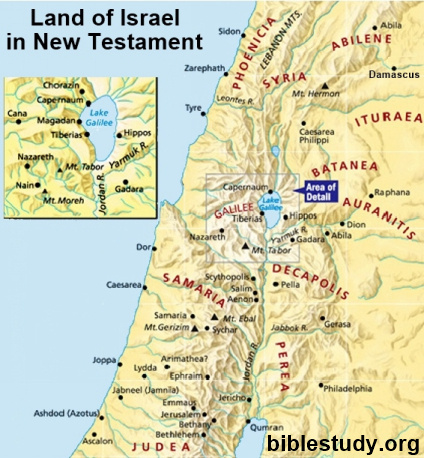
Palestine during
the ministry of Jesus Map

Holy land at the time of Jesus
 

The ministry of John the Baptist, which preceded Jesus' by six months, ran from 26 to 29 A.D. It was his calling to prepare the people for the literal appearing of the anticipated Messiah. John's ministry ended when Herod Antipas, who ruled part of Palestine as one of the sons of Herod of Great, beheaded him. The ministry of Jesus ran for three and one-half years, from the Fall of 26 A.D. to the Spring of 30 A.D. He lived in Capernaum, located on the northern shore of the Sea of Galilee, during the entire period of his preaching and spreading the good news of God's kingdom.

Galilee, which the Romans considered the northern part of Palestine, was the focal point of many miracles and events in the life of our Savior. At least five of his twelve disciples were living in the region when He called them to be apostles. Nineteen out of the thirty-two parables Jesus gave were spoken in Galilee. Twenty-five of Jesus' thirty-three great miracles were performed in the area. Jesus' very first public miracle was at the wedding in Cana of Galilee, as well as his last one performed on the shore of Galilee's sea after his resurrection. It was from Galilee that Jesus gave his well-known message known as "the sermon on the mount" (Matthew 5-7; Luke 6:20-49).

 
How did the region get its name?

Palestine's name and borders of have varied throughout history. Palestine originally denoted only the seacoast of the land of Canaan inhabited by the Philistines. It is in this sense exclusively that the Hebrew name Pelesheth (translated "Philistia" in the King James Version Bible) occurs in the Old Testament. In 68 B.C., what would later be called the land of Palestine, was reduced by Pompey the Great to a Roman province.

The name was given to these lands by the Romans around 135 A.D. after they had suppressed the Bar Kokhba Revolt. The commander of the revolt, Simon bar Kokhba, was hailed as a Messiah among the Jews, a heroic person who could restore Israel to its glory. The movement sought to gain independence from the Roman Empire. After only two years of independence, however, Roman Emperor Hadrian had five full legions brutally suppress the uprising. Jews were barred from Jerusalem and the practice of the Jewish faith was made illegal.

Before the revolt the Romans had divided up the region into four pieces:

  • Judea, the southern portion of the country.

  • Samaria, the middle province, whose northern boundary ran along the hills to the south of the plain of Esdraelon (valley of Jezreel).

  • Galilee, the northern province.

  • Perea (a Greek word which means "opposite country"), an area that lies east of the Jordan and the Dead Sea.

After the uprising was stopped the Roman authorities combined Judea with Galilee and other surrounding cities to form what they called Syria Palaestina.


Additional Study Materials
from BibleStudy.org
Flow of Bible History
from Creation to Apostle Paul
Palestine under
the Maccabees
Holy Land under the
rule of Herod the Great
Map of Greatest Extent
of Roman Empire


Bible Answers to Questions  -  Basic Articles  -  Beginners Studies  -  Pictures  -  In-Depth Articles  -  Life of Paul
Maps and Timelines  -  Prophecy  -  Reference Materials  -  Roman Empire  -  The Sabbath  -  Study by Topic
Homeschool links  -  Discount Bookstore  -  FREE books