Explore our New Testament timeline covering Biblical history from 37 B.C. to 100 A.D.!
37 B.C. to c. 4 B.C.
Period when Herod the Great rules as Roman-appointed King of Judea (King of the Jews).
27 B.C. to 14 A.D.
Period when Augustus, the first true Roman emperor, rules the empire.
20 B.C.
Herod the Great begins rebuilding Jerusalem's temple.
7 B.C.
High-level Parthian priests known as the Magi begin to see what appears to be a bright star appearing in the sky. They firmly believe that this miraculous beacon will lead them to the "King of the Jews" whom they desire to worship (Matthew 2).
6 B.C.
May 15 - 29
Zacharias serves in Jerusalem's temple (Luke 1).
May 23
May 23 is the Day of Pentecost. The archangel Gabriel appears to Zacharias, while he if offering incense in the temple, to reveal he will soon become the father of John the Baptist (Luke 1).
May 30 - June 12
John the Baptist is conceived (Luke 1).
Late November to Early December
Gabriel appears to Mary during her cousin Elizabeth's sixth month of pregnancy (Luke 1). The archangel informs her that she will miraculously conceive, through the power of God, the Savior of mankind (Luke 1)!
After Mary willingly accepts God's will she is overshadowed by His power and conceives Jesus. She then rushes to the home of her cousin Elizabeth (Luke 1) where she will stay until early March of 5 B.C.
5 B.C.
February 27 and March 11
John the Baptist is born.
Late August to Early September
Mary and Joseph journey to Bethlehem, Joseph's ancestral home, to pay Roman taxes (Luke 2).
Jesus' birth takes place between August 27 and September 9 in 5 B.C. It likely occurs in the middle of this period which is Saturday, September 2. This date is special in that it is not only the first day of the Hebrew civil year, but also the highly symbolic Feast of Trumpets (Rosh Hashanah).
September 9
Jesus is circumcised in accordance with God's law (Leviticus 12:3, Luke 2:21).
Early October
The Magi arrive in Jerusalem (Matthew 2:1) and immediately meet with Herod the Great.
October 11
Mary's last of her 40 days of purification occurs on October 11 (Leviticus 12:1 - 4).
October 12 - 28
Mary and Joseph take Jesus to Jerusalem to present him before God and make an offering (Luke 2:22 - 24). They then go back home to Bethlehem. The Magi receive Herod's answer regarding where Jesus would be born. As they exit Jerusalem the miraculous star they had seen reappears again and leads them to the home (not manger!) where the holy family is staying. After giving their gifts, instead of returning home through Jerusalem, they take another route (Matthew 2).
Mary and Joseph take Jesus, immediately after the Magi leave Bethlehem, out of the city and flee to Egypt to avoid Herod's wrath (Matthew 2).
October 29 - November 4
Herod, after the Magi do not return to him to reveal where Jesus is located, flies into a rage. He has all male children in and around Bethlehem, two years old or younger, slaughtered (Matthew 2).
4 B.C.
February 11 - 17
Herod the Great dies.
After February 17
Joseph, while in Egypt, is told in a dream by the angel of the Lord that he can return to Israel as Herod the Great was now dead (Matthew 2:19 - 21). The Bible does not reveal exactly when this dream took place.
February 25 - March 3
Herod Archelaus, one of Herod the Great's sons, become ruler over Samaria, Judea and parts of Idumea.
April 11 - 18
Herod Archelaus has his troops slaughter 3,000 men in Jerusalem during the spring festivals of Passover and Feast of Unleavened Bread (Antiquities of the Jews by Josephus, 17.9.3).
After April 18
Joseph, shortly after entering Israel, discovers that Herod Archelaus now rules Judea (Matthew 2:21 - 22). He is also likely informed about Archelaus' brutal slaughter in Jerusalem. His fear of returning to live in Bethlehem halts his journey.
An angel, yet again, appears to Joseph in a dream confirming his fear of living in Bethlehem. The family decides to continue their travels and live in Nazareth (Matthew 2:22 - 23).
9 A.D.
Spring Holy Day Season
Jesus is twelve years old in 9 A.D. He travels with his parents, relatives and acquaintances to Jerusalem to celebrate the spring Holy Days. These days began at sunset on March 28 and ended at sunset on April 5.
Mary and Joseph, after the Feast ends, leave Jerusalem assuming Jesus is among family also departing. They are soon shocked to discover that he is nowhere to be found!
Jesus did not leave Jerusalem like the rest of his family after the spring Holy Days (Luke 2:41 - 45). He had stayed behind in the temple carefully listening to what the priests said and asking questions.
Jesus' parents, after rushing back to Jerusalem, find him at the temple engrossed in theological discussions. Mary then chides her son for the panic he caused (Luke 2:48). Jesus responds by stating he must be about his Father's business (verse 49).
26 A.D.
March
John the Baptist's ministry begins about six months before Jesus' ministry starts (see Matthew 3:1 - 12, Mark 1:1 - 8, Luke 3:1 - 18 and John 1:6 - 27).
September 2
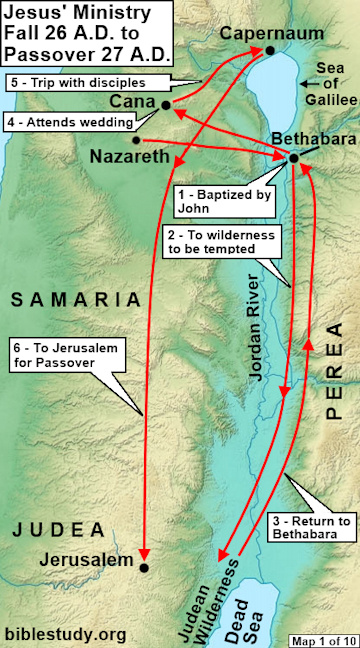
Jesus turns thirty years old. Shortly after his birthday he travels to Bethabara to be baptized by John (John 1:28 - 32).
September 11 - October 20
Jesus arrives in the Judean wilderness and begins his forty days of fasting which kicks off his ministry. During this period he will experience unparalleled temptations at the hands of God's great adversary (Matthew 4:1 - 11, Mark 1:12 - 13, Luke 4:1 - 13). His fast, and the devil's forty-day long marathon to tempt him, likely began on the Day of Atonement (Yom Kippur) which occurred on Wednesday, September 11.
October 20
Satan's concentrated temptations finally ended on Sunday, October 20, exactly forty days after they began. The devil, of course, continues his laser-focused attempt to tempt Christ to sin a short time later.
After overcoming the temptation of the adversary, the "god of this world" (John 12:31, 2Corinthians 4:4), Jesus is in a weakened physical state. God sends angels to help minister to him.
Late October
In Bethabara (John 1:28), John the Baptist sees Jesus walking toward him and proclaims, "Behold the Lamb of God, Who takes away the sin of the world!" (John 1:29).
Jesus will initially meet with at least five of his disciples. They are John and Andrew (John 1:35 - 39) then Peter (also called Simon or Simon Peter, verses 40 - 42), followed by Philip (verses 43 to 44) and then Nathanael (Bartholomew - verse 45).
November
Jesus, on the third day after calling Nathanael, travels with his disciples to Cana to attend a wedding ceremony and the celebration that follows. What occurs during the celebration in Cana will be the catalyst for Jesus' first public miracle (John 2)!
27 A.D.
April to May
Jesus and the disciples leave Capernaum (John 2:12) and travel south toward Jerusalem. They leave as the Passover, which begins at sunset on April 8, is approaching (verse 13).
When Jesus arrives at Jerusalem's temple makes a whip out of some cords and drives away the animals, while also overturning the tables of the moneychangers, so that the temple could be cleansed. The Lord then gives a prophecy of his death (John 2:18 - 21).
The Lord, while still in Jerusalem after the spring Feast days, is approached by a man named Nicodemus who is a Pharisee and a member of the Sanhedrin (John 3).
Jesus trains his disciples to baptize (John 3:22 - 24, 4:1 - 2).
Jesus then travels to Jacob's well where he meets a Samaritan woman. After a brief interaction the Lord admits he is the Messiah and then preaches the gospel among the Samaritans (John 4:5 - 43).
Middle of May
John the Baptist is thrown into prison.
Jesus travels to Cana (John 4:46). A royal official from Capernaum, who knew he was in the city, requests his sick and dying son be healed. Instead of visiting the child, however, Jesus simply declares the son will live! This is the first healing miracle recorded during Jesus' ministry (John 4:49 - 53)!
June 1 (Pentecost)
Jesus, in Nazareth for Pentecost, is asked in a local synagogue to read from the Bible. He quotes Isaiah concerning the Jubilee Year and then reveals that he is the fulfillment of its prophecy (Luke 4:16 - 21)! The people of the city then attempt to toss the Lord over a cliff (verses 28 - 30).
Jesus makes Capernaum his home in fulfillment of prophecy (Matthew 4:13 - 16).
After Pentecost
The Lord calls Peter, Andrew, James and John, while they are fishing on the Sea of Galilee, to come with him on his first preaching tour in Galilee (Mark 1:16 - 20, Matthew 4:18 - 22, Luke 5:1 - 11).
Jesus (based on tradition) travels to Mount Eremos which is located on the northwestern part of the Sea of Galilee. It is here that he will give his Sermon on the Mount (Matthew 5:1 - 8:1, Luke 6:20 - 7:1).
28 A.D.
April 5
Jesus and his disciples, hungry while walking through a grain field on the last day of Unleavened Bread (April 5), pluck heads of wheat and eat them. This simple act, done out of need, roused the anger of the Pharisees who believed it was "work" that broke the Holy Day (Luke 6:1 - 5, Mark 2:23 - 28, Matthew 12:1 - 8).
Mid-April to Early Summer
Jesus begins to have confrontations with Jewish religious leaders over the proper application of God's law, especially concerning Sabbath observance (Matthew 12:9 - 14, Mark 3:1 - 6, Luke 6:6 - 11).
While in Galilee the Lord goes up a local mountain and prays all night. He then officially selects and ordains twelve of his disciples to be his apostles (Luke 6:13 - 16, see also Mark 3:13 - 19).
Jesus learns that a Roman centurion's servant is ill and near death. Rather than personally visiting the sick person, he simply commands the person be made whole (Matthew 8:5 - 13, Luke 7:2 - 10).
Summer
Jesus is accused of casting out demons through the power of Beelzebub (Mark 3:22 - 30, Matthew 12:24 - 33).
Jesus resurrects from the dead the only son of a Nain widow (Luke 7:12 - 17).
John the Baptist, in prison, sends some of his disciples to question Jesus about whether his is the promised Messiah (Luke 7:19 - 23).
September
During the fall festival season Jesus heals a man who had an infirmity for 38 years. When the Jews hear of the miracle the question the healed man and believe his picking up and carrying his bedroll is a Sabbath sin. Jesus' response is that both He and His Father have been constantly working. The Jew believe Jesus' claim that God is His Father is blasphemous (John 5).
October to near end of year
Jesus continues spreading the gospel with several women accompanying and supporting him (Luke 8:1 - 3).
Near End of 28 A.D.
to Early 29 A.D.
Jesus gives many parables and then explains why he uses them in his teachings (Matthew 13, Mark 4, Luke 8).
The Lord, after being woke up by the disciples who fear their boat will sink, calms the storm (Matthew 8:24 - 26, Mark 4:35 - 41, Luke 8:22 - 25).
Jesus casts out a "legion" of demons from two men living in a region known as the Gadarenes (Matthew 8, Mark 5, Luke 8).
Jesus resurrects from the dead the daughter of a synagogue ruler named Jairus. A woman who has suffered blood loss for years is healed when she touches the Lord (Matthew 9:18 - 26, Mark 5:25 - 43, Luke 8:41 - 56).
Jesus is rejected a second time in Nazareth (Matthew 13:54 - 58, Mark 6:2 - 6).
The twelve apostles are sent on an evangelistic training mission (Matthew 10:1 - 11:1, Mark 6:7 - 13, Luke 9:1 - 6).
29 A.D.
Before April 16
John the Baptist is beheaded by Herod Antipas at an unknown time before Passover (April 16).
April to Mid-September
After John the Baptist's death Jesus travels to a wilderness area near Bethsaida. He then feed 5,000 men (likely 10,000+ people total) with just five loaves of bread and two fishes (Matthew 14:13 - 21, Mark 6:30 - 42, Luke 9:10 - 17, John 6:1 - 13).
Jesus walks on water at the Sea of Galilee to get to his disciples whose boat had been blown off course. Peter's request to also walk on water is granted only to soon sink and have the Lord save him (Matthew 14:22 - 31, Mark 6:45 - 52, John 6:14 - 21).
The Lord teaches that he is the true Bread, or manna, from heaven. This bread, he states, gives life to all those who eat it (John 6:32 - 35).
Jesus' teaching that believers must eat his flesh and drink his blood causes many disciples to leave him (John 6:22 - 71)
The Lord forcefully corrects Jewish religious leaders for their vain traditions (Matthew 15:1 - 14, Mark 7:1 - 16).
Jesus and the disciples visit the region of Tyre where a non-Israelite woman's persistence leads to her daughter being healed (Matthew 15:22 - 28, Mark 7:24 - 30).
The Lord travels to the Decapolis region where he heals countless people and feeds 4,000+ from seven bread loaves and a few fish (Matthew 15:29 - 38, Mark 7:31 - 8:9).
The disciples are warned about the "leaven" (false teachings) of the Pharisees and Sadducees (Matthew 16:1 - 12, Mark 8:10 - 21).
Mid to Late September
Jesus and the disciples travel to near Caesarea Philippi where he asks them who do people think he is (Matthew 16:13 - 18, Mark 8:27 - 30, Luke 9:18 - 21).
The devil inspires Peter to rebuke Jesus (Matthew 16:22 - 27, Mark 8:32 - 38, Luke 9:23 - 26).
Late September
Jesus' transfiguration takes place witnessed by Peter, James and John (Matthew 16:28 - 17:9, Mark 9:1 - 10, Luke 9:27 - 36).
Early October
The Lord and the disciples leave Capernaum and secretly travel through Galilee and Samaria until they reach Jerusalem. In the middle of the Feast of Tabernacles Jesus appears at the temple and begins to preach. During the morning portion of the Last Great Day he offers salvation to anyone who thirsts for it. The Jewish religious leaders are unable to arrest him (John 7:3 - 52).
October 19
An adulterous woman is caught by some religious leaders and brought to Jesus to determine how he would treat her. Jesus' brief writing on the ground causes all her accusers to leave, after which the woman is allowed to leave (John 8:1 - 11).
The Pharisees verbally attack Jesus and accuse him of being demon possessed. The Lord's response is to proclaim that the real father of his accusers is not God but Satan the devil (John 8:12 - 59).
October 22 to Mid-November
Jesus heals at the pool of Siloam a man born blind. The Jews, who refuse to believe the Lord did so through God, cast the man out of the synagogue (John 9:1 - 41)!
Mid-November to Mid-December
Jesus miraculously pays his and Peter's temple tax through a coin found in a fish's mouth (Matthew 17:24 - 27).
The disciples dispute among themselves who will be the greatest in God's kingdom (Matthew 18:1 - 5, Mark 9:33 - 37, Luke 9:46 - 48).
James and John are rebuked for impulsively wanting to destroy a Samaritan village with fire (Luke 9:52 - 55).
Seventy disciples are sent on an evangelistic training mission (Luke 10:1 - 37).
Jesus gives the only prophetic sign to confirm his authority, truthfulness and that he is the promised Messiah (Luke 11:29 - 30).
The Lord forcefully chastises the Pharisees and other religious leaders for their vanity, pettiness and other sins (Luke 11:37 - 52).
Jesus teaches that time and chance can affect any person (Luke 13:1 - 5). He later answers the question of whether only a few people will be saved (Luke 13:23 - 30).
December 18 - 26
Jesus and the disciples travel to Jerusalem for Hanukkah (Festival of Lights, Feast of Dedication). At the festival Jesus' claim that He is God's son causes the Jews to gather stones to kill him (John 10:22 - 39).
30 A.D.
January to February
Jesus travels north for what will become his last visit to his home in Capernaum (Luke 14).
In Capernaum the Pharisees fail to entrap Jesus by putting a man with dropsy, on the Sabbath day, in front of him. The man is healed after which the Lord teaches about humility (Luke 14).
Leaving his home for the last time, Jesus teaches a huge crowd several well-known parables. They are the parables of the lost sheep (Luke 15:1 - 7), a lost coin (verses 8 - 10), a prodigal son (verses 11 - 32), and an unjust steward (16:1 - 9). He also teaches that man cannot serve both God and money, followed by the parable of the rich man and Lazarus (verses 13 - 31).
February to Late March
Jesus, continuing his travels, is told Lazarus is sick. When he arrives in Bethany Lazarus had been in the grave for four days. He publicly resurrects his friend to the amazement of even the religious authorities from nearby Jerusalem (John 11)!
Jesus leaves Bethany for Ephraim and then travels to Jericho. His presence in the city causes a dishonest tax collector named Zaccheus to repent (Luke 19).
March 29
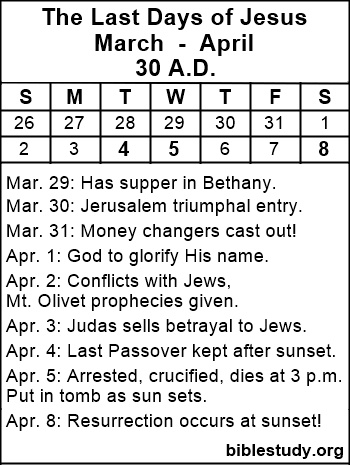
The Lord and his disciples leave Jericho for Bethany, a journey of roughly seventeen miles (27.3 kilometers). He has supper with Lazarus and his sisters (John 12).
March 30
Jesus makes his triumphal entry into Jerusalem (Matthew 21, Mark 11, John 12).
March 31
Jesus curses a fig tree as he reenters Jerusalem. He then casts out the money changers from the temple like he did at the start of his ministry (Matthew 21, Mark 11, Luke 19).
April 1
On the morning of the weekly Sabbath day, while traveling to Jerusalem, the disciples notice that the fig tree Jesus cursed is dried up (Matthew 21:19 - 22, Mark 11:20 - 26). Later some Greek proselytes fail in their attempt to talk to the Lord (John 12).
April 2
Jesus has many confrontations with Jewish leaders such as the chief priests, scribes, Pharisees, etc. (Matthew 21 - 22, Mark 11 - 12, Luke 20, John 12). Please see our timeline on Jesus' last days for details about these confrontations.
Jesus gives his famous Mount of Olives prophesies concerning the end time (Matthew 24, Mark 13, Luke 21).
The chief priests, scribes, elders, etc. of the Great Sanhedrin, who hate Jesus, meet at the palace of Caiaphas the high priest. They meet to discuss how to arrest and kill the Lord (Matthew 26, Mark 14, Luke 22).
April 3
Judas, who is briefly possessed by Satan the devil, arranges to betray Christ to the chief priests for thirty pieces of silver (Matthew 26:14 - 16, Mark 14:10 - 11, Luke 22:3 - 6).
April 4
At sunset Jesus and the disciples partake of the Lord's last Passover. Jesus institutes the symbols of the New Covenant offered to all humans through his suffering and death (Matthew 26, Mark 14, Luke 22, John 13 - 17).
After Passover the group walks to the Garden of Gethsemane to await Jesus' arrest.
April 5
Judas betrays Jesus with a kiss after which the disciples abandon him. The Lord then experiences two trials and is condemned to death by Jewish religious leaders. The Jews get the Romans to carry out the task of killing Christ. Man's sinless Savior dies at 3 p.m. and is buried in a tomb (Matthew 26 - 27, Mark 14 - 15, Luke 22 - 23, John 18 - 19).
April 6
Guards are placed at Jesus' tomb (Matthew 27:62 - 66).
April 7
Mary Magdalene, Mary the mother of James and Salome buy and prepare spices for the body of Jesus (Mark 16:1, Luke 23:56).
April 8
Late in the afternoon of the weekly Sabbath, Mary Magdalene and the "other Mary" check on where Jesus is buried (Matthew 28:1). Then, just before sunset, precisely three days and three nights after Jesus was placed in his tomb, he is resurrected from the dead!
April 9
Jesus makes his first appearances to humans after his resurrection. He appears to Mary Magdalene, then two men going to Emmaus, then ten of his eleven remaining apostles (Matthew 28, Mark 16, Luke 24, John 20).
April 16 to May 18
Jesus appears alive several times to several groups of people. Please see our article on Jesus' ministry after his resurrection for more information!
Jesus, one last time, meets with the disciples on the Mount of Olives (Acts 1). He gives them, just before his ascension, what is referred to as the Great Commission. He also tells them to wait ten more days, in the city of Jerusalem, so that they may receive the power of the Holy Spirit.
May 28
The birth of the Christian church occurs on the day of Pentecost (Acts 2).
32 A.D.
Stephen is martyred (Acts 6 - 7), the first person, after the resurrection of Christ, to die for his faith (John the Baptist also was killed for following God). Persecution against the early church arises (Acts 8).
Christians leave Jerusalem and begin to spread the gospel far and wide. Peter confronts Simon Magus (Simon the Magician) in Samaria. Philip preaches the gospel to the Ethiopian eunuch.
33 A.D.
Saul, on his way to Damascus, is converted and becomes the apostle Paul (Acts 9). He soon flees the city to Arabia, where he is taught personally by Christ for three years (Galatians 1:15 - 18).
33 - 44 A.D.
Paul's travels before his Missionary Journeys (Galatians 1, Acts 9 - 12).
35 A.D.
Matthew completes the first Gospel writing.
36 A.D.
Paul travels to Jerusalem for the first time after his conversion and stays for fifteen days (Acts 9:26 - 30, Galatians 1:18 - 20).
37 A.D.
The apostle Peter preaches the gospel in Lydda and Joppa (Acts 9:32 - 41). Peter also stays in Joppa with Simon the Tanner for many days (verses 42 - 43).
38 A.D.
Peter baptizes Cornelius, the first Gentile (non-Jew) believer to be converted (Acts 10).
39 - 40 A.D.
Believers fleeing Saul's persecution take the gospel message to Jews in Antioch, the island of Cyprus and elsewhere (Acts 11:19). The apostles in Jerusalem send Barnabas to Syrian Antioch to ministry to the city's growing Christian population (verse 22 to 24).
39 - 44 A.D.
After Herod Antipas' death his son, Herod Agrippa I, becomes new ruler of Galilee and Perea.
41 A.D.
Paul and Barnabas teach in Syrian Antioch for a year.
42 A.D.
A prophet by the name of Agabus foretells a famine will soon occur that will last for three years (Acts 11:27 - 28).
44 A.D.
In the spring, food and relief are sent to Jerusalem by the hands of Paul and Barnabas (Acts 11:30). Herod Agrippa I, in the Spring of 44 near Passover, persecutes the early church and beheads the apostle James (brother of John). He also has the Apostle Peter arrested. Soon after these events God strikes Herod dead while he is visiting Tyre and Sidon (Acts 12). In late spring Paul and Barnabas are ordained as apostles (Acts 13:1 - 3).
44 - 46 A.D.
Apostle Paul conducts his first Missionary Journey (Acts 13 - 14).
49 A.D.
The Jerusalem Conference, which will discuss if circumcision is required for salvation, takes place in the Fall (Acts 15). The conference is headed up by James, the half-brother of Jesus and the author of the book of James.
49 - 52 A.D.
Apostle Paul conducts his second Missionary Journey (Acts 15 - 18). In Lystra Paul meets Timothy, who will become his traveling companion and best friend (1Timothy 1:2, 4:14).
50 A.D.
Apostle Paul writes 1Thessalonians, the first of fourteen books he will write that will be included in the Bible.
52 - 53 A.D.
Peter comes to Syrian Antioch during the Feast of Unleavened Bread. He is strongly rebuked by Paul for not eating with Gentiles during the Spring Holy Days (Galatians 2:11 - 20).
53 - 58 A.D.
Apostle Paul conducts his third Missionary Journey (Acts 18 - 21).
54 - 68 A.D.
Emperor Nero rules the Roman Empire. The apostles Paul and Peter, along with others, become martyrs under his reign.
60 - 63 A.D.
The apostle Paul travels on his fourth Missionary Journey (Acts 21 - 28).
62 A.D.
In Jerusalem, religious zealots martyr James, the half-brother of Jesus and leader of the Jerusalem church, around the time of Passover.
63 - 67 A.D.
Apostle Paul conducts his fifth and final Missionary Journey (Acts 28; Titus 1, 3; Romans 15).
64 - 67 A.D.
The apostle John must address a heresy, spreading is some New Testament churches, that denies Jesus' humanity. He writes 1, 2 and 3John to refute these false teachings.
65 A.D.
The rebuilding of Jerusalem's temple, begun by Herod the Great, completes.
67 A.D.
The apostle Paul is back in prison in Rome, where he writes his last New Testament book (2Timothy).
67 - 68 A.D.
Roman Emperor Nero carries out the Roman Empire's first of ten state-sponsored persecutions against Christians. The Apostle Peter is believed to have been put to death by Nero during this period, although his martyrdom in Rome is open to debate.
c. 67 to 68
According to church historian Eusebius (c. 260 - 265 to 339 A.D.), the Christians in Jerusalem are warned by God of the city's impending destruction by the Romans (Eusebius, Church History 3, 5, 3). The Apostle John, along with other Jewish Christians, flee the city for Pella.
68 A.D.
The Apostle Paul suffers a martyrs' death in the city of Rome just before Emperor Nero commits suicide on June 9.
70 A.D.
The Romans destroy Jerusalem and its temple on the 9th day of the Hebrew month of Ab.
94 - 96 A.D.
Roman Emperor Domitian, who ruled from 81 to 96 A.D., begins Rome's second wave of persecutions against Christians. In 95 - 96 the apostle John is exiled to the island of Patmos "because of the Word of God and the testimony of Jesus Christ" (Revelation 1:9, HBFV). He soon receives visions from God that ultimately become the book of Revelation, which he writes while on the island.
96 A.D.
Emperor Domitian dies in September 96 and is succeeded by Emperor Nerva. The apostle John is released from Patmos and makes his way back to Ephesus. His last task, before his death, is to canonize not only the New Testament but also the entire Bible.
98 - 100 A.D.
Emperor Nerva dies in January of 98 A.D. and is succeeded by Trajan. John, the last living apostle, completes his canonization of the Scriptures and dies, of natural causes, in Ephesus c. 98 - 100.