The Middle East country of Israel has a total land and water area of 20,770 square kilometers and is slightly bigger than the state of New Jersey. Both the Gaza Strip and what is called the West Bank are occupied by the state of Israel. Their status is subject to an Interim Agreement.
The Middle East's West Bank, with a total area of 2,262 square miles (5,860 square kilometers), is the larger of the two areas comprising the Palestinian territories. The state of Israel, in 1950, declared that Jerusalem was its capital, but the United States and many other countries around the world do not maintain an embassy in the city but rather have one in Tel Aviv.
Jordan has a total land and water area of 89,342 square kilometers, which is ranked 112th in the world. The country is a little smaller than the state of Indiana. Its estimated 2017 population is just above 10 million. Jordan's economy is one of the smallest in the Middle East.
The Middle Eastern country of Kuwait has a total land and water area of 17,818 square kilometers, which makes it somewhat smaller than the state of New Jersey. Though the nation is relatively small, it contains (based on a 2017 estimate) the world's sixth largest proven reserves of crude oil.
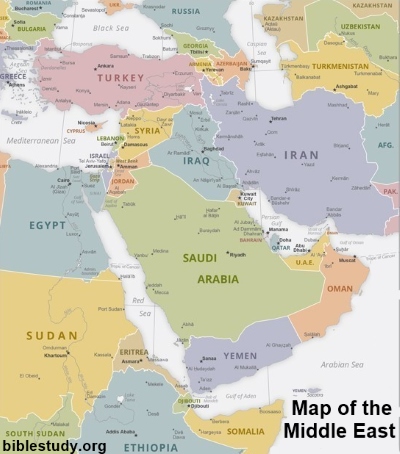
Syria has a total land and water area of 185,180 square kilometers, making it a little bigger than the state of North Dakota. The country has one of the greatest budget deficits in the world based on GDP. Due to the country's internal turmoil, which began to heighten in late 2011, it is estimated that more than 13 million people in Syria are in the need of humanitarian assistance.
Turkey, one of the larger countries of the Middle East, has a total land and water area of 783,562 square kilometers, which is ranked 37th in the world. It has a total population of almost 81 million people (2017 estimate) which ranks it 18th in the world. It is the world's seventh largest importer of natural gas.
Yemen has a total land and water area of 527,968 square kilometers, which is a little more than double the size of the state of Wyoming. This Middle Eastern country, since 2014, has experienced conflict and war that has taken a significant toll on the economy and the people (source: CIA World Factbook).