Late Spring 58 A.D.
Paul's desire was to arrive in Jerusalem to celebrate the Feast of Pentecost on May 21 of 58 A.D. (Acts 20:16). He desired is fulfilled when he arrives in the city (Acts 21:17). Arriving in Jerusalem he visits James and soon afterwards goes to the temple with four Jewish converts. Jews from Asia, who hate Paul, see him at the temple and very loudly accuse him of wrongdoing (Acts 21:17 - 28).
A riot soon erupts. The mob seizes Paul, drags him out of the temple, and begins to beat him. The Romans quickly find out what is happening and dispatch troops to the temple area. Those beating him stop doing so when Roman soldiers arrive at the scene (Acts 21:30 - 32).
The Romans bind Paul and begin to escort him to some nearby barracks. As he is led away he requests and is given permission to speak to the people (Acts 21:33 - 40).
Paul's speech to the mob (Acts 22:1 - 21), through sincere, only fans the flames of resentment against him. The crowd begins to call for his death and the riot increases in intensity. He is led away to the Roman barracks where they want to scourge him to find out why the people rioted against him. Just before his scourging he tells a Roman centurion that he is a Roman citizen.
When the commander finds out what Paul told the centurion he personally verifies his citizenship status as a Roman. After confirming that he is indeed a Roman citizen the commander immediately cancels the scourging (Acts 22:25 - 29).
The next day the apostle is released from his bonds and brought before the Sanhedrin to have them determine what caused the tumult in the temple (Acts 22:30). His defense before the Jewish religious leaders accomplishes little (Acts 23:1 - 10). The night after his hearing he has a vision of Jesus, standing next to him, assuring him he will make it to Rome (Acts 23:11).
When daybreak arrives some forty zealous Jews band together and swear an oath that they will not eat or drink until Paul is killed. They conspire with the chief priests and elders to have him murdered as he travels to meet with them a second time. Paul's sister's son hears about the plot against his uncle and informs the Romans (Acts 23:12 - 22).
Paul is soon escorted out of the city, at night, by two hundred (200) Roman soldiers (Acts 23:23 - 24) who will take him through Antipatris to Caesarea where his case can be heard. When he arrives in Caesarea governor Felix decides to keep him in the Praetorium of Herod (Acts 23:35).
Early Summer 58 to Early Autumn 60
Paul is a Roman prisoner in Caesarea from early Summer 58 A.D. to early Autumn 60 A.D. In Caesarea he defends himself several times while he is a prisoner (Acts 24). He is found to have done nothing worthy of bonds or death. Governor Felix, in spite of his innocence, keeps him a Roman prisoner in the hope that a bribe will be offered to secure his release (Acts 24:26 - 27).
Felix, to facilitate the possibility of a bribe for Paul's release, gives him liberties such as not being bound and the right to have people visit and provide for his needs. In two years Felix, the Roman governor of Judea, is replaced by Porcius Festus.
Governor Festus hears the accusations against the apostle made by several Jews from Jerusalem, none of which can be proved (Acts 25:6 - 8). Festus, wanting to garner favor from the Jews, asks him if he is willing to have his case officially tried by him in Jerusalem. Paul, as a Roman citizen, requests his case be heard by Caesar in Rome.
Festus agrees to send him to Rome. King Agrippa and his wife arrive in Caesarea and allow Paul to defend himself against the charges laid against him (Acts 25:13 - 26:29). Not only does Agrippa find that he has done nothing worthy of imprisonment or death (Acts 26:30 - 31) but that Paul might have been freed if he had not appealed his case to Caesar (Acts 26:32).
Autumn 60 A.D. to Early Spring 61 A.D.
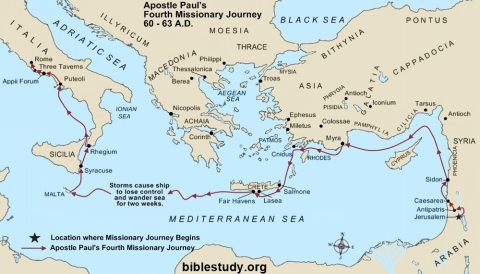
In the Autumn of 60 A.D. Paul, along with several other prisoners, boards a boat bound for Rome. His travel to Rome is considered his fourth evangelistic journey.
The prisoners are escorted to Rome by a Roman Centurion named Julius (Acts 27:1 - 2). From Caesarea they set sail and soon arrive at Sidon. From Sidon the ship hugs the coast near Antioch and the Roman provinces of Cilicia and Pamphylia before arriving at Myra.
In Myra the people board a ship bound for Italy. Because of the wind, however, the ship is unable to sail directly to Italy. Instead, the ship hugs the coast until it arrives near Cnidus, where it turns south toward the island of Crete (Acts 27:3 - 7).
After a difficult journey the ship anchors at the Cretan city of Fair Havens. Although Paul warns Julius not to sail the Mediterranean during this dangerous time of the year (September to October), the Centurion disregards his advice and has the ship set sail for the western part of the island and the harbor of Phoenix (Acts 27:9 - 12).
The ship soon encounters a fierce storm which drives it out to sea. Storms, strong winds and overcast skies which hide the sun and moon cause the ship to lose control and be aimlessly tossed at sea for about two weeks (Acts 27:13 - 27). Eventually the ship drifts near the island of Malta where it is run aground.
All two hundred and seventy-six people on the boat abandon ship. They grab whatever parts of floating wreckage they can from the shipwreck and make their way to the island (Acts 27:37 - 44). All those on the ship arrive safely on Malta, fulfilling God's promise that no life would be lost (Acts 27:22 - 25).
Paul stays three months on Malta where he is treated kindly by the natives. In his short stay on the island he miraculously survives a bite from a poisonous viper, heals the father of the island's governor, then heals the diseases of those on the island (Acts 28:1 - 10).
Paul soon, however, boards a ship wintering at the island and set sail to Syracuse and Rhegium. They eventually arrives at the Italian port city of Puteoli, where he stays for one week with Christians in the area (Acts 28:11 - 14). He is then taken to Rome on the well-known Appian Way road (Acts 28:14 - 16).
Early Spring 61 to Early Spring 63
The apostle is a prisoner in Rome for two years (Acts 28:30). Although Paul is a prisoner, he is allowed to live by himself guarded only by a Roman soldier (Acts 28:16). Shortly after his arrival in the city he speaks with Jewish religious leaders regarding his arrest (Acts 28:17 - 29). During his imprisonment He is given the privilage of being able to receive visitors and continue to preach the Gospel (Acts 28:17 - 31).