| Does the Rose of Sharon symbolize Jesus? Was it used as a healing balm in ancient Israel? | |
| Q. Is the Rose of Sharon a symbol for Jesus? Was the Rose of Sharon some sort of healing balm used in ancient Israel? (Submitted by: Gabrielle) A. Easton's Bible Dictionary gives the following explanation: "Sharon was a plain, a level tract extending from the Mediterranean to the hill country to the west of Jerusalem, about 30 miles long and from 8 to 15 miles broad, celebrated for its beauty and fertility (1 Chronicles 27:29; Isaiah 33:9; 35:2; 65:10). The 'rose of Sharon' is celebrated (Song of Solomon 2:1). It is called Lasharon in Joshua 12:18 " The Song of Solomon uses the phrase "rose of Sharon" to describe the beauty of a young woman [2:1]. The plain of Sharon was known for its beautiful flowers in the time of Solomon. The entire second chapter of the Song of Solomon is quite poetic: |  " I am a rose of Sharon, a lily of the valleys. Like a lily among thorns is my darling among the maidens. Like an apple tree among the trees of the forest is my lover among the young men. I delight to sit in his shade, and his fruit is sweet to my taste. He has taken me to the banquet hall, and his banner over me is love. Strengthen me with raisins, refresh me with apples, for I am faint with love. His left arm is under my head, and his right arm embraces me. Daughters of Jerusalem, I charge you by the gazelles and by the does of the field: Do not arouse or awaken love until it so desires. Listen! My lover! Look! Here he comes, leaping across the mountains, bounding over the hills. My lover is like a gazelle or a young stag. Look! There he stands behind our wall, gazing through the windows, peering through the lattice. |
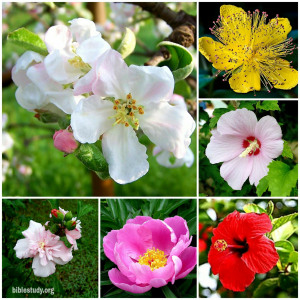
| "My lover spoke and said to me, "Arise, my darling, my beautiful one, and come with me. See! The winter is past; the rains are over and gone. Flowers appear on the earth; the season of singing has come, the cooing of doves is heard in our land. The fig tree forms its early fruit; the blossoming vines spread their fragrance. Arise, come, my darling; my beautiful one, come with me. "My dove in the clefts of the rock, in the hiding places on the mountainside, show me your face, let me hear your voice; for your voice is sweet, and your face is lovely. Catch for us the foxes, the little foxes that ruin the vineyards, our vineyards that are in bloom. My lover is mine and I am his; he browses among the lilies. Until the day breaks and the shadows flee, turn, my lover, and be like a gazelle or like a young stag on the rugged hills." (Song of Solomon 2, NIV) | | The pictures above are what some believe to be the actual rose of Sharon, which, according to archeological records from the area, is not actually a "rose" at all according to the modern definition, but a member of the gladiolus family. No one today knows exactly what this flower looked like at the time of Solomon. The Hebrew word chabatstseleth is translated as "rose" but Hebrew lexicons say this referred to a "meadow saffron," many of which can still be found in the area today. Gilead was nearby and the balm of Gilead is mentioned in the Bible [Genesis 37:25; Jeremiah 8:22; 46:11] as a healing ointment of great value, sometimes used as a trading commodity. There is not direct Biblical connection between the two but your question was quite interesting since portions of today's roses, called rose "hips", are used for medical treatment. The Bible does not use the rose of Sharon as a symbol for Jesus but this phrase obviously has had tremendous resonance in our culture. | | | Written by: Clay Willis |
|
|