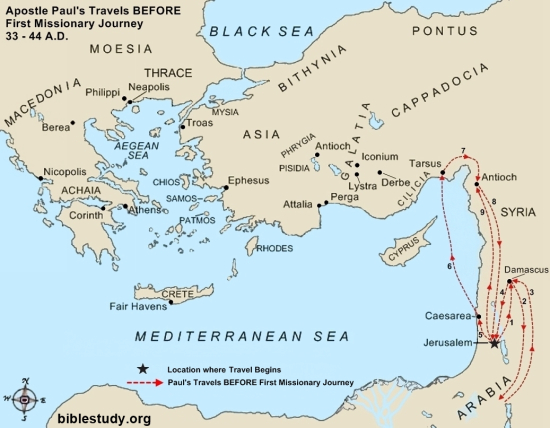
32 A.D. Martyrdom of Stephen in Jerusalem Stephen, whose Grecian name means "crown," is stoned for his testimony about Jesus (Acts 6-7). Stephen was one of the first deacons specially appointed by the early church to serve (Acts 6:1-6) and is considered the first Christian martyr. A young, zealous Saul (Paul) consents to and witnesses Stephen's death (Acts 7:58-8:1), after which he leads persecution against believers of Christ (Acts 8:1-4). | | | | #1 - 33 A.D. The Conversion of Saul of Tarsus Saul (Paul) receives written permission from the High Priest to search in Damascus' synagogues for those who believe Jesus is the Messiah. Saul is also given the authority to arrest and bring these believers to Jerusalem for trial and punishment. (Acts 9:1-2) Saul, accompanied by several others, travels to Damascus. As he approaches the city a burst of light suddenly appears and causes him to fall to the ground (Acts 9:3-4). He then hears the booming voice of Jesus saying: "Saul, Saul, why do you persecute me?" (Acts 9:4, NIV) Saul is struck blind and led into Damascus by his traveling companions. Three days later Jesus inspires a disciple named Ananias to visit Saul and heal him of his blindness. After he is healed Saul is baptized and receives God's Holy Spirit. (Acts 9:4-18) Saul (who is first referred to as Paul in Acts 13:9) stays in Damascus and powerfully preaches the gospel. After learning of the plot against his life, Paul flees the city at night by having Christians lower him down a gate wall using a basket! Once out of the city he travels to Arabia. | | | | #2 - Spring 33 A.D. to Spring 36 A.D. Paul taught in Arabia directly by Jesus Paul spends three years in Arabia being personally taught by Jesus Christ. "But I make known to you, brethren, that the gospel which was preached by me is not according to man. For I neither received it from man, nor was I taught it, BUT IT CAME THROUGH THE REVELATION OF JESUS CHRIST. . . " "But when it pleased God, who separated me from my mother’s womb and called me through His grace, to reveal His Son in me, that I might preach Him among the Gentiles, I did not immediately confer with flesh and blood, nor did I go up to Jerusalem to those who were apostles before me; BUT I WENT TO ARABIA, and returned again to Damascus. Then after three years I went up to Jerusalem to see Peter, and remained with him fifteen days." (Galatians 1:11-12, 15-18, NKJV unless otherwise stated)
| | | | #3 - Spring 36 A.D. Paul comes back to Damascus After three years in Arabia Paul journeys back to Damascus in the Spring of the year (Galatians 1:17). | | | | #4, #5, #6 - Spring to Summer 36 A.D. Paul's First Visit to Jerusalem after his Conversion Paul travels to Jerusalem and stays fifteen days (Acts 9:26, Galatians 1:18-19). Although Paul tries to get to know other converted people in Jerusalem, the brethren are suspicious of him and stay away (Acts 9:26). Barnabas, a disciple known for encouraging others, takes Paul to the apostles and personally vouches for his converted character (Acts 9:27). Paul (Saul) speaks boldly to Greek-speaking Jews about Jesus Christ. The Grecians reject his message, however, and seek to murder Paul (Acts 9:28-29). The brethren find out about the plot against Paul's life and escort him to Caesarea where they then send him back to Tarsus (Acts 9:30). | | | | Summer 36 A.D. to Summer 40 A.D. Paul stays home | | | | #7 - Summer 40 A.D. to Summer 41 A.D. Barnabas seeks Paul's help due to growth in Antioch church Brethren scattered because of Saul’s (Paul's) persecution (before his conversion) preach the Word of God to Jews as far away as Phoenicia, Cyprus and Antioch (Acts 11:19). Some converted men from Cyprus and Cyrene travel to Antioch in Syria and begin to speak to Grecians (non-Jews) concerning Jesus. God blesses their efforts and a great number of people become converted. (Acts 11:20-21). Word of the gospel's success in Antioch reaches Jerusalem. The Jerusalem church sends Barnabas to aid in the ministering to the new converts. When he arrives in Antioch he encourages the brethren to continue to grow as believers. (Acts 11:22-24). Because of the continued growth of the Antioch church Barnabas travels to Tarsus to seek Paul's help with teaching the newly converted Gentiles. Paul and Barnabas journey from Tarsus back to Antioch and stay in the city for an entire year (Acts 11:25-26). It is in Antioch that believers in Jesus as the Messiah are called Christians (Acts 11:26). The designation of believers as Christians occurs only three times in the New Testament (Acts 11:26, 26:28, 1Peter 4:16). | | | | Spring 42 A.D. A famine is prophesied to occur The prophet Agabus travels from Jerusalem to Antioch. In Antioch he prophesies that a three-year famine will soon occur (Acts 11:27-28). In response to the prophecy the disciples plant and prepare food and relief to send to the believers in Jerusalem (Acts 11:29). | | | | #8, #9 - Spring 44 A.D. Relief sent to Jerusalem by the hand of Paul and Barnabas Food and relief are sent to Jerusalem by the hands of Paul and Barnabas (Acts 11:30). After delivering relief Paul and Barnabas, along with John Mark, return to Antioch (Acts 12:25). | | | | | | | | | |
|