Magnificat Background
Elizabeth, the cousin of Mary (Jesus' future mother), is miraculously healed of being barren. God heals her for the express purpose of enabling, with her husband Zacharias, the conception of John of Baptist in early June of 6 B.C. (Luke 1:5 - 25). Six months later Jesus is miraculous conceived in Mary's womb (Luke 1:30 - 31, 35, 38).
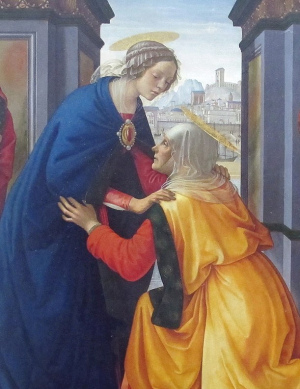
Mary, after learning her cousin is pregnant, rushes to visit her in late November or early December of 6 B.C. (Luke 1:36, 39 - 40). When Elizabeth hears her voice the baby in her womb leaps for joy (v. 41)! Mary then begins what is called her Magnificat, which runs from verse 46 to 55, after being praised for her faith (v. 45).
The Name
The Magnificat takes its name from a verse in the Vulgate Bible. The Vulgate, created at the behest of the pope, is a late 4th century A.D. translation of Scripture into Latin. Most of the work to create this version of God's word was carried out by a theologian named Jerome.
The word Magnificat is the first word listed, in Latin, of what Mary began to speak to Elizabeth starting in Luke 1:46.
et ait Maria ("And Mary said") magnificat anima mea Dominum ("My soul magnifies the Lord") (Luke 1:46, Vulgate).
The Magnificat is also referenced as the Canticle (or Song) of Mary.
References and Allusions
Mary's Magnificat is amazing because, even though she was quite young at the time (possibly only a few years past puberty), she references many Old Testament verses. Below is a list of the verses spoken by Mary along with one or two (of usually many) passage(s) she is alluding to or referencing.
Magnifying God
Then Mary said, "My soul magnifies the Lord, and my spirit has exulted in God my Savior" (Luke 1:46 - 47, HBFV unless stated).
My soul shall make its boast in the Lord; the humble shall hear and be glad. O magnify the Lord with me, and let us exalt His name together (Psalm 34:2 - 3, see also 35:9 and Isaiah 12:2 - 3).
Mercy Toward the Humble
"For He has looked upon the humble estate of His handmaid; for behold, from this time forward all generations shall count me blessed." (Luke 1:48).
Who remembered us in our low estate, for His mercy endures forever (Psalm 136:23, see also 138:6).
God's Greatness in Love
"Because the Mighty One has done great things to me, and holy is His name; And His mercy is toward those who fear Him, from generation to generation.' (Luke 1:49 - 50).
And Your righteousness, O God, is very high, You Who have done great things. O God, who is like You? (Psalm 71:19, see also 126:3).
But showing mercy to thousands of those who love Me and keep My commandments (Exodus 20:6, see also Psalm 103:17).
Humbling the Haughty
"He has worked strength with His arm; He has scattered the haughty in the imagination of their hearts. He has put down rulers from thrones, and has exalted the lowly." (Luke 1:51 - 52).
Your right hand, O Lord, has become glorious in power. Your right hand, O Lord, has shattered the enemy in pieces (Exodus 15:6).
The Lord takes away, and He gives riches; He brings low; yea, He lifts up high. He raises up the poor out of the dust; He lifts up the needy from the dunghill to set them among princes; yea, He causes them to inherit a throne of honor . . . (1Samuel 2:7 - 8).
Filling the Empty
"He has filled the hungry with good things, and the rich He has sent away empty." (Luke 1:53).
For He satisfies the thirsty soul and fills the hungry soul with good things (Psalm 107:9).
Mercy to Israel and Abraham
"He has helped His servant Israel, in remembering His mercy, exactly as He spoke to our fathers, to Abraham and to his seed forever." (Luke 1:54 - 55).
He has remembered His steadfast love and His faithfulness toward the house of Israel; all the ends of the earth have seen the salvation of our God (Psalm 98:3).
O you seed of Abraham His servant, you children of Jacob His chosen. He is the Lord our God . . . He has remembered His covenant forever, the word which He commanded to a thousand generations; The covenant which He made with Abraham . . . and to Israel for an everlasting covenant . . . (Psalm 105:6 - 7, 8 - 10, see also Genesis 12:1 - 3).
Conclusion
Mary, like many others (Luke 2:25, 38, Matthew 2:1 - 2), looked forward to and rejoiced at the long-awaited appearance of the Messiah. The Magnificat is her response to the mercy and love God lavished on her and through her to all humans.
"It is an ecstasy of praise for the inestimable favor bestowed by God on the Virgin, for the mercies shown to Israel, and for the fulfillment of the promises made to Abraham and to the patriarchs." (1913 Catholic Encyclopedia article on the Magnificat).