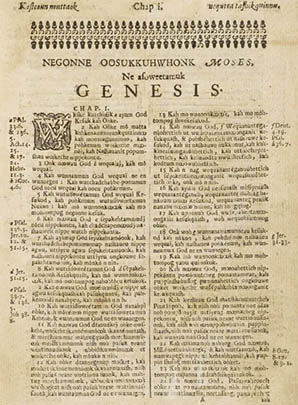
"However, Jerome did not wholly follow the inspired order of the books according to the final canonization by the high priest Ezra and the Great Assembly, and preserved by the Aaronic/Levitical priesthood — the TRUE custodians of the Old Testament. Instead, he chose to follow the order found in the Septuagint, an early Greek translation of the third century B.C." (The Holy Bible in Its Original Order, Second Edition, page 1)
The below division of the Bible was taken from The Holy Bible in Its Original Order, Second Edition. | OLD TESTAMENT | | | DIVISION ONE | DIVISION TWO | DIVISION THREE | THE LAW Genesis, Exodus, Leviticus, Numbers, Deuteronomy | THE PROPHETS Former Prophets (one book) Joshua, Judges | THE WRITINGS Psalms, Proverbs, Job, Song of Solomon, Ruth, Lamentations, Ecclesiastes, Esther, Daniel | | | Book of the Kingdoms (one book) 1Samuel, 2Samuel, 1Kings, 2Kings | Ezra, Nehemiah (one book) 1Chronicles, 2Chronicles (one book) | | | The Latter or Major Prophets Isaiah, Jeremiah, Ezekiel | | | | Minor Prophets (one book) Hosea, Joel, Amos, Obadiah, Jonah, Micah, Nahum, Habakkuk, Zephaniah, Haggai, Zechariah, Malachi | | | | | What is the difference between MAJOR and MINOR prophets? | | | | The designation of a prophet's writings as MAJOR or MINOR is based on the length of their book in relation to other Old Testament prophetic writings.
The MAJOR prophets Isaiah, Jeremiah and Ezekiel have sixty-six (66), fifty-two (52) and forty-eight (48) chapters, respectively. The writings of these prophets are significantly longer than those of the MINOR Prophets, whose two largest books, Hosea and Zechariah, each have only fourteen (14) chapters. | | |
No less than Jesus HIMSELF confirms that there were three main sections of the Old Testament: "Then He said to them, 'These are the words which I spoke to you while I was still with you, that all things must be fulfilled which were written in the LAW of Moses and the PROPHETS and the PSALMS (or Writings) concerning Me.'" (Luke 24:44)
After centuries of copies have ERRORS crept into the Old Testament text? Skeptics have pointed out that the oldest extant version of the Old Testament is less than 1,500 years old. They state that, after centuries of copies, errors HAD to have crept into the original language text used to create a Bible translation. This point is well taken. The argument reminds one of the game where about twenty children sit, in a circle. The first one whispers a sentence into the ear of the second child. The second child whispers the same message into the ear of the third child. The message is whispered all the way around the circle. By the time it reaches the ear of the last child, it is usually a totally different message than what came out of the mouth of the first child. The accurate preservation of the Bible should be a concern for all Christians. It is important to understand that the copying methods used in reproducing the Bible were computer-like in their accuracy. Notice the beginning of the history of Biblical preservation: "So it was, when Moses had completed writing the words of this law in a book, when they were finished, that Moses commanded the Levites, who bore the ark of the covenant of the Lord, saying: 'Take this Book of the Law, and put it beside the ark of the covenant of the Lord your God, that it may be there as a witness against you . . .' " (Deuteronomy 31:24-26, NKJV throughout). Here we see the beginning of the sacred trust given to the Levites to safeguard the Scriptures. The "writing of words" referred to here are the first five books of the Bible: Genesis, Exodus, Leviticus, Numbers, and Deuteronomy, which as a group are also known as the Law, Pentateuch (Greek) or Torah (Hebrew). From that time forward, the religious leaders of Israel became the zealous guardians of the Scriptures. Later, after the Babylonian captivity of Judah, these Scriptures were practically worshipped as much as was the Creator Himself. It could be said that the love that the Jews had for the Law was tantamount to idolatry! They watched over these Sacred Writings more carefully than any other possession in the Holy Land. Joshua, Moses' successor, also instructed the Israelites to have a special concern for "all the words of the law" (Joshua 8:34). He told the people to sit down as the Law was read to them. This reading probably took several days because the Torah was a lengthy volume. As a side note, many people assume that Paul wrote more of the Bible than any other servant of God. Actually, Paul wrote more books than anyone else, but Moses wrote more in terms of volume. Each of Moses' five books are much longer than any of Paul's smaller books. All in all, Moses wrote about three times as much material as Paul. In the time of Joshua, the entirety of the Torah was read to the children of Israel. A great reverence for the Scripture had developed within one generation after the Exodus. We also see that the Levites were not the only ones involved in preserving the Scriptures. God knew that the day would come when His people would reject Him as their king and that they would insist on having a human king (Deuteronomy 17:14-15). God knew a human king over Israel was inevitable, and gave Israel instructions on what the new king should do: "Also it shall be, when he sits on the throne of his kingdom, that he shall WRITE FOR HIMSELF a copy of this law in a book, from the one before the priests, the Levites. And it shall be with him, and he shall read it all the days of his life, that he may learn to fear the Lord his God and be careful to observe all the words of this law and these statutes . . . " (Deuteronomy 17:18-19). The kings of Israel not only had to study and obey the Law, they also had to write THEIR OWN personal copies of that Law! How were EXACT hand-written copies of the Bible made POSSIBLE? Israel's reverence of God's word brought the creation of a copying system which is nothing less than astounding! The Levites had to create a system of making new copies of the Bible as old copies wore out and had to be destroyed. They knew it would be easy to make a mistake in copying a new transcript, so here is what they did. They developed elaborate and meticulous RULES for transcribing. They decreed that when a person was making a new text, he had to copy the original page with such exactness that the number of words on a page could not be changed. If the original page had 288 words, then the page being copied had to have the same 288 words. Each line on a new page had to be the exact same as the line on the old page. If the first line on the original page had nine words, the first line on the copy page had to have nine words. After a page was copied, the number of letters on that page was counted and compared with the original. After a page was copied, each letter was counted and compared with the original. After a page was copied, someone would check to see what the middle letter was on the copy and the original: "A synagogue roll [remember that they did not have paper as we do today] must be written on the skins of clean animals, the length of each column must not extend less than 48 or more than 80 lines; the breadth must consist of 30 letters. No word or letter, not even a yod, must be written from memory... Between every consonant the space of a hair or thread must intervene, between every book three lines. Besides this the copyist must sit in full Jewish dress, and wash his whole body" (The Hebrew text of the Old Testament, Davidson). The scribes were not allowed to copy sentence for sentence or even word for word. They had to copy LETTER for LETTER. After a page was copied and checked by another, still a third person would check to see what the middle word was on the page. Then, when the whole book was finished, another would count the phrases. These are just a few examples of the great detail that went into ensuring the accuracy of the Scriptures. There were many more steps taken in the process. All of this could be characterized as a: "fence to the Scriptures (Massorah) because it locked all words and letters in their places... It records the number of times the several letters occur in the various books of the Bible; the number of words, and the middle word; the number of verses, and the middle verse; the number of expressions and combinations of words, etc... All this ...for the set purpose of safeguarding the Sacred Text, and preventing the loss or misplacement of a single letter or word" (Bullinger's Companion Bible). These men had no worry whatsoever that there might have been an error. For that reason, they felt no more need to keep their older copies than a data processing manager feels a need to keep his older printouts when he knows his current hard copies are accurate. What was the role of the SCRIBES? The ancient Israelites kept a copy of the Scriptures in Jerusalem's first temple. They put it inside the Ark of the Covenant. This copy became known as "The Temple Scriptures." Today we would call this copy Israel's master copy of God's word. Even though the first temple was destroyed and the Jews were taken to Babylon, the Scriptures were preserved. In the Babylonian captivity a group of Levites who became known as the Scribes painstakingly copied and disseminated the Scriptures to other Jews. One of the most pivotal historical figures during this time was Ezra. It was Ezra the priest, assisted by the priests and Levites of the Great Assembly or Synagogue, that completed the final editing and canonization of the Old Testament Scriptures in the late fifth century B.C. (Holy Bible in Its Original Order, page 4) After the Jews returned to Palestine, the Scribes continued to take an active part in preserving and distributing the Scriptures. When the second temple was built, another master copy was put in the Holy Place. By the time Jesus was born, the Scribes had become so obsessed with counting the jots and tittles that they forgot the very messages that were in the sentences they were transcribing! Their obsession with detail caused Christ to say, "Woe to you, scribes and Pharisees, hypocrites! For you pay tithe of mint and anise and cummin, and have neglected the weightier matters of the law: justice and mercy and faith. These you ought to have done, without leaving the others undone. " (Matthew 23:23).
Even after the destruction of Jerusalem in 70 A.D. the Scribes continued their work. Has the Old Testament been accurately preserved for us today? ABSOLUTELY! Jack Finegan, a noted Bible scholar said, "It has been ...estimated that there are ...variations in hardly more than a 1000th part, of the text." This means the Old Testament is at least 99.9% true to the original! Do we have the RIGHT books in the Old Testament? To find our answer, we begin by noting that we do not have to research all the way back to the nation of Israel, the original authors, and the preservers of the text. We only have to go back to the time of Jesus. If the Jews during the time of Christ's earthly ministry were using the wrong books, He would have mentioned it and the Gospel writers would have recorded it. But as we pointed out earlier, Luke 24:44 puts Jesus' stamp of approval on the Old Testament that was utilized by the Jews of His time. Jesus made many references to Old Testament events. He talked about the Creation epic and the Flood. He talked about, men such as Abel, Abraham, Moses, David, Solomon and others. He talked about the destruction of Sodom and Gomorrah. Christ had no problem whatsoever with the Old Testament canon that existed in His time and which was continued long after his death. What about the APOCRYPHA? The word "Apocrypha" comes from the Greek word meaning "secrets." The Apocrypha itself is a set of books found mostly in Catholic Bibles and a few others. There are fourteen (14) total apocryphal books such as Baruch, Judith, Tobit, 1 & 2 Maccabees and others. Most of the books that compose the Apocrypha are MYSTERY books that were written between 200 to 100 B.C. This means they were written at least a couple of hundred years after Ezra finalized the canon of the Old Testament. Virtually all of the Old Testament was written by Israelites who lived in Palestine. The Apocrypha, however, appears to have been written by Jews in Alexandria, Egypt. This city had a large Jewish colony before the birth of Jesus. In conclusion: God's Word is True! God insured that the Old Testament would be preserved. No English translation, however, is perfect. For this reason, we should look at several translations when we have difficulty in understanding a particular verse. It is these scriptures that the apostle Paul was referring to when he wrote to Timothy: "All Scripture is given by inspiration of God, and is profitable for doctrine, for reproof, for correction, for instruction in righteousness, that the man of God may be COMPLETE, thoroughly equipped for every good work." (2Timothy 3:16). |