Herod the Great Born
c. 72 B.C.
Herod the Great is born to Antipater I the Idumaean (which means 'from the land of Edom'), who is the founder of the Herodian dynasty of rule.
Pompey Occupies Palestine
63 B.C.
Roman troops, led by Pompey, occupy Palestine in the name of the Roman Republic. The empire conquers Jerusalem and she falls.
Great Civil War
49 B.C.
A contention between Pompey and Julius Caesar over the leadership of the Roman state leads to what is known as the Great Roman Civil War.
Pompey Murdered
48 B.C.
Pompey, who fled to Egypt after his defeat by Caesar in the Battle of Pharsalus, is murdered by an officer of King Ptolemy XIII.
Herod Made Governor
47 B.C.
Julius Caesar appoints Antipater I the Idumaean to be procurator of Judea in recognition of the aid he gave him during Rome's civil war. Antipater is also given the right to collect taxes. He makes his son Herod governor of Galilee.
Caesar Assassinated
44 B.C.
Julius Caesar is assassinated on March 15th (commonly known as the Ides of March).
Antipater Murdered
43 B.C.
Antipater I is murdered by poison.
Herod Becomes Tetrarch
41 B.C.
Mark (Marc) Antony elevates Herod the Great to the rank of tetrarch of Jerusalem and Galilee.
King of the Jews
40 B.C.
Herod is appointed, in Rome, as King of Judea ("King of the Jews") by the Roman Senate.
Herod Conquers Jerusalem
37 B.C.
Although appointed King of Judea in 40 B.C., it takes another three years before Herod and his army travel to Palestine and take Jerusalem. He eventually becomes sole ruler of Judea.
Aristobulus Born
31 B.C.
Aristobulus IV (31 to 7 B.C.), son of Herod and his second wife Mariamne, is born.
End of Republic
27 B.C.
End of the Roman Republic. Augustus Caesar becomes Roman Emperor.
Archelaus Born
23 B.C.
Herod Archelaus is born.
Antipas Born
before 20 B.C.
Herod Antipas is born.
Rebuilding Temple Begins
20 B.C.
Herod the Great, desirous of gaining the favor of the Jews, begins work to restore and expand Jerusalem's temple, which had laid unfinished for about five hundred years.
Agrippa I Born
10 B.C.
Agrippa I (known as Herod Agrippa in the New Testament) is born.
Herod Dies
c. 4 B.C.
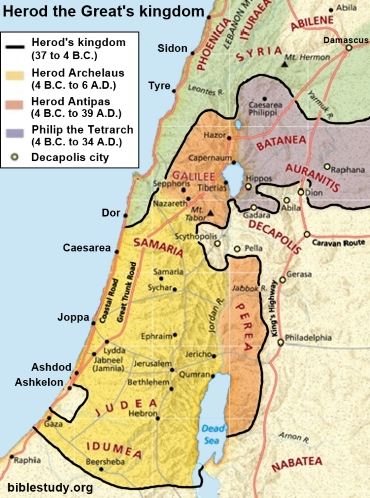
Herod the Great dies in Jericho and is buried in Herodium, Judea. Roman Emperor Augustus, after his death, divides his kingdom among some of his sons.
Herod Archelaus is made Ethnarch (a title of rule that is less than a king) of Samaria, Idumea (Edom) and a large part of Palestine. He rules from 4 B.C. to 6 A.D. when the Judea province is formed and put under direct Roman rule. Archelaus lives until c. 18 A.D.
Herod Antipas is made tetrarch of Galilee and Perea. He rules from 4 B.C. to 39 A.D. He not only arrested and beheaded John the Baptist but also played a part in the crucifixion of Jesus.
Philip the Tetrarch (often referred to as Herod Philip II) is given the northeast part of his father's kingdom, which includes Batanea, Auranitis and Trachonitis. He rules from 4 B.C. to 34 A.D.
Agrippa II Born
27 / 28 A.D.
Agrippa II, son of Agrippa I and great-grandson to Herod the Great, is born.
Agrippa I Made Tetrarch
39 A.D.
After Antipas' death in Gaul, Agrippa I is made ruler over Galilee and Perea as Roman tetrarch.
Apostle James Murdered
44 A.D.
Agrippa I beheads the apostle James and has Peter arrested. Soon after this event, God sends the angel of the Lord to kill him (Acts 12).
Agrippa II Made Tetrarch
48 A.D.
Herod of Chalcis, brother of Agrippa I, dies. He was tetrarch of Chalcis (a kingdom north of Judea) for an unknown period. In his place, Herod Agrippa II is made tetrarch of Chalcis. Although forced to give up Chalcis in 53 A.D. he is made king of Batanea, Trachonitis and other areas by Emperor Claudius.
Temple Work Completes
65 A.D.
Work on Jerusalem's second temple is finally completed.
Rome Destroys Jerusalem
70 A.D.
Roman legions, under the command of military commander Titus (later Emperor Titus), destroy Jerusalem and set fire to its temple.
Herodian Dynasty Ends
c. 92 A.D.
Herod Agrippa II dies. He is the last of the Herodian dynasty to rule.