Big and Strong
We need to first cover how big and strong was Goliath the Giant who challenged Israel and battled David. He was, of course, a giant, from the city of Gath. The Bible states he was six cubits and a span tall (1Samuel 17:4).
Various Bible commentaries place the length of a cubit anywhere from 43 centimeters to 53 centimeters. The length of a span is believed to have been around 23 centimeters. Goliath, the giant of Gath, was easily 2.8 meters tall and likely bigger!
And a bronze helmet was upon his head, and he was armed with scaled armor. And the weight of the coat was five thousand shekels of bronze.
And greaves of bronze were upon his legs, and a bronze javelin slung from is shoulders. And the staff of his spear was like a weaver’s beam. And his spear’s head weighed six hundred shekels of iron. And the shield bearer went in front of him. (1Samuel 17:5 - 7, HBFV throughout).
The protective coat worn by Goliath in his battle with David weighed at least 78 U.S. pounds (35.4 kilograms). Several commentaries place the weight of the coat at an amazing 156 U.S. pounds (70.8 kilograms)! The length of his spear may have been as long as 26 feet (7.9 meters). The head alone on his spear weighed at least 17 pounds U.S. (7.7 kilograms). He was a formidable opponent indeed!
Sons of a Giant
Our initial question assumes that David picked up five slingshot stones in order to fight Goliath and his four similarly gigantic brothers. Now we know from 2Samuel 21 that there were at least four other Philistine giants. The King James, and other Biblical translations, uses the phrase "sons of the giant" to refer to those produced by a large man. There is an interesting translation issue, however, in this chapter in that the term translated "the giant," in the plural, can mean "Rephaim."
And Ishbi-Benob, who was of the sons of the giant [rapha or rephaim, Strong's Concordance #H7498] (the weight of whose spear was three hundred shekels of bronze), being girded with a new sword, thought to kill David. But Abishai the son of Zeruiah came to his aid and struck the Philistine, and killed him . . .
Now it came to pass after this there was again a battle with the Philistines at Gob. Then Sibbechai the Hushathite killed Saph, who was of the sons of the giant (rapha or rephaim) . . .
And there was again a battle with the Philistines in Gob, where Elhanan of Bethlehem, the son of Jaare-Oregim, killed one of the sons of Goliath the Gittite . . .
And there was yet again a battle in Gath. And there was a man of stature who had six fingers on each hand, and six toes on each foot, twenty-four in number. And he also was born to the giant (rapha or rephaim). . . (2Samuel 21:16, 18 - 20).
The Rephaim was a race or breed of giants, such as Og, the king of Bashan, who had a bedstead of about 13 1/2 feet in length and 6 feet wide (Deuteronomy 3:3, 11; cf. Joshua 12:4). Although one of the four other Philistine giants mentioned above was the brother of Goliath, the others are not clearly said to be.
And there was war again with the Philistines. And Elhanan the son of Jair killed Lahmi the brother of Goliath the Gittite, whose spear was like a weaver's beam. (1Chronicles 20:5).
Scripture additionally does not reveal how many total brothers Goliath had.
Another giant race in the Bible are called the Anakim (Numbers 13:28, 32 - 33), but it does not appear they were related to the Philistines whom David fought.
A Wise Choice
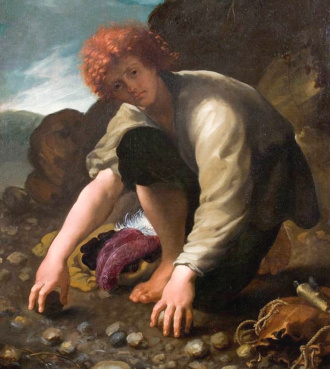
What is interesting, from the viewpoint of faith, is that David took five stones (1Samuel 17:40), not just one, despite believing in God and His protection. He prudently planned that it might take more than one stone to kill the giant man, much as Jacob carefully prepared before encountering his brother Esau (Genesis 32 - 33).
David also wisely chose smooth stones in order to maximize their accuracy and minimize their resistance to the air. Other shapes of stones would have traveled through the air slower and less accurately.
In conclusion, young King David fought only a single giant, Goliath, in the famous Biblical confrontation of 1Samuel 17. Later in his life, however, He would fight the physically large and powerful Philistines on many occasions.