God did not initially inspire the division of the Bible (the Old Testament at the very minimum) into sections such as chapters and verses. The ancient, original manuscripts in Hebrew (and Greek for the New Testament), from which was produced the modern English Bible, simply did not contain such edits.
The First Attempt
The first person believed to have attempted to divide Scripture is Cardinal Hugo de Sancto Caro, whose efforts took place from 1244 to 1248 A.D. The Cardinal's division of the Bible occurred while he was creating a Latin Vulgate concordance to aid in looking up scriptures.
Our modern division of Bible chapters, however, is credited to Stephen Langton (c. 1150 - 1228 A.D.), an Archbishop in Canterbury, England. He started his editing work around 1227.
Division by Verses
As for the division of the Bible into verses, one Jewish teacher, Mordecai Nathan, divided the Old Testament manuscripts in such a fashion beginning in 1445 A.D. Robert Estienne was a 16th century printer living in Paris, France. He is credited as being the first person to print copies of the New Testament using the numbering system for Bible verses we are familiar with today.
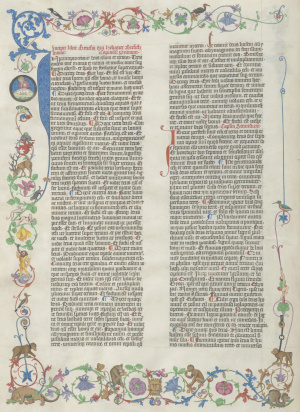
Since the time of the Geneva translation (an English version published in Paris, 1560), which preceded the famous 1611 King James translation, nearly all Bibles have used the same numbering system.
Misleading
The division and numbering system found in almost all modern Bibles works well most of the time. Sometimes, however, verses are not accurately divided or punctuated, leading to misunderstandings among those who study Scripture. An interesting case in point appears in the book of Revelation chapter 20.
But the rest of the dead did not live again until the thousand years were finished. This is the first resurrection (Revelation 20:5, King James Bible).
The resurrection that occurs at the end of the Millennium is the second resurrection, while the first (general) resurrection occurs when Jesus returns at the beginning of the millennium (see verses 6, 11 - 13). Using the King James Bible division of verses, it be would doctrinally accurate to put parenthesis around a part of verse five to offset it from the rest as shown below.
(But the rest of the dead did not live again until the thousand years were completed.) This is the first resurrection (Revelation 20:5, HBFV).
Another Errorneous Division
Another interesting case of an erroneous division of the Bible occurs in Genesis 2:1 - 3. These verses discuss how the Sabbath day was created. Since these three verses continue the rhythmic pattern of Genesis 1's description of the first six days, chapter 2 of Genesis should have started after these three verses.
Thus the heavens and the earth were finished, and all the host of them. And on the seventh day God ended his work which he had made; and he rested on the seventh day from all his work which he had made.
And God blessed the seventh day, and sanctified it: because that in it he had rested from all his work which God created and made. (Genesis 2:1 - 3, KJV).
Students of the Bible need to be aware that the chapter and verse system, found in modern translations, were not placed there by the authors. This division can be a distraction in some cases, or cause readers to separate thoughts or ideas that were not originally separate when the inspired writers wrote their books.