What is Prodigal?
The parable of the prodigal son is only recorded in the book of Luke (Luke 15:11 - 32). It was given in early 30 A.D., a relatively brief time before the crucifixion would take place. It is the fifth in a series of parables Jesus spoke which began in Luke 14:8.
It should be noted that the word "prodigal" is not found in the King James or other major Bible translations. The word itself did not originate in the English language until around 1500 A.D. (dictionary.com).
The phrase "prodigal son" sometimes appears as a section heading in some Bibles. Some modern translations (e.g. Holman Christian Standard, NIV, etc.) label this section as the "Parable of the Lost Son" perhaps due, in part, to most people today not knowing what "prodigal" means! The word itself is defined as referring to someone who recklessly spends money hot and fast without any concern about what will happen when it is gone.
The Context
Jesus' prodigal story was in response to the self-righteous Pharisees and scribes (Luke 15:1 - 2) who sought to criticize his behavior of accepting and eating with sinners.
Now all the tax collectors and the sinners were drawing near to hear Him (Jesus); And the Pharisees and the scribes criticized Him, saying, "This Man welcomes sinners and eats with them" (Luke 15:1 - 2, HBFV throughout).
The Story
In ancient Israel, each male child expected to inherit a part of the father's possessions upon his death. The firstborn usually received a double portion, while what was given to younger male heirs varied. In this parable, the prodigal son made the unusual request to receive his inheritance early. His father acquiesces and gives him the part due him while the firstborn would someday be given the remaining wealth (Luke 15:31).
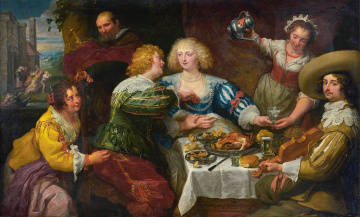
The youngest son, after receiving his inheritance, uses it foolishly to fulfill his carnal desires. He squanders what he receives on indulging himself in prostitutes and partying (Luke 15:13, 30).
After some humbling experiences, the young man comes to his senses and returns home. His father, much to his surprise, accepts him back with open arms and throws a party to celebrate his return.
The prodigal's older brother hears noise coming from his father’s house and, after discovering a party was being held for his foolish brother, becomes incredibly angry. He refuses to go near the celebration. His father then entreats him about his attitude (Luke 15:31).
Symbolism
The prodigal son symbolizes sinners in general who, after living a riotous life, realize that they have done wrong.
The father in this prodigal story is Jesus. He, like the Lord, was willing to extend mercy and offer a relationship to those who sinned but later came back to him. The attitude of rejoicing over even a single "lost" sinner who is found is perfectly illustrated in the two parables given by the Lord prior to this one.
Which man of you who has a hundred sheep, and has lost one of them, does not leave the ninety-nine in the wilderness and go after the one that is lost, searching until he finds it? And when he finds it, he lays it on his shoulders, rejoicing . . .
I tell you that likewise, there shall be joy in heaven over one sinner who repents . . . (Luke 15:4 - 5, 7, see also verses 8 - 10).
The prodigal's older brother symbolizes the Jewish religious leaders who were critical of Jesus and his ministry. They had, many times prior to 30 A.D., shown their disdain for him associating with sinners (everyone but themselves!) and outcasts (Matthew 9:11 - 13, 11:19, Mark 2:15 - 17, etc.).
The brother, like the religious leaders, believed he was superior to others and despised them since (in his mind) he was always obedient. Both the brother of the prodigal son and the Jewish leaders felt those they looked down upon as sinners were unworthy of mercy no matter what they did.