Background
The camel through the eye of a needle parable was given by Jesus in 30 A.D. just a brief time before his final Passover and death. His somewhat humorous comparison is mentioned in three of the four gospel accounts (Matthew 19:23 - 26, Mark 10:23 - 27, Luke 18:24 - 27).
The context of the camel parable is that a rich young man approached Jesus and asked what it took to have eternal life.
Now at that time, one came to Him and said, "Good Master, what good thing shall I do, that I may have eternal life?" (Matthew 19:16).
Jesus' answer to the young man was to delineate several of the Ten Commandments (Matthew 19:18 - 19). The man answered that he had kept the commandments since he was young. He then asked what he still seemed to lack. The answer he received was meant to test him, to see if he was willing to give up everything to follow Christ as the twelve disciples were required to do.
Jesus said to him, "If you desire to be perfect, go and sell your property, and give to the poor, and you shall have treasure in heaven; and come and follow Me." (Matthew 19:21).
After hearing the Lord's answer the rich man went away very sad. The Bible then gives us the camel through the eye of the needle parable.
Then Jesus said to His disciples, "Truly I say to you, it is extremely difficult for a rich man to enter into the kingdom of heaven. And again I say to you, it is easier for a camel to pass through the eye of a needle than for a rich man to enter into the kingdom of God" (Matthew 19:23 - 24, HBFV).
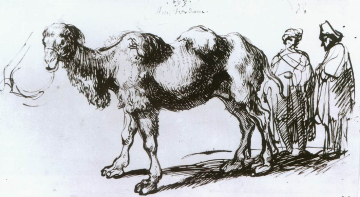
Why Use a Camel?
There are a few possible explanations for what Jesus meant by his analogy using a camel. Some claim there existed somewhere in Jerusalem's city wall a narrow gate known as the "eye of the needle." The explanation is that such a small gate made it impossible for a fully loaded large animal to pass through it. The animal would have either to be fully unloaded or walk on its knees to traverse the opening.
The major problem with the above explanation is that archaeologists and other scholars have never found evidence of such an opening used by such tall beasts or reference to a gate referred to as the eye of the needle.
Several Bible commentaries have noted the Aramaic word for camel is nearly identical to the word used for rope. Some believe that when the New Testament's original scrolls were translated into Greek an error in translation may have occurred. The correct translation, based on such an assumption, would be "it is easier for a ROPE to pass through . . ."
Some of these commentaries also say the words "eye of a needle" refers to the small opening of the tool used to sew clothes and other things together. Trying to pass rope through such a small opening would certainly prove difficult!
A third possible, and likely, explanation is that Jesus was simply using a commonly used saying to underscore the spiritual situation of those who are rich. It is another way of saying it is as difficult for the wealthy to do what it takes to be saved as it is for an animal the size of a camel to pass through a needle opening.
Who Can be Saved?
When the disciples heard Jesus' analogy of a "camel through the eye of the needle," they responded with astonishment and wondered about its meaning. They then asked, "Who then is able to be saved?" (Matthew 19:25). Jesus' response was the following.
But Jesus looked at them and said, "With men this is impossible; but with God all things are possible." (Matthew 19:26).
Why would the disciples be amazed it was hard for a rich person to enter the Kingdom? It was because it was commonly believed that material wealth was a sign that a person obeyed and pleased God. Jesus' parable of the camel and the eye of the needle refuted this common assumption.
Jesus' statement in Matthew 19:26 says it was impossible for rich people, of themselves, to enter God's Kingdom. They can, however, do so with God's help. Old Testament examples of this include wealthy and faithful men like Abraham (Genesis 13:2), Isaac (Genesis 26:12 - 14), Jacob (Genesis 30:43), Job (Job 42:10 - 12) and others.