Why It Is Important
Understanding the real meaning behind the rich man and Lazarus parable is critical, as countless churches use it as their primary argument to justify the existence of an ever-burning Hell. The New Testament nowhere uses the "fires of Hell" or the threat of unending pain as a way of spreading the good news of the gospel!
A parable, like the rich man and Lazarus, is a short symbolic (but not literal) story designed to teach a principle or lesson. Parables are a teaching method that involves a comparison. They use situations, events and circumstances known to those being taught to convey a principle or meaning that is not understood.
In Jesus' case, he used parables to convey spiritual truths and, in the case of this story, as correction. By their very nature they are NOT to be taken literally true in every detail.
The Jewish Rabbis of Jesus’ day commonly used parables as teaching tools. This is in part why he used them to correct the Pharisees (self-righteous religious leaders) who were unjustly criticizing what he taught.
The Parable Begins
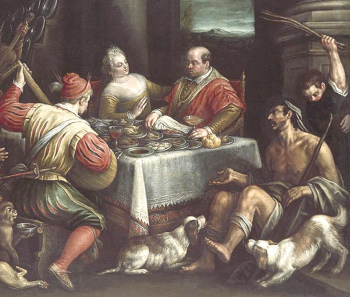
Now there was a certain rich man, and he was clothed in purple and fine linen, and daily indulged himself in luxury. And there was a certain poor man named Lazarus, who was laid at his porch, full of sores (Luke 16:19 - 20).
Why did Christ refer to this poor beggar as Lazarus? The meaning of his name is "assistance of God" or "whom God helps."
The Pharisees prided themselves on their righteousness through strict obedience to their interpretation of God's law. They also despised others, especially sinners and tax collectors (see Luke 18:9 - 14). The irony here is that those who believed they served and represented God would not help someone "whom God helps." They disdained someone whom God accepted.
This beggar was what we today would call a street person who had become terminally ill. He is portrayed as having no one that could or would help him - he was entirely on his own and had nothing. Note that he was so desperate that he wanted to eat (but did NOT get) the food scraps that fell on the floor (Luke 16:21).
Lazarus, because of the depth of his plight, was willing to eat food trash since the wealthy person of the parable would not help him at all. In stark contrast we have a rich man (symbolic of the Pharisees) whose house he is placed in front of. He, however, is so callused about the human condition that he won't even let the beggar eat his trash!
Now it came to pass that the poor man died, and he was carried away by the angels into Abraham's bosom. And the rich man also died and was buried (Luke 16:22).
In time both the beggar and the rich man die. The beggar is "helped by God" to Abraham while the well-off man is still buried and lies in his grave.
What Does It Not Say?
Now note what Luke 16:22 does NOT say! It does not say that the beggar went to heaven. It also does not say the rich man, upon death, was immediately tossed into some eternal Hell. The verse says the beggar is carried to "Abraham's bosom." But what does this phrase mean?
One of the many definitions of "bosom" is that it is symbolic of an intimate or close relationship. Lazarus is carried into a close relationship with Abraham (who symbolizes faith in God and salvation), which means he is allowed entrance into God's kingdom. Note also that it doesn't say when this event takes place!
An Erroneous Teaching
We now come to the verse that, because of a mistaken translation of one word, has led countless people to believe in a fiery Hell where sinners suffer forever!
The word translated in the NKJV, NASB, NRSV and other Bibles as "Hades" in verse 23 and "Hell" in the KJV and NIV translations comes from the Greek word hades (Strong's Concordance #G86). This Greek word is the exact equivalent of the Hebrew word sheol (#H7585). Both hades and sheol mean the grave, as the following translation shows.
"And in the GRAVE he lifted up his eyes and was in torment, for he saw Abraham afar off, and Lazarus in his bosom." (Luke 16:23, HBFV, see also Acts 2:27, Revelation 1:18, 20:13).
We also find proof in verse 23 that this parable is not meant to be taken literally in every detail. Both the rich man and Lazarus are shown to be alive after they died. If we were to take verse 22 and 23 literally, it would mean the resurrection of the dead has already taken place!
The Bible clearly says, however, the first resurrection of the dead is a yet future event that occurs after the Great Tribulation (see Revelation 20:4 - 6).
Why was the rich man tormented in the grave? It is because he saw a lake of fire before him and realized the time of his judgment before God has arrived. When is he brought back to life? In the second resurrection, which occurs during the Great White Throne judgment (Revelation 20:11 - 15).
Reaching Out to the Living
Next, we see the rich man trying to reach out to others. He feels lost himself, so at last, though he did not reach out to others before, he now sees this as his only possible last wish before he eternally dies. To think that he is taking in the whole scene and realizing where he is in time is not rational. In his thinking, a moment ago he had need of nothing. Now he is as good as dead, but believes his brothers are still alive. He wants to save them from this place, if possible (Luke 16:27 - 28).
They have Moses and the prophets; let them hear them (Luke 16:29).
In essence, what Jesus was saying to the Pharisees (through Abraham) is "you (Pharisees) have Moses and the prophets" and therefore have NO excuse for your approach to life and how you treat other people.
(the rich man then asks) But if someone were to rise from death and go to them, then they would turn from their sins. But Abraham said, 'If they will not listen to Moses and the prophets, they will not be convinced even if someone were to rise from death' (Luke 16:30 - 31).
Jesus ultimately reveals the meaning of the rich man and Lazarus parable. He was telling the Pharisees (who were self-righteous hypocrites) that since they did not believe and follow what Moses and the prophets wrote, no amount of miracles and wonders would be able to change their minds and alter how they lived life. It was the hardness of their hearts that kept them from truly repenting and serving God.