Occurrences in the Bible
The English word "crimson" appears only five times in the King James Bible translation, with all occurrences for the color coming from the Old Testament. It is found three times in 2Chronicles and once each in the books of Isaiah and Jeremiah.
There are three words from which the word "crimson" is derived in the King James. The first is karmity (Strong's Concordance #H3758) which means a deep red. The second word, tola (#H8438), refers to the maggot from which this color of dye is derived. The third and final word, shaniy (#H8144), is a direct reference to the color's name.
Background
Crimson has an HTML hex code of #DC143C. It is a color, on the visible spectrum, with a wavelength of approximately 627 nanometers.
The dried bodies of an insect named Kermes were historically used to create crimson. It was a costly pigment due to the labor required to collect and grind up the bugs. Over time the bodies of a different insect, the female cochineal, were used to extract a version of the color. Crimson was the firmest of dyes and not easily removed from cloth.

Biblical Symbolism
Crimson is associated with sin as found in Isaiah.
Come now, and let us reason together, saith the Lord: though your sins be as scarlet, they shall be as white as snow; though they be red like crimson (tola), they shall be as wool (Isaiah 1:18, KJV).
The color crimson also played an important role in the construction of Jerusalem's temple by King Solomon. It was a labor-intense pigment that represented great wealth.
When King Solomon began to plan for the building of God's temple in Jerusalem, he asked King Hiram of Tyre for help. Hiram had a friendly relationship with King David, a friendship that Solomon wished to continue (2Chronicles 2:3). Tyre at this time was famous for its dyes, dyeing industry and skilled craftsmen.
Send me (King Solomon) now therefore a man cunning to work in gold, and in silver, and in brass, and in iron, and in purple, and crimson (karmity), and blue, and that can skill to grave with the cunning men that are with me in Judah and in Jerusalem, whom David my father did provide.
Send me also cedar trees, fir trees, and algum trees, out of Lebanon: for I know that thy servants can skill to cut timber in Lebanon . . . (2Chronicles 2:7 - 8, KJV).
And he made the veil of blue, and purple, and crimson (karmity), and fine linen, and wrought cherubims thereon (2Chronicles 3:14, KJV).
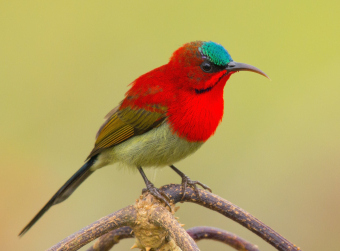
Crimson can also symbolize wealth and prosperity as seen in Jeremiah's prophecy concerning Judah and Jerusalem.
For thus has the Lord said, "The whole land shall be desolate, yet I will not make a full end. The earth shall mourn for this, and the heavens above shall be black because I have spoken, I have purposed it, and will not repent, nor will I turn back from it.
Every city shall flee from the sound of the horsemen and bowmen . . .
And you, O desolate one, what will you do? Though you dress with crimson (shaniy), though you put on ornaments of gold, though you make your eyes large with paint, you shall make yourself beautiful in vain; your lovers will despise you; they will seek your life. (Jeremiah 4:27 - 30).
More Info on Crimson
The vast majority of flags for modern nations do not use crimson. Nepal is one of the very few, if only, country which uses the color. Nepal also holds the distinction of having the only flag in the world that is not rectangular or square.
Some commentaries on God's word believe that that crimson and scarlet refer to the same thing in Scripture.

In Joshua 2:18, the Hebrew word translated as "scarlet" (Strong's #H8144) is the same one translated as "crimson" in Jeremiah 4:30. The word used in Joshua denotes the pigment of the cloth Rehab was to hang outside her window as a sign to the Israelites not to attack her house. The color can symbolize the worship of God (2Chronicles 2:7,14, 3:14, Jeremiah 4:30) or a person's sins (Isaiah 1:18).