Occurrences in the Bible
The English word "blue" appears 50 times in 49 King James translation verses. The related word "blueness" is found only once (Proverbs 20:30) for a total of 51 color occurrences in 50 verses.
Blue is found the most in the book of Exodus (34 times) followed by Numbers (6) and then a three-way tie with 2Chronicles, Esther and Ezekiel (three each). Surprisingly, the color blue is not mentioned at all in the King James New Testament.
Out of its 51 occurrences the word "blue" is translated 49 times from the Hebrew word tekeleth (Strong's Concordance #H8504). This word is in reference to the cerulean mussel from which the dye was obtained.
One occurrence of blue, in Esther 1:6, comes from shesh (Strong's #H8336) which can be used to refer to marble. The remaining appearance of the color, in Proverbs 20:30, is derived from chabburah (#H2250) used as a description of a wound.
Where were white, green, and blue (tekeleth), hangings, fastened with cords of fine linen and purple to silver rings and pillars of marble: the beds were of gold and silver, upon a pavement of red, and blue (shesh), and white, and black, marble. (Esther 1:6, KJV).
The blueness (chabburah) of a wound cleanseth away evil: so do stripes the inward parts of the belly. (Proverbs 20:30, KJV).

Background
Several Biblical commentaries state that, anciently, the liquid from which blue dye originated came from a shellfish native to the Mediterranean Sea. The possibility also exists it was extracted from the rind of pomegranates.
Blue pigments were also, at one time, derived from sources such as azurite, ultramarine, smalt, and indigo. Ultramarine was originally extracted from ground up lapis lazuli stones.
Blue has an HTML hex code of #0000FF. It is a color, on the visible spectrum, between green and violet, with a wavelength between 450 and 495 nanometers.
Blue is considered a primary color that can be mixed to produce a host of other ones depending on the application.
Red, yellow and blue (RYB) are considered traditional primaries in dyes, pigments, and paints. They can be mixed to make secondary colors such as orange, green, and purple.
Red, green and blue (RGB) are considered primary for displaying images on electronic devices such as televisions, computer screens and smartphones. Mixing these in equal amounts produces white light.
Biblical Symbolism
Blue can represent God or something dedicated to a holy purpose. This color is found extensively within Israel's wilderness tabernacle and later Jerusalem's temple (see 2Chronicles 2:7, 14).
God accepted offerings of blue, purple and scarlet (Exodus 25:4) from the Israelites. He then used them to make the curtains, curtain loops, the veil that separated the Holy of Holies from the rest of the sanctuary, and other pieces related to the construction of the wilderness tabernacle (see Exodus 25 - 27).
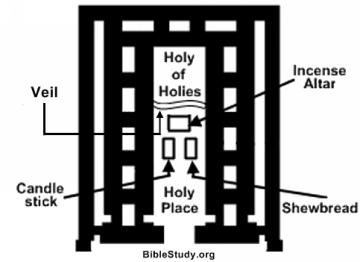
This color was additionally used to transport the tabernacle from one place to another.
And when the camp sets forth, Aaron and his sons shall come, and they shall take down the covering veil and cover the ark of testimony (ark of the covenant) with it. And they shall put on it the covering of tanned leather skins, and shall spread over it a cloth wholly of blue, and shall put in its staves.
And they shall spread a cloth of blue upon the table of showbread, and put the dishes on it, and the spoons, and the bowls, and the cups of the drink offering, and covers to cover it with . . . (Numbers 4:5 - 7).
Other holy tabernacle furniture such as lampstands, tongs, oil vessels, the golden altar and others (Numbers 4:9 - 12) were covered in blue when transported.
This color can symbolize royalty or a high rank.
And Mordecai went out from the presence of the king in royal clothing of blue and white, and with a great crown of gold, and with a garment of fine linen and purple. And the city of Shushan rejoiced and was glad. (Esther 8:15).
"They were clothed with purple, even their governors and rulers, all of them desirable young men, horsemen riding upon horses." (Ezekiel 23:6).
It can additionally symbolize riches, prosperity and great wealth.
Silver spread into plates is brought from Tarshish, and gold from Uphaz, the work of the workman, and of the hands of the founder: blue and purple is their clothing: they are all the work of cunning men. (Jeremiah 10:9, KJV).
Fine linen with broidered work from Egypt was that which thou spreadest forth to be thy sail; blue and purple from the isles of Elishah was that which covered thee.
The inhabitants of Zidon and Arvad were thy mariners: thy wise men, O Tyrus (Tyre), that were in thee, were thy pilots. (Ezekiel 27:7 - 8, KJV).
Blue can also convey service to God and godly living.
"Speak to the children of Israel and command them that they make fringes in the borders of their garments throughout their generations, and that they put upon the fringe of the borders a ribbon of blue." (Numbers 15:38).
More Info on Blue
Moses, Aaron, two of Aaron's sons, and the seventy elders of Israel went up Mount Sinai to worship God before he gave the Israelites the Ten Commandments in stone (Exodus 24). They not only saw God but also noticed that under his feet was some sort of pavement made of Sapphires.
And they (Moses, Aaron and the elders) saw the God of Israel. And there was under His feet as it were a paved work of a sapphire stone, and as it were the heavens in clearness. (Exodus 24:10).
Sapphires, one of the many gemstones mentioned in Scripture, is referenced nine times in God's word. The gem reflects the beautiful color of a blue sky.
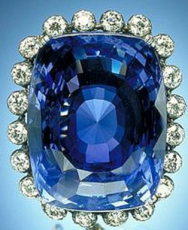
Sapphires are also found on the "breastplate of judgment" sometimes worn by the High Priest (Exodus 28:18). This blue colored gem was one of several that God personally placed as ornamentation on Lucifer when he created him (Ezekiel 28:13). This stone, according to the Bible, will soon be used to decorate one of the twelve foundations God will create for the New Jerusalem (Revelation 21:19).