Occurrences in the Bible
The English word "red" appears 51 times in 50 King James Bible verses. The word "reddish" for the color shows up another two times (Leviticus 13:49, 14:37) for 53 total appearances in 52 verses.
"And if the plague is greenish or reddish in the garment, or in an article of leather, either in the spun yarn or in the woven cloth, or in anything of leather, it is a plague of mold leprosy. And it shall be shown to the priest." (Leviticus 13:49).
Red is found the most in the book of Exodus (11) followed by Numbers and the Psalms (6 times each). The color makes a brief appearance in the New Testament, showing up six times with Matthew and Revelation each having two occurrences.
There are several Hebrew Old Testament words that are translated as the color red. The most frequently used words are adom (Strong's Concordance #H122), which is the color's name, and chakliyl (#H2447), which literally means "dark" or a person stimulated by wine. There is also suph (#H5488 and #H5489), which means "a reed" and is used to refer to the Red Sea, and adam (#H119), which means to show blood.

In the New Testament, the Greek words from which red are derived are purrhazo (#G4449), which refers to the color's name, and eruthros (#G2063), which is used to refer to a sea. There is additionally purrhos (#G4450) which references something that is the shade of fire or flame.
Background
Red has an HTML hex code of #FF0000. It is a color, on the visible spectrum, with the longest wavelength at between 625 to 750 nanometers.
Red is considered a primary color that can be mixed to produce a host of other ones depending on the application.
Red, yellow and blue (RYB) are considered traditional primary colors in dyes, pigments, and paints. They can be mixed to make secondary colors such as orange, green, and purple. Red, green and blue (RGB) are considered primary colors for displaying images on electronic devices such as televisions, computer screens and smartphones.
Red and reddish dyes can be produced from a wide variety of sources. The roots of the madder plant can produce this color, as well as the bodies of the cochineal insect. Red has also been retrieved from minerals such as iron oxide, red ochre and cinnabar.
Red lead, also known as lead tetroxide, is an artificially created compound that traces its use back to the ancient Greeks. This substance is toxic to humans.
Ancient Aztecs treated dyes in this coloration as more valuable as gold or silver, as it took hundreds of people to collect the female cochineal beetle from which it was made.
Biblical Symbolism
Red can symbolically refer to sin. It can also refer to the devil's rebellion, along with the deception and violence he has and will use to carry out his will.
"Come now, and let us reason together," says the Lord. "Though your sins are as scarlet, they shall be as white as snow; though they are red like crimson, they shall be like wool." (Isaiah 1:18).
And another sign was seen in heaven: and behold, a great red dragon (symbolic of Satan the devil), having seven heads and ten horns, and seven crowns on his heads . . .
And his (the devil's) tail swept away (deceived) a third of the stars of heaven (angels who turned themselves into demons), and cast them to the earth. And the dragon stood before the woman who was ready to deliver, so that he might devour her child when she gave birth. (Revelation 12:3 - 4).
The prophetic red horse of Revelation 6 symbolizes war and bloodshed. It will be unleashed on the entire world, in the end time, as a precursor to the dreaded Day of the Lord when God's wrath against sin is manifested.
And another horse went out that was red; and power was given to the one sitting on it to take peace from the earth, and to cause them to kill one another; and a great sword was given to him. (Revelation 6:4).
David's Hidden Reference
God, displeased with King Saul's disobedience, commanded the prophet Samuel to anoint a new king over Israel. Samuel was sent to Bethlehem to the house of Jesse to search for this ruler. After seven of Jesse's sons were rejected the eighth and youngest, David, was brought to the prophet.
And he sent, and brought him in. Now he (David) was ruddy, and withal of a beautiful countenance, and goodly to look to. And the Lord said, Arise, anoint him: for this is he. (1Samuel 16:12, KJV, see also 17:42).
What is "ruddy?" The word comes from the Hebrew admoniy (Strong's Concordance #H132) which refers to someone who possesses reddish hair or complexion. David, unlike many of his depictions in art, either had red skin or hair like Esau (Genesis 25:25)!
The Red Heifer
God commanded ancient Israel to use the ashes of a red heifer for the ceremonial cleansing of the tabernacle in the wilderness.
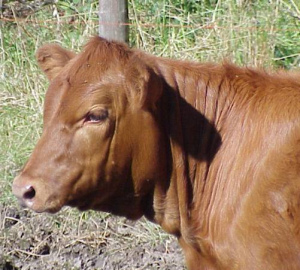
"This is the ordinance of the law which the Lord has commanded, saying, 'Speak to the children of Israel that they bring you a red heifer, a perfect one, in which there is no blemish, on which no yoke ever came . . .
" ' And Eleazar the priest shall take some of her blood with his finger and sprinkle some of her blood directly toward the tabernacle of the congregation seven times.'" (Numbers 19:2, 4).
The New Testament seems to indicate that some sort of altar or temple (with sacrifices?) in Jerusalem will exist in the End Time before the return of Christ (Mark 13:14, Matthew 24:15, 2Thessalonians 2:3 - 4).
Some Christians and orthodox Jews would like to see a third temple built in Jerusalem. If and when such a building is erected, however, the belief is it would first need cleansing by the ashes of a red heifer before it could be used.
The Red Sea
The Red Sea is mentioned by name 28 times in 28 KJV verses. It is a body of water that lies between the African continent (modern Egypt, Sudan, Eritrea, and Djibouti) and the Arabian Peninsula (Saudi Arabia and Yemen). Its length is about 1,400 miles, with a maximum width of about 220 miles, and is the most northern sea on the planet that is tropical.
Egypt's Pharaoh was angry and foolish enough to chase the fleeing Israelites as they miraculously crossed the Sea dry shod. When the last Israelite made it to the other side, God caused its waters to return to normal, thus drowning Pharaoh's entire army.
Pharaoh’s chariots and his army He has thrown into the sea; his chosen captains also are drowned in the Red Sea. (Exodus 15:4).
This one (Moses) led them out, after working wonders and signs in the land of Egypt and in the Red Sea, and in the wilderness for forty years. (Acts 7:36).
By faith Moses, after becoming a great leader, refused to be called the son of Pharaoh’s daughter . . .
By faith they (Moses and the Israelites) passed through the Red Sea as through a dry land in which the Egyptians, while making the attempt, were swallowed up by the waters. (Hebrews 11:24, 29).
Jacob and Esau
Jacob's twin brother Esau was born looking red and hairy.
And when her days to be delivered were fulfilled, behold, twins were in her womb! And the first came out red, like a hairy garment all over. And they called his name Esau. (Genesis 25:24 - 25).
The color red continued to play a leading role in Esau's life when he decided to sell his birthright blessings to his brother.
And Esau said to Jacob, "I beg you, let me eat of the red, this red soup, for I am faint." Therefore, his name was called Edom.
And Jacob said, "Sell me your birthright today." And Esau said, "Behold, I am at the point of dying, and what profit shall this birthright be to me?"
And Jacob said, "Swear to me this day." And he swore to him, and he sold his birthright to Jacob. (Genesis 25:30 - 33).
Esau's willingness to foolishly sell his birthright for a red colored meal (the KJV says it was pottage) is used as a warning in the New Testament.
Looking diligently, lest anyone fall from the grace of God; lest any root of bitterness springing up trouble you, and through this many be defiled;
Lest there be any fornicator or godless person, as Esau, who for one meal sold his birthright; Because you also know that afterwards, when he wished to inherit the blessing, he was rejected (see Genesis 27); and he found no room for repentance, although he sought it earnestly with tears. (Hebrews 12:15 - 17).
The red colored Esau and his descendants, the Edomites, would ultimately settle in an area south of the Dead Sea.