Leviathans are the third most mentioned mythical animal in the Bible. It appears, by name, 5 times in four Old Testament verses. Only dragons (35 mentions) and Unicorns (9) are found more times in the King James translation of Scripture.
Amazingly, although leviathan is mentioned by name only once in Job 41, the entire chapter, all 34 verses, are dedicated to it. This, along with its three other mentions in the Bible, make it the most discussed mythical beast in Scripture!
Canst thou draw out leviathan with an hook? or his tongue with a cord which thou lettest down? (Job 41:1).
The Hebrew word from which the King James gets "leviathan" is livyathan (Strong's Concordance #H3882). It, in Hebrew, can refer to a large sea monster or serpent, dragon, or possibly an extinct dinosaur (Brown-Driver-Briggs' Hebrew Definitions). Five out of livyathan's six occurrences are translated as "leviathan," with one translated as "mourning" in Job 3:8.
Characteristics
Leviathans in the Bible are presented to us as the king of all water-based animals even as behemoths are the kings of all land beasts.
Upon earth there is not his like, who is made without fear. He beholdeth all high things: he is a king over all the children of pride. (Job 41:33 - 34).
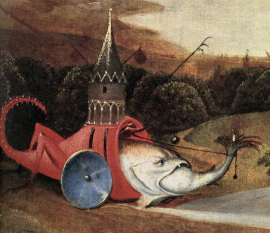
The fierceness and power of the leviathan was such that no human could capture and eat it, let alone tame it.
Will he (leviathan) make many supplications unto thee? will he speak soft words unto thee? Will he make a covenant with thee? wilt thou take him for a servant for ever? . . .
Shall the companions make a banquet of him? shall they part him among the merchants? . . .
None is so fierce that dare stir him (leviathan) up: who then is able to stand before me? (Job 41:3 - 4, 6, 10).
The leviathan had a large tongue (Job 41:1) and a thick, impenetrable skin composed of scales that nothing could penetrate. It had a strong neck and jaws powerful enough to withstand being pried open. It also possessed terrifying sharp teeth.
Who can open the doors of his face? his teeth are terrible round about. His scales are his pride, shut up together as with a close seal.
One is so near to another, that no air can come between them. They are joined one to another, they stick together, that they cannot be sundered . . .
In his neck remaineth strength, and sorrow is turned into joy before him. The flakes of his flesh are joined together: they are firm in themselves; they cannot be moved. (Job 41:14 - 17, 22 - 23).
The leviathan also seemed to shoot fire from his mouth and smoke from its nostrils. This image in the Bible is not unlike the fire-breathing dragons described since the early Middle Ages.
Out of his mouth go burning lamps, and sparks of fire leap out. Out of his nostrils goeth smoke, as out of a seething pot or caldron.
His breath kindleth coals, and a flame goeth out of his mouth. (Job 41:19 - 21).
Symbolism in the Bible
God used the leviathan to symbolize his eternal power, majesty and wisdom that was far above what humans possessed. These, of course, were qualities Job lacked, which was the point of the Lord's entire rebuke from Job 38:1 to 41:34.
In Psalm 74:12 - 14 the leviathan symbolizes Egypt's power which God broke in order to free his people Israel.
For God is my King of old, working salvation in the midst of the earth. Thou didst divide the sea by thy strength: thou brakest the heads of the dragons in the waters.
Thou brakest the heads of leviathan in pieces, and gavest him to be meat to the people inhabiting the wilderness. (Psalm 74:12 - 14).
In Isaiah 27 the leviathan represents, in the end time, God's punishment on the world for its sins.
In that day the Lord with his sore and great and strong sword shall punish leviathan the piercing serpent, even leviathan that crooked serpent; and he shall slay the dragon that is in the sea. (Isaiah 27:1).
Was It Real?
Was leviathan a real creature? It clearly was real, as it would make no sense for God to use an imaginary creature to humble Job! The Lord's challenge to Job presupposes he was aware of the beast and its fierceness.
Canst thou draw out leviathan with an hook? or his tongue with a cord which thou lettest down? Canst thou put an hook into his nose? or bore his jaw through with a thorn? (Job 41:1 - 2).
God, additionally, prior to Job 41:1, mentions what are undeniably real animals such as lions, ravens, wild goats, deer, wild donkeys, peacocks, ostriches, horses and so on (see Job 38:39 - 39:30). It therefore makes sense that the leviathan was also real.
What Was It?
Biblical commentaries, in trying to link leviathans with animals that currently exist, offer a wide range of speculations.
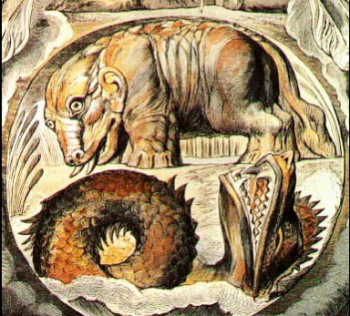
"It (the leviathan) may refer to any of the larger marine animals such as large jellyfish, whales, or sharks, or to a large reptile like the crocodile. (Tyndale Bible Dictionary).
"This beast has been variously interpreted as the seven-headed sea monster Lotion of Ugaritic mythology, the whale, the dolphin, a marine dinosaur that survived the Flood, and, most likely, the crocodile." (Bible Knowledge Commentary).
"In the margin of Job 3:8 and text of Job 41:1 the crocodile is no doubt the animal meant, and also in Psalm 74:14. In Psalm 104:26 the name represents some animal of the whale tribe in the Mediterranean . . . (People's Dictionary of the Bible).
Some commentaries are at least honest enough to admit that modern conclusions regarding such animals like the leviathan may be nothing more than guesses.
Surprisingly, the descriptions in the Bible of leviathans better fits extinct dinosaurs than any other beast or mythical creature! Henry Morris writes the following in this regard.
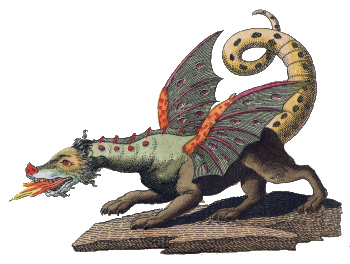
"Although commentators (including modern Orthodox Jewish scholars) have commonly identified . . . the leviathan with the crocodile, it is obvious from the descriptions (in Job 40 and Job 41:1-34) that these modern animals in no way qualify for such identification . . .
". . . leviathan fits what we know about some large marine reptiles, such as the plesiosaur or ichthyosaur, for example . . .
"Whatever one may make of such characteristics (of leviathans), they do not describe a crocodile! The obvious allusion to "fire-breathing dragons" is supported by the fact that many of the dragon traditions of the various nations also speak of this phenomenon.
"Since these animals are apparently now extinct and cannot be examined directly, it is presumptuous merely to write all this off as mythological and impossible. To say that the leviathan could not have breathed fire is to say much more than we know about leviathans (or water dragons or sea serpents)." (Biblical Basis for Modern Science, chapter 12).
Other Fascinating Facts
According to the 1906 Jewish Encyclopedia, certain Jewish writings offer the following about leviathans.
"According to a midrash (early Jewish interpretation of the Old Testament), the leviathan was created on the fifth day (of creation) (Yalḳ., Gen. 12).
"Originally God produced a male and a female leviathan, but lest in multiplying the species should destroy the world, He slew the female, reserving her flesh for the banquet that will be given to the righteous on the advent of the Messiah (B. B. 74a) . . .
"When the leviathan is hungry . . . he sends forth from his mouth a heat so great as to make all the waters of the deep boil . . . The body of the leviathan, especially his eyes, possesses great illuminating power . . ." (article on leviathans and behemoths).
The King James Apocrypha book of 2Esdras states the following about the creation of leviathan.
Then didst thou ordain two living creatures, the one thou calledst Enoch, and the other Leviathan; And didst separate the one from the other: for the seventh part, namely, where the water was gathered together, might not hold them both . . .
But unto Leviathan thou gavest the seventh part, namely, the moist; and hast kept him to be devoured of whom thou wilt, and when. (2Esdras 6:49 - 50, 52).
The book of Enoch, a Jewish religious text likely written between 200 to 300 B.C., states the following about leviathans.
And on that day were two monsters parted, a female monster named Leviathan, to dwell in the abysses of the ocean over the fountains of the waters. But the male is named Behemoth, who occupied with his breast a waste wilderness named Dendain, on the east of the garden where the elect and righteous dwell . . ." (Enoch 60:7 - 8).