This series will examine 22 gemstones found within the Bible. It will also discuss the precious stones embedded in the High Priest's breastplate and the stones God will use to someday build a New Jerusalem.
What Are They?
Gemstones are usually minerals that are sought after for their beauty or scarcity. Many times they are cut, polished, engraved upon, and so on to enhance their appearance and increase their perceived value.
Emeralds, rubies, sapphires and diamonds, in modern times, are generally considered precious gemstones. All other mineral-based stones, and those created organically (e.g. corals and pearls) are considered semi-precious gems.
How Often Do Gems Appear?
According to "Gemstones in the Breastplate" by E. Raymond Capt (pg. 9), the King James Bible contains 1,704 references to gemstones and minerals.
The gemstones mentioned the most, by name, in the King James are Sapphires (12 times), Onyx (11), Pearls (10), Beryls (8), Jasper (7), Rubies and Emeralds (6 each) and lastly Topaz (5).
The generic phrase "precious stones," in reference to gemstones in general, is recorded 19 times in 19 King James verses. It is found the most in 2Chronicles (5 times) followed by Revelation (4) and then both 1Kings and 1Chronicles (3 each).
The First Gemstone
How early in the Bible are gemstones mentioned? The first reference to gems is made in the second chapter of Genesis. Moses, the writer of Genesis, noted that one of the riches found in Havilah, a land near the Garden of Eden, was the semi-precious onyx stone.
And a river went out of Eden to water the garden; and from there it was divided and became four heads. The name of the first is Pishon, which surrounds all the land of Havilah, where there is gold.
And the gold of that land is good. There is also bdellium and the onyx stone. (Genesis 2:10 - 12, HBFV).
Where Are They Mentioned?
The Biblical books that write about precious stones the most are Exodus followed by Revelation, Ezekiel and then Job. Three of these four have passages which contain the highest concentration of gemstones. These sections of the Bible discuss the creation of Lucifer (Ezekiel), the clothing worn by Israel's High Priest (Exodus), and the composition of the New Jerusalem created by God (Revelation).
Creation of Lucifer
The first time, chronologically, gemstones are used is in God's creation of Lucifer. The Lord mentions he used nine precious stones to adorn his greatest creation up to that point in history (Ezekiel 28:13)!
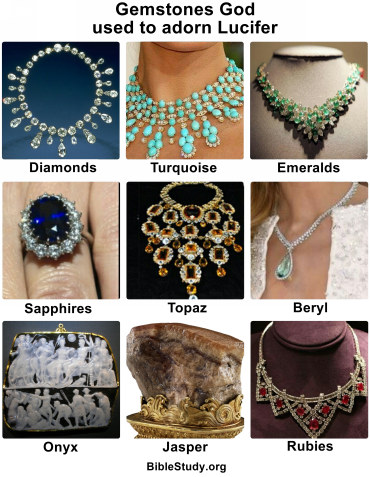
Thou hast been in Eden the garden of God; every precious stone was thy covering, the sardius, topaz, and the diamond, the beryl, the onyx, and the jasper, the sapphire, the emerald, and the carbuncle, and gold:
the workmanship of thy tabrets and of thy pipes was prepared in thee in the day that thou wast created. (Ezekiel 28:13, KJV).
Clothing of High Priest
Israel's High Priest was commanded to wear an ephod that had an onyx stone over each shoulder. The names of the first six sons of Israel, in birth order, were engraved on one of the gemstones while the other was engraved with the remaining six sons.
And you shall take two onyx stones, and you shall engrave on them the names of the children of Israel. Six of their names shall be on one stone, and six of the remaining names on the other stone, according to their birth.
And you shall put the two stones upon the shoulders of the ephod for stones of memorial to the children of Israel. And Aaron shall bear their names before the Lord upon his two shoulders for a memorial. (Exodus 28:9 - 10, 12, HBFV).
The priest's special breastplate, called the breastplate of judgment, had twelve gemstones embedded in it. The King James lists these twelve gemstones as sardius, topaz, carbuncle, emerald, sapphire, diamond, ligure, agate, amethyst, beryl, onyx and jasper (Exodus 28:17 - 20).
A New Jerusalem
The third Biblical passage with a high concentration of gemstones describes God's prophetic creation of a New Jerusalem. Each of the twelve gates of New Jerusalem will be made from a single pearl.
And the twelve gates were twelve pearls; every several gate was of one pearl: and the street of the city was pure gold, as it were transparent glass. (Revelation 21:21, KJV).
The city will be built upon twelve magnificent foundations of gemstones.
The first foundation was jasper; the second, sapphire; the third, a chalcedony; the fourth, an emerald;
The fifth, sardonyx; the sixth, sardius; the seventh, chrysolite; the eighth, beryl; the ninth, a topaz; the tenth, a chrysoprasus; the eleventh, a jacinth; the twelfth, an amethyst. (Revelation 21:19 - 20, KJV).
How Did They Get Them?
The land of Israel, of itself, lacked deposits of gemstones.
"Jewels have been more rare in archaeological finds in Palestine than in Egyptian, Greek, or Phoenician archaeological remains . . . (one reason for this lack was) the land of Israel had no natural deposits of precious stones." (Holman Bible Dictionary on jewelry).
Precious stones, however, could be purchased from traders such as the Tyrians or others (Ezekiel 27:16, 22). Gemstones, made into jewelry, were also often taken as war booty. Israelite captains, at the time of Moses, took a portion of their Midianite booty and offered it to God.
"And we bring an offering for the Lord, what every man has found, of jewels, of gold, chains and bracelets, rings, earrings and tablets to make an atonement for our souls before the Lord." (Numbers 31:50).
Gemstones were often given as gifts.
And the queen of Sheba heard of the fame of Solomon and came to test Solomon with hard questions at Jerusalem, with a very great company and camels that carried spices, and gold in abundance, and precious stones. (2Chronicles 9:1).
Judah's righteous King Hezekiah received so many gemstones as gifts (and possibly through trade) that he built a special storehouse for them!
And many brought gifts to the Lord to Jerusalem, and presents to Hezekiah king of Judah, so that he was magnified in the sight of all nations from that time forward . . .
And Hezekiah had exceedingly much riches and honor. And he made himself treasuries for silver, and for gold, and for precious stones, and for spices, and for shields, and for all kinds of pleasant jewels. (2Chronicles 32:23, 27, HBFV).
King Solomon and King Hiram, as part of a business venture (1Kings 9:26 - 28), sent ships to Ophir to retrieve valuable goods which included gemstones.
And also the navy of Hiram (King of Tyre) which brought gold from Ophir, brought in from Ophir great abundance of almug trees and precious stones. (1Kings 10:11).
What Are They Used For?
The earliest chronological use of gemstones recorded in the Bible was in God's creation of the spirit being named Lucifer. These stones were used to further enhance his looks to the point where he was considered "perfect in beauty" (Ezekiel 28:12).
Gemstones were frequently made into jewelry used not simply as adornment but as a sign of a person's wealth or status.
King Solomon used gemstones to decorate the inside of Jerusalem's temple (2Chronicles 3:6). Gems were used in worship as offerings to God (Numbers 31:50).
Gems were placed in royal crowns as a way of conveying the power, wealth and authority of the sovereigns who wore them.
David gathered all the people and went to Rabbah and fought against it and took it. Then he took the king's crown from off his head, the weight of which was a talent of gold, and a precious stone was in it. And it was set on David's head. (2Samuel 12:29 - 30).
Gemstones were also considered a wise investment or as something that possessed magical properties.
"Besides their use for adornment and for gifts, gems and semiprecious stones were regarded by men of property - then as today - as a prudent investment - that is, of a constant value over the long haul, marketable, and easily stowed away or transported.
"One additional attraction of jewels to biblical people has disappeared with the passage of time: the belief in the magical properties and benefits to the owner of certain jewels." (Harper's Encyclopedia of Bible Life, section on jewelry).