It should be noted that modern cultural references to the gates of heaven being made of pearls is based on Revelation 21:21. Job states that the gaining of wisdom is more precious than gabiysh (Strong's #H1378). This Hebrew word comes from an unused root that means, "to freeze" or "crystal" (from its resemblance to ice) which Strong's translates as "pearls."
Although the KJV Bible translates gabiysh as this gem in Job 28:18, many other translations render the word as "crystal." Interestingly, this stone still shows up in this quote, as several translations (ESV, HCSB and NASB) translate the Hebrew paniyn (Strong's #H6443) as this natural gem.
No mention shall be made of coral or of crystal (Hebrew gabiysh); the price of wisdom is above pearls (Hebrew paniyn - Job 28:18, ESV).
This stone is the second most referenced gemstone in the entire KJV Bible, primarily due to its use in the New Testament (see Matthew 7:6, 13:45 - 46 and our article about one of these parables). It is also one of the two major gems in Scripture that are produced organically (the other being coral) as opposed to inorganically.
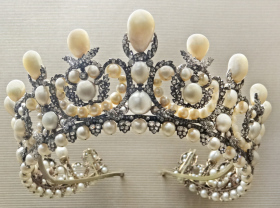
Natural pearls, which are composed primarily of calcium carbonate, are created within the soft tissue of living shelled mollusks (usually clams). Anciently, because they were rare to find, many oysters had to be gathered and opened (thus killing them) in order to find one of these gems. One modern method for making these gemstones more available is producing them in farms that use human as well as natural processes to create them.
This natural gem can be round, pear, egg, or other shapes. While white is the most familiar coloration of this gemstone, they can also come in other colors such as light rose, black, blue, red, and violet. Their beauty and desirability goes back at least 4,000 years (Diamonds, Pearls and Precious Stones, page 42).
Folklore
Folklore surrounding pearls associates them with the moon and Monday, although they were also considered a talisman of Sunday (Curious Lore of Precious Stones, page 30, 332, 358). In dreams, this gemstone was believed to symbolize faithful friends. They were also considered, in some cultures, as the tears of the gods.