Where is amethyst found in the modern world? What commodities have been created using this stone? What is its relationship to the Christian church? What are some of the myths and folklore surrounding this gem?
Description of Gem
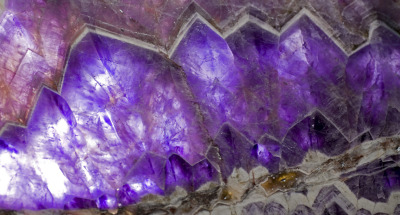
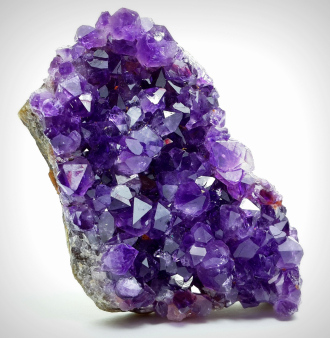
Amethyst is a purple or violet variety of crystalline quartz that is one of the most popular gemstones. Its color comes from trace amounts of iron combined with natural irradiation within the crystal structure. It usually forms inside geodes (hollow rock cavities) often as pointed crystal clusters.
Four varieties of amethyst were recognized by Pliny as precious. They were all transparent and possessing tints of purple.
Sources
In modern times, major deposits of amethyst are found in Brazil, Uruguay, Zambia, and South Korea.
How Hard Is it?
Amethyst has a hardness of 7 on the Mohs scale where 10 is the hardest gemstone. It, along with the Biblical gem known as rock crystal, is one of the hardest precious stones discussed in God's word.
Biblical Occurrences
Amethyst is mentioned, by name, three times in three Bible verses. It is found twice in the book of Exodus and once in Revelation.
This precious stone was embedded in the High Priest's breastplate. It was located in the third of four rows of stones, which each row having three precious gems.
And thou shalt make the breastplate of judgment with cunning work; after the work of the ephod thou shalt make it . . . And thou shalt set in it settings of stones, even four rows of stones . . .
And the third row a ligure, an agate, and an amethyst (Hebrew achlamah, Strong's Concordance #H306). (Exodus 28:15, 17, 20, see also 39:12, King James throughout).
Strong's states the Hebrew word behind amethyst means "dream stone." Brown-Driver-Briggs' Hebrew Definitions says that the identification of the stone is not certain but that it was purple.
The twelfth and last foundation stone used to create the prophetic New Jerusalem will be an amethyst.
And the foundations of the wall of the city were garnished with all manner of precious stones. The first foundation was jasper; the second, sapphire; the third, a chalcedony; the fourth, an emerald;
The fifth, sardonyx; the sixth, sardius; the seventh, chrysolite; the eighth, beryl; the ninth, a topaz; the tenth, a chrysoprasus; the eleventh, a jacinth; the twelfth, an amethyst (Greek amethustos, Strong's #G271). (Revelation 21:19 - 20).
Other Uses
Precious and semi-precious gemstones like amethyst were commonly used for bead work.
"Beads, commonly made of rock crystal, amber, shells, and agates of two or three colors, were widely owned and used by women.
"They could also be more handsomely put together of more expensive semiprecious stones, such as lapis lazuli . . . carnelian, onyx, and jasper. Amethyst beads would be very luxurious." (Harper's Encyclopedia of Bible Life, section on jewelry).
Beads and other ornaments of amethyst have been found in old Egyptian tombs showing that it was considered precious even in very ancient times.
Jewelry such as rings, necklaces, earrings, bracelets and pendants, as well as carvings, have also been made from amethyst.
Facts and Folklore
Amethyst has a history of being associated with royalty. In the Middle Ages it was considered a pious gem and used by the Christian Church.
Anciently, it was believed that any intoxicating liquid drunk from a cup composed of amethyst would render the drink unable to cause someone to be drunk. The Greek word, amethustos, translated as this gem in the Bible means "to prevent intoxication."
Amulets made of amethyst were also worn as they were believed to counteract the effects of wine. The gem was also believed to bring calmness, clarity, protection, and spiritual awareness.
Amethysts, in the fifteenth century A.D., were believed to control evil thoughts, make a person generally smarter and give them the ability to be a shrewd in business. They also, according to legend, gave soldiers the ability not to be harmed in battle and be victorious over their enemies. It was additionally thought to aid those in capturing wild animals (Curious Lore of Precious Stones, page 58).