Where, anciently, was the onyx gemstone found? What makes it unique in the Bible? How does the sardonyx fulfill prophecy? What are some of the myths and folklore surrounding this gemstone?
Description of Gem
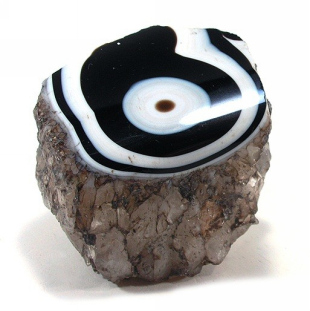
Onyx is a variety of chalcedony stones that also includes jaspers, agates, carnelians and chrysoprase. This type of gemstone is known for its smooth and solid bands of color.
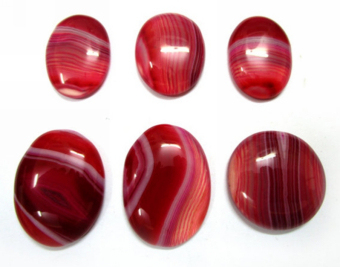
One common variation of onyx includes those marked with bands of red (or reddish-brown) colors that are called a sardonyx. The "sard" in sardonyx means red. Other common variations of this stone include those with black or white bands.
According to Pliny, the name sardonyx was at first given to an Indian (red) sarda with a layer of white in it, both being transparent. He also states that three colors were considered essential, but that they might be repeated many times. The Arabian sardonyx was "characterized by several different colors, black or azure for the base and vermilion surrounded with a line of rich white for the upper part . . ."
Onyx forms from silica-rich groundwater depositing layers of chalcedony in rock cavities that builds up parallel bands of colors.
Sources
Anciently, according to the 1913 Catholic Encyclopedia, the onyx gemstone was mined in Egypt, Arabia and India.
How Hard Is it?
Onyx gemstones have a hardness of 6.5 to 7 on the Mohs scale where 10 is the hardest gemstone. They share the same hardness as other Biblical precious stones such as jaspers, peridots, agates, carnelians and others.
Biblical Occurrences
The gemstone known as onyx (including its variation referenced as sardonyx) is recorded, by name, twelve times in twelve King James Bible verses. It is found the most in Exodus (7 times) followed by once each in Genesis, 1Chronicles, Job, Ezekiel and Revelation.
The onyx is the first precious stone mentioned in Scripture. They also hold the distinction, along with sapphires, of being the most frequently mentioned gemstone in the KJV!
The onyx stone, along with emeralds and beryls, are also Biblically unique in another way. They are included not only in the High Priest's breastplate, but also as a stone used to beautify Lucifer and a gem (in the form of sardonyx) used in the New Jerusalem!
Moses reveals, in Genesis, that one of the many material blessings near the Garden of Eden was an abundance of onyx stones!
And the gold of that land is good: there is bdellium and the onyx stone. (Genesis 2:12, KJV throughout).
An onyx stone was placed on each of the High Priest's shoulders. Attached to his ephod, each stone was engraved with six of the names of Israel's tribes as an everlasting memorial before God.
And thou shalt take two onyx stones, and grave on them the names of the children of Israel:
Six of their names on one stone, and the other six names of the rest on the other stone, according to their birth. (Exodus 28:9 - 10, see also 39:6).
This precious stone, as stated previously, was also embedded in the High Priest's breastplate. It was located in the fourth of four rows of stones, which each row having three precious gems.
And thou shalt make the breastplate of judgment with cunning work; after the work of the ephod thou shalt make it . . .
And the fourth row a beryl, and an onyx, and a jasper: they shall be set in gold in their inclosings. (Exodus 28:15, 20, see also 39:13).
King David, just before he died, gave his son Solomon a vast quantity of materials for building Jerusalem's temple. One of the materials he generously gave was the onyx stone.
Now I have prepared with all my might for the house of my God the gold for things to be made of gold, and the silver for things of silver, and the brass for things of brass, the iron for things of iron, and wood for things of wood;
onyx stones, and stones to be set, glistering stones, and of divers colors, and all manner of precious stones, and marble stones in abundance. (1Chronices 29:2).
Job, in his long discourse concerning his trials, comments that wisdom was more valuable than this precious gemstone.
But where shall wisdom be found? and where is the place of understanding? . . . It cannot be gotten for gold, neither shall silver be weighed for the price thereof.
It cannot be valued with the gold of Ophir, with the precious onyx, or the sapphire. (Job 28:12, 15 - 16).
When God created the cherub named Lucifer, he adorned him with many gemstones, one of which was onyx.
Thou hast been in Eden the garden of God; every precious stone was thy covering, the sardius, topaz, and the diamond, the beryl, the onyx, and the jasper, the sapphire, the emerald, and the carbuncle, and gold . . . (Ezekiel 28:13).
The Reddish Variety
John's prophecy of the New Jerusalem reveals that the sardonyx, the reddish variety of onyx, will be utilized by God to create the city's fifth foundation stone!
And the foundations of the wall of the city were garnished with all manner of precious stones. The first foundation was jasper; the second, sapphire; the third, a chalcedony; the fourth, an emerald;
The fifth, sardonyx; the sixth, sardius; the seventh, chrysolite; the eighth, beryl; the ninth, a topaz; the tenth, a chrysoprasus; the eleventh, a jacinth; the twelfth, an amethyst. (Revelation 21:19 - 20).
Other Uses
Onyx has a long history of being used in jewelry. It is utilized for beads, rings, pendants and cabochons. Carvings, pottery items such as bowls and decorative objects such as sculptures were also crafted from the gem.
"Beads, commonly made of rock crystal, amber, shells, and agates of two or three colors, were widely owned and used by women.
"They could also be more handsomely put together of more expensive semiprecious stones, such as lapis lazuli . . . carnelian, onyx, and jasper. Amethyst beads would be very luxurious." (Harper's Encyclopedia of Bible Life, section on jewelry).
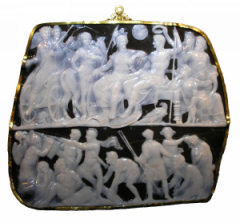
This stone also has a history of use in carved cameos and intaglios dating as far back as ancient Greece and Rome.
Folklore and Myth
Onyx was often associated with protection, grounding, self-control, and strength.
Another belief about the onyx stone, not found in the Bible, was that it could cool the passions of love when worn by a person around the neck. This made it a popular gemstone to wear in India. One major side effect, however, of wearing the stone was that it supposedly encouraged discord and separation of couples (Curious Lore of Precious Stones, pages 98 - 99).