Philippians 1
1. Why did Paul write to Philippi? Answer
2. When did Paul visit Philippi before he wrote Philippians between 61 and 63 A.D.? (v. 1 - 5) Answer
3. Why did Paul feel especially close to the church in Philippi? (v. 7 - 8) Answer
4. Where was Paul "in bonds" when he wrote the book of Philippians? (v. 7). Answer
5. What are the "fruits of righteousness?" (v. 11) Answer
6. What was the purpose of writing verses 12 to 18? Answer
7. Why did Paul seem to debate whether to live or die? (v. 20 - 24) Answer
8. Did Paul ever revisit the Philippians after writing this letter? (v. 26) Answer
9. What does verses 27 and 28 reveal about the Philippian church? Answer
10. What is revealing about verse 29? Answer
Philippians 2
11. How are Christians to be likeminded? (v. 2 - 5) Answer
12. What is revealed in verses 5 to 11 about Jesus? Answer
13. What belief does verses 10 and 11 reinforce? Answer
14. What does verses 12 and 13 mean? Answer
15. Why should Christians not complain or argue? (v. 14 - 15) Answer
16. When was verse 17 fulfilled in Paul's life? Answer
17. Who was Epaphroditus and why was he sent to Philippi? (v. 25 - 30) Answer
Philippians 3
18. What is the meaning of Paul's statements in verses 2 to 9? Answer
19. Did Paul think he was guaranteed salvation no matter what he did after his conversion? (v. 11 - 14). Answer
20. What is the warning given in verses 17 to 19? Answer
21. What is the promise of verse 21? Answer
Philippians 4
22. Who was Euodia, Syntyche and Clement in Philippi? (v. 2 - 3) Answer
23. How can we achieve the peace of God? (v. 6 - 7) Answer
24. What was one of the traits that made the Philippian church unique? (v. 15 - 16) Answer
25. What is the meaning of verse 22? Answer
26. Is verse 23 correct about Philippians being written in Rome? Answer
Philippians 1 Answers
1. Paul wrote to the church at Philippi to thank them for their selfless financial support of his ministry which they sent through Epaphroditus (Philippians 1:5, 4:18). He also wrote to both encourage them in their Christian walk and point out some wrong attitudes that had developed (2:1 - 5, 4:2 - 3).
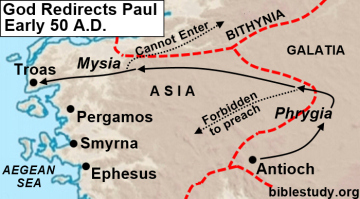
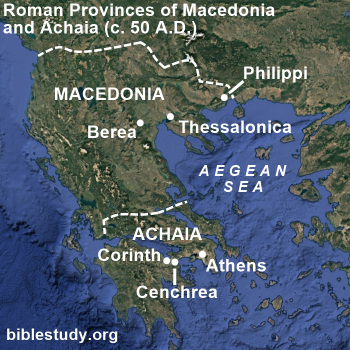
2. Paul, with traveling companions Timothy, Silas and Luke, first visited Philippi during his second missionary journey. After God blocks his evangelistic desires in Asia Minor twice, he tells him in a vision to go to Macedonia. The group travels to Troas where they take a ship to Macedonia. Once on land they walk to Philippi (Acts 16:6 - 10).
Paul starts the Philippian church by baptizing a woman named Lydia and her entire family on Pentecost (May 17) in 50 A.D. (Acts 16:13 - 15). The church becomes the first one the apostle establishes on the European continent!
Paul revisits Philippi twice during his third missionary journey. In 57 A.D. he visits the city as he is traveling west in Macedonia. While in Philippi he writes 2Corinthians where he mentions Timothy is also with him (2Corinthians 1:1).
[Apostle Paul's Second
Missionary Journey Map]
The apostle then leaves Philippi and travels to Corinth where, after staying only a few months, he retraces his steps and visits Philippi yet again. He keeps the spring Feast Days of 58 A.D. with the Philippian brethren (Acts 20:5 - 6) before continuing his evangelism.
3. The church in Philippi was special to Paul as they were the only ones who supported him financially even while he ministered in other cities!
Now did I commit sin by humbling myself so that you might be exalted, because I preached the gospel of God to you freely? I robbed other churches, receiving wages from them for ministering to you.
And when I was present with you and in need, I was not a burden to anyone (for the brethren who came from Macedonia fully supplied my needs) . . . (2Corinthians 11:7- 9, see also Philippians 4:15 - 18).
What further endeared the Philippians to Paul was that they chose to help him, several times, even though they were a fairly poor church who was being persecuted (2Corinthians 8:1 - 5).
[How Long Was Paul in Prison?]
4. Paul was a Roman prisoner in Rome from spring of 61 A.D. to spring of 63 A.D. (see Acts 28:30 - 31). During this time he wrote what are called his "prison epistles" of Ephesians, Philippians, Colossians and Philemon.
5. Paul lists some of the fruits of righteousness in his writing to Galatia.
[What Are the Gifts
of God's Holy Spirit?]
But the fruit of the Spirit is love, joy, peace, long-suffering, kindness, goodness, faith, meekness, self-control; against such things there is no law (Galatians 5:22 - 23, HBFV).
6. Paul wanted the Christians in Philippi to know that his imprisonment, rather than curtailing the gospel, was actually advancing it! Part of this advance came from his ability to preach the truth to the Roman soldiers, the praetorian guards, who rotated in their responsibility to guard him.
"All this imagery becomes doubly forcible if we remember that when St. Paul wrote the words (of Philippians) he was chained to a soldier, and in the close neighborhood of military sights and sounds.
"The appearance of the Praetorian guards was daily familiar to him; - as his 'chains' on the other hand . . . became 'well known throughout the whole Proetorium.' " (Life and Epistles of Paul, chapter 26).
[Roman Empire in
New Testament Map]
The praetorian guards had the primary responsibility to serve as personal security escorts for the Roman emperor.
The gospel was also advanced by those emboldened to speak who knew of Paul's bonds for spreading the truth. Some preached the word out of an attitude of sincerity and love. Others, however, preached out of selfish ambition. They evangelized from a heart of envy and rivalry that sought to stir up more trouble for Paul.
Paul's attitude was that, in spite of the motives of some, it was good that the gospel was being disseminated.
[Symbols of the Gospel Writers]
What then? notwithstanding, every way, whether in pretence, or in truth, Christ is preached; and I therein do rejoice, yea, and will rejoice. (Philippians 1:18, KJV).
7. Paul, by the time he wrote Philippians, had suffered physically on many occasions due to being persecuted. He also had experienced the many pitfalls in traveling during the first century A.D. He wrote in 2Corinthians, 4+ years before the book of Philippians, what were some of the things he endured for the sake of the gospel.
Are they servants of Christ? . . . So am I, above and beyond measure - in labors more abundant, in stripes above measure, in imprisonments more frequent, in deaths often.
Five times from the Jews I received forty stripes less one. Three times I was beaten with rods; once I was stoned; three times I was shipwrecked; a night and a day I spent in the deep.
I have been in journeyings often, in perils of rivers, in perils of robbers, in perils from my own race, in perils from the Gentiles . . . in weariness and painfulness, in watchings often, in hunger and thirst, in fastings often, in cold and nakedness . . . (2Corinthians 11:23 - 27, HBFV).
[What Does Proverbs
Say About Trials?]
It is easy to see why Paul, who was likely between 59 and 61 years old when he wrote to Philippi, wanted his struggles to end through death! His Christian duty to preach the gospel and serve the church, however, led him to make the selfless decision to continue living.
For to me to live is Christ, and to die is gain. Now if I live in the flesh, this is the fruit of my labor. But I do not know what I should choose.
For I am hard pressed to choose between the two. I desire to depart, and to be with Christ, which is far better; But to remain in the flesh is more necessary for your sakes. (Philippians 1:21 - 24, HBFV).
8. The Bible never mentions Paul visiting Philippi after his first imprisonment in Rome.
[Paul's Last Missionary Journey Map]
Paul's travels after being released from Rome's prison in early 63 A.D. constitutes his fifth (last) missionary journey. After leaving Rome he likely visited Crete where Titus was overseeing the church.
After leaving Titus in Crete (Titus 1:5) he went to Nicopolis (Titus 1:5, 3:12). He then likely sailed to Spain (Romans 15:22 - 24, 28) and possibly to Britain to spread the gospel. In late 67 or early 68 A.D. he is arrested again and sent back to Rome where he would await his martyrdom (2Timothy 4:6 - 8).
9. Philippians 1:27 - 28 shows that the church had, and likely still was at the time, being persecuted for believing the gospel. The New International Version of this passage makes this point clear.
. . . I will know that you stand firm in one spirit, contending as one man for the faith of the gospel without being frightened in any way by those who oppose you. This is a sign to them that they will be destroyed, but that you will be saved . . . (Philippians 1:27 - 28, NIV).
10. Philippians 1:29 reminds Christians that they are sometimes called by God to suffer for his name's sake and for the gospel.
Because it has been granted to you on behalf of Christ, not only to believe in Him, but also to suffer for His name’s sake; Experiencing the same conflict that you saw in me, and now hear of concerning me. (Philippians 1:29 - 30, HBFV).
Philippians 2 Answers
11. Christians can be of the same mind if they all agree to fully take on the attitude of Jesus Christ. In whatever they do, they should serve with humility and consider the needs of others at least as much as their own. Paul's teaching in this passage is similar to what he wrote in Galatians 6.
Bear one another's burdens, and so fulfill the law of Christ. (Galatians 6:2, HBFV).
[How to Become
More like Jesus!]
Christians should also strive to avoid promoting themselves at the expense of others and reject pursuing empty vanity.
12. Philippians 2:5 - 11 uses Jesus' attitude before and while he was a human as the standard to be strived for by all Christians.
Jesus, although he was God, was willing to do whatever it took to make our eternal salvation and glory possible. His perfect love moved him to not covet all he had but rather humble himself by becoming a human.
Christ, as a human, willingly allowed himself to being tempted to sin through the same human nature we all possess. He chose to subject himself to both God the Father and man's corrupt system of rule so that he could die as a perfect sacrifice for sin. His death and subsequent resurrection made possible the perfecting of righteous character in humans so that they can ultimately live forever in glory.
13. Philippians 2:10 - 11 reinforces the belief that Jesus was God before his human birth and returned to being a member of the Godhead at his resurrection. He therefore should be justly worshipped to the glory of the Father.
[Is Jesus the God
of the Old Testament?]
14. Salvation, as Paul will point out later in Philippians 3:11 - 14, is a process that takes time. Christians must work out, meaning to put conscious effort into, obeying God, doing good works and overcoming the pulls of human nature. This, with God's help, will build in believers the righteous character necessary for living forever.
So then, my beloved, even as you have always obeyed, not as in my presence only, but now much more in my absence, work out your own salvation with fear and trembling.
For it is God Who works in you both to will and to do according to His good pleasure. (Philippians 2:12 - 13, HBFV).
Believers must be faithful to the very end of their physical existences before they can receive the gift of eternal life. Philippians 2:12 - 13 also implies that those who take their calling for granted, who DO NOT actively pursue obeying God and doing what is right, are not doing his will or pleasing him!
15. Christians should not complain or argue among themselves so that they may be an example of righteousness to others. Living a Christian life matters in the spreading of the gospel as our behavior glorifies God.
16. The completion of Paul's offering of his life, in service to God, took place when he was martyred in 68 A.D. The apostle wrote of his impending death to his dear friend Timothy.
For I am now ready to be offered, and the time of my departure is at hand. I have fought a good fight; I have finished the course; I have kept the faith. (2Timothy 4:6 - 7, HBFV).
17. Epaphroditus was specially selected by those in Philippi to deliver financial support, clothes and other necessities to the apostle while he was a prisoner in Rome. He was a leader in the Philippian church who was considered a "fellow soldier" in spreading the gospel and serving the church.
[Important New Testament People]
[Who Delivered Paul's Letters?]
Epaphroditus, possibly while traveling to Rome, got so sick that when he arrived in the city he almost died (Philippians 2:27). The apostle commended him to the Philippians for this selfless act and willingness to place his own life at risk for the cause of Christ.
After Epaphroditus' lengthy recovery he was sent back home to Philippi to deliver Paul's letter.
Philippians 3 Answers
18. The act of circumcision ("concision" in the KJV), in the Old Testament, was commanded by God. It was the sign of the covenant between him and his people (Genesis 17:12 - 14, Exodus 12:48, etc.).
The need for New Testament believers, however, to be physically circumcised in order to have a full relationship with God (be saved) was determined to no longer be needed in 49 A.D.'s Jerusalem Conference (Acts 15). Physical circumcision, as a means of making one right with God, was replaced by circumcision of the heart in the New Covenant.
For we are the circumcision, which worship God in the spirit, and rejoice in Christ Jesus, and have no confidence in the flesh. (Philippians 3:3, KJV).
[What Was the
Jerusalem Conference?]
In spite of the church's decision against the necessity of physical circumcision (Acts 15:22 - 29), it continued to deal with others who forcefully argued it was needed for gentile believers. It was this teaching that Paul vehemently opposed.
Paul statements in Philippians 3:4 - 9 uses his own personal life to teach that physical circumcision is not what God wants under the New Covenant. The apostle, after his conversion, considered what he learned about salvation as a zealous Jew to be no longer valid.
Yet the things that were gain to me, these things I have counted as loss for the sake of Christ . . .
And may be found in Him, not having my own righteousness, which is derived from law, but that righteousness which is by the faith of Christ . . . (Philippian 3:7, 9, HBFV).
19. The concept that a person, after they become a Christian, cannot lose their salvation is known as "once saved, always saved." Paul, however, did not believe in this teaching nor taught it during his ministry!
If by any means I may attain unto the resurrection of the dead; Not as though I have already received, or have already been perfected; but I am striving, so that I may also lay hold on that for which I also was laid hold of by Christ Jesus.
Brethren, I do not count myself as having attained . . . (Philippians 3:11 - 13, HBFV).
Paul repeatedly made conditional statements regarding his own salvation. He said, "IF BY ANY MEANS . . ." implying his inclusion in the (first) resurrection could change. He admitted he had not irrevocably been saved as he had yet to be perfected by God. He drives the point of not being "always saved" further by stating, "I do not count myself as having attained . . ."
[What Is the First Resurrection?]
[Who Was Resurrected with Jesus?]
Paul knew that he, like all Christians, was required to obey God and keep the faith until death (Revelation 2:10, 12:11)! Believers, after conversion, must live a life of overcoming and doing good to qualify to receive the gift of salvation. They, with God's help through the holy spirit in them, must constantly strive to build holy righteous character. This is why Paul ended his argument with the following.
I press toward the goal (something he did not yet have!) for the prize of the high calling of God in Christ Jesus. (Philippians 3:14, HBFV).
[Is the Holy Spirit a Person?]
20. Paul first encourages the church at Philippi to use himself, and other mature believers, as an example of how to live their life. These righteous patterns would help the Philippians detect those who were false teachers and who only pretended to be Christians.
The false believers Paul warned of had three characteristics that marked them as such. First, their goal was not righteousness but the fulfilling of their selfish and carnal desires. Second, they sought to glorify themselves instead of God. Third, they set their hearts on earthly things rather than on God.
[How Can We Detect
False Prophets?]
Whose end is destruction, whose god is their belly, and whose glory is in their shame; for they mind earthly things. (Philippians 3:19, HBFV).
21. Philippians 3:21 promises Christians will receive, in the resurrection, the same type of eternal spiritual body God has!
Who will transform our vile bodies, that they may be conformed to His glorious body, according to the inner working of His own power, whereby He is able to subdue all things to Himself. (Philippians 3:21, HBFV)
Philippians 4 Answers
22. Euodia and Syntyche were prominent female Christians living in Philippi. Paul, in his letter to the church, asked them to settle their differences. Both of them had helped him in the work of the gospel. It is unknown the exact nature of their disagreement or whether it was successfully resolved.
[What Role Should
Women Play in Church?]
Clement was considered a coworker in the gospel by the Apostle Paul and specifically mentioned in Philippians as having his name written in the Book of Life. Origen, a third century A.D. Catholic theologian, believed this Clement became the Catholic Church's fourth Pope.
23. Philippians 4:6 - 7 reminds us that we receive the peace of God when we thank him for our blessings and make known all our needs.
By placing, through prayer, all our cares and problems before our Father we are trusting him to work them out for our good (Romans 8:28). This brings peace, in part, because we are not relying solely on ourselves or our own resources to deal with the trials and troubles we face daily.
24. Those in Philippi were willing to financially support Paul's ministry even when he was serving other churches who were wealthier than they! Paul makes this point abundantly clear to the well-off Corinthians who lived in a large mercantile city made rich by trade.
[How Many Churches
Did Paul Start?]
I robbed other churches, receiving wages from them for ministering to you. And when I was present with you and in need, I was not a burden to anyone (for the brethren who came from Macedonia (Philippi) fully supplied my needs); for I kept myself, and will continue to keep myself, from being burdensome to you in anything. (2Corinthians 11:8 - 9, HBFV).
25. Paul wanted to encourage the Philippians to view his imprisonment in a different light. His time under arrest in Rome gave him the opportunity to spread the gospel to those he might not otherwise have access to or interact with.
[How Many Times
Was Paul Arrested?]
The apostle almost certainly evangelized his Roman guards, some of which directly served the emperor. He also interacted with Roman slaves and possibly relatives of Caesar's household during his two years in prison. Some of these, no doubt, became Christians. This is why he could send greetings from Caesar's household.
26. Philippians 4:23, in the King James, is correct when it states the following.
The grace of our Lord Jesus Christ be with you all. Amen. To the Philippians written from Rome, by Epaphroditus. (Philippians 4:23, KJV).
It was Epaphroditus who both wrote down Paul's letter to Philippi and delivered it to the church. The apostle, for 93% of his books, had someone write down his words for him.
Amazing Facts About Philippians!