What made the Philippian church unique among all of Paul's churches? What role did women play in the fellowship? Why were Paul and Silas arrested, beaten and thrown in a Philippi prison while Luke and Timothy were not?
No Holy
The book of Philippians, in the King James, does not record the English word "holy." It is also not found in Paul's other writings of Galatians, 2Thessalonians and Philemon. The Greek word from which we get "holy" in the apostle's writings is hagios (Strong's Concordance #G40).
Was There a Philippian Synagogue?
Paul's habit, upon entering a city, was to first seek out its synagogue and evangelize those in attendance (Acts 13:14, 14:1, 17:1, 17, 19:8). In Philippi, however, the apostle gathered with "God fearers" by the city's river who had gathered for prayer.
Then on the day of the weeks (Pentecost) we went outside the city by a river, where it was customary for prayer to be made; and after sitting down, we spoke to the women who were gathered together there.
And a certain woman who worshiped God was listening; she was named Lydia . . . (Acts 16:13 - 14, HBFV).
[What Were Jesus'
Synagogue Miracles?]
Jewish tradition at the time was that a minimum of ten Jewish men were necessary to constitute a regular synagogue. Since the number of male Jews in Philippi was small it had no synagogue, forcing Paul to go near the city's river.
The meaning of the phrase "which (who) worshipped God" in Acts 16:14 is debated. Some commentaries claim the women gathered were gentile proselytes of Judaism living in Philippi. Others, however, state they were simply gentiles who worshipped the God of the Bible.
The Man from Macedonia
Was Luke the "man of Macedonia" who appeared to the Apostle Paul in his Troas vision (Acts 16:9)? It was this vision that led Paul to visit and establish the Philippian church as well as start at least two other fellowships in the Roman province of Macedonia.
And a vision appeared to Paul in the night; There stood a man of Macedonia, and prayed him, saying, Come over into Macedonia, and help us. (Acts 16:9, KJV).
One Biblical commentary takes a stab at who might be the mysterious Macedonian man who would lead to the apostle visiting Philippi.
"The man of Macedonia has sometimes been supposed to be St. Luke, or even the guardian angel of Macedonia (Daniel 10:12). The man was recognized as Macedonian by his speech, or by his dress." (A Commentary on the Holy Bible on Acts 16:9).
[Timeline of the Life of Luke]
The man is Paul's vision was not Luke as the evangelist was with the apostle in Troas!
And after he had seen the vision, WE immediately sought to go into Macedonia, concluding that the Lord had called US to preach the gospel to them. (Acts 16:10, HBFV).
Luke is the author of the book of Acts. Since He includes himself in Acts 16:10 he could not be the mysterious man in Paul's vision.
A Fruitful Journey
How successful was Paul's second missionary journey of which Philippi was only one of several places visited from 49 to 52 A.D.?
[What Is the History of Philippi?]
[Apostle Paul's Second
Missionary Journey Map!]
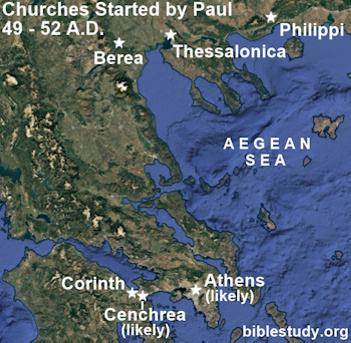
The first new church started during the apostle's second evangelistic campaign was in Philippi (Acts 16:12 - 15, 40). It was soon followed by new Christian churches in Thessalonica and Berea (17:1 - 4, 11 - 12). Paul then establishes a new church in Corinth where he stays for about a year and a half (18:1 - 11).
Evidence suggests that the apostle may have started a church in Athens which he visited prior to coming to Corinth (Acts 17:15 - 34). While staying in Corinth he may have also started a Christian fellowship in nearby Cenchrea (see Romans 16:1 - 2).
Prison Visitors
Paul was a prisoner in Rome, under house arrest, from early spring of 61 to early spring of 63 A.D. During this time, other than writing Philippians and three other books, he entertained several people who visited him!
[How Often Was Paul Arrested?]
Timothy was, of course, with Paul during most of this period (Philippians 1:1, Colossians 1:1, Philemon 1:1). Epaphroditus of Philippi was also with him (Philippians 2:25, 4:18, 23).
Tychicus (Ephesians 6:21), Epaphras (Colossians 1:7) and Onesimus (4:9) also traveled to Rome to see Paul while he awaited trial. Additionally, the gospel writer Mark (Colossians 4:10), Jesus (also called Justus, 4:11), Aristarchus, Luke and Demas (4:10, 14) made the trip to the empire's capital to see the apostle.
The Women of Philippi
Paul was given a vision of a Macedonian man crying out for help that led him to visit Philippi (Acts 16:9 - 10). Ironically, when he entered the city, his first evangelism involved preaching the gospel to a group composed mostly (if not entirely) of women (verse 13)!
It was a woman named Lydia, a seller of purple, whose baptism (and that of her household) began the Philippians church (Acts 16:14 - 15, 40). Her conversion and zealous generousity (16:15, 40) seems to have set the tone for Philippi females to take an unusually active role in the church.
Paul hints at the influence of Philippi women when he asks an unknown man to help reconcile two active Christian women in the congregation.
I exhort Euodia, and I exhort Syntyche, to be of the same mind in the Lord. And I ask you, my true yokefellow, to assist these women, who labored with me in the gospel . . . (Philippians 4:2 - 3, HBFV).
[What Role Should
Women Play in Church?]
Were women in the Philippian church the primary reason why they alone initiated helping the Apostle Paul with his needs?
For you Philippians also know that in the beginning of the gospel, when I came from Macedonia, not one church communicated with me in regard to giving and receiving, except you alone.
And when I was in Thessalonica, you sent to supply my need both once and twice. (Philippians 4:15 - 16, HBFV, see also 2:30, 4:10 - 14, 18 and 2Corinthians 11:7- 9).
It is likely that the Philippian church's unique proactive concern for Paul's basic needs came from its foundation of female believers!
"Women seem to be unusually prominent in the history of this (Philippian) church, and this is consistent with what we know concerning the position accorded to woman in Macedonian society . . .
"The prominence of women in the congregation at Philippi or the dominance of Lydia's influence among them may account for the fact that they seem to have been more mindful of Paul's comfort than any of his other converts were . . .
"There seem to have been no theological differences in their company. That may testify to the fact that the most of them were women." (International Standard Bible Encyclopedia).
Escaping Punishment
When Paul visited Philippi for the first time he was with Silas, Timothy and Luke. After Paul casts a demon out of a female slave both he and Silas were dragged to the city's Roman magistrates by her owners.
And when her masters saw that the hope of their gain was gone, they laid hold of Paul and Silas and dragged them into the marketplace before the magistrates.
And they brought them to the captains, saying, "These men, who are Jews, are greatly troubling our city . . ." (Acts 16:19 - 20, HBFV).
Paul and Silas were subsequently beaten then cast into a Philippian prison where their legs are put in stocks. What happened, however, to Luke and Timothy? Why weren't they also arrested and punished? The likely key to answering this question is found in Acts 16:20 where it was stated that Jews were troubling the city.
Both Paul and Silas were Jews whereas Luke and Timothy were not. Luke was a Gentile convert to Christianity while Timothy, although his mother was Jewish, had a Gentile father (Acts 16:1, 2Timothy 1:5).
[How Long Was Paul in Prison?]
The Romans in Philippi were likely sensitized to Jews causing trouble as Emperor Claudius had recently cast them all out of Rome (Acts 18:1 - 2). It is likely Luke and Timothy escaped the wrath of the Philippian magistrates because they were not Jewish.