Was Luke ever a painter and did he ever paint the Virgin Mary? What does tradition say about where and how Luke died? How did the body believed to be his end up in three separate locations?
The Greatest Events!
The gospel of Luke records eight out of the nineteen greatest New Testament events.
[List of Greatest New Testament Events!]
These events include John the Baptist's birth (Luke 1), Jesus' birth (chpt. 2), the Lord's baptism as well as his temptation (chpts. 3 - 4) and the Sermon on the Mount (chpt. 6). Other greatest events recorded in Luke are the Last Passover (chpt. 22), Jesus' crucifixion and death (chpt. 23) and the Lord's resurrection from the dead (chpt. 24).
Jesus Is Innocent!
Luke lists four out of the six people who professed Jesus was innocent of the charges against him. They are Pontius Pilate (Luke 23:14), Herod (23:15), one of the thieves on the cross near Christ's (23:41) and a Roman Centurion who was at the crucifixion (23:47). The other two, not in Luke, who believed he was innocent are Judas (after the devil left him - Matthew 27:3) and Pontius Pilate's wife (Matthew 27:19).
[Why Was Jesus' Trial Illegal?]
Luke the Ox?
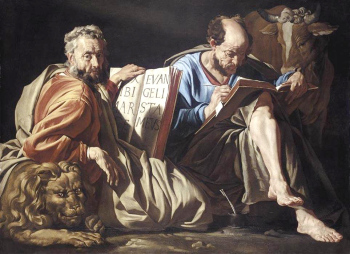
Early Christian authors, starting in the second century A.D., began to attach a symbol to each gospel writer. They used as their inspiration the four animals mentioned in Ezekiel's vision (Ezekiel 1:5) and in Revelation (Revelation 4:6 - 10). Over time Luke was symbolized by an ox (bull), Mark by a lion, Matthew by a man and John by an eagle.
[Symbols of the Gospel Writers]
Angels at Work
Luke reveals the fascinating role angels played in the conception and birth of both John the Baptist and Jesus!
In Luke's account he mentions that an Angel of the Lord appeared to Zacharias to let him know that his barren wife Elizabeth would bear a son (Luke 1:5 - 17). The name of this angel was Gabriel (verse 19), the same righteous spirit being who gave the prophet Daniel the 70-weeks prophecy that foretold when the Messiah would appear (Daniel 9:20 - 21, 24).
Gabriel was also used to inform Mary that, although a virgin, she would miraculously give birth to God's Son to be named Jesus (Luke 1:28 - 37). This announcement by the angel to Mary is sometimes referred to as the Annunciation.
Luke also tells us it was an angel of the Lord who announced, to lowly shepherds tending their sheep outside of Bethlehem, that mankind's Savior had been born (Luke 2:9 - 12).
Luke further reveals that a heavenly host of angels (Luke 2:13), after Jesus birth is supernaturally announced, appears in the sky above Bethlehem's shepherds. They immediately commence singing praises to God and proclaiming peace to all those who serve him (verse 14)!
A Rare Angelic Name
The gospel of Luke references, by name, the angel Gabriel twice (Luke 1:19, 26). It is the only mention of this angelic being in the New Testament and two of only four times he is referenced by name (the other two are Daniel 8:16 and 9:21). Although not stated in the Bible, Gabriel was highly likely an Archangel given the tasks he has carried out for God.
Luke the Painter?
One well-known tradition related to Luke is that he was a painter. This tradition has existed as early as the sixth century A.D. when someone claimed he painted a portrait of the Virgin Mary. It has also been claimed that he painted a picture of Mary holding Jesus as an infant. These paintings are believed to be in a church somewhere in Rome.
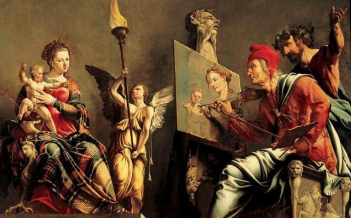
Another tradition, started in the 8th century A.D., claims that Luke was the first icon painter (Wikipedia article on Luke). He is thought by some to have painted icons of Mary, Jesus, Peter and Paul, as well as illustrating a gospel book.
It is the belief that Luke was a painter that led the Roman Catholic Church (and other denominations) to consider him the patron saint of artists (1913 Catholic Encyclopedia article on patron saints). He is also considered the patron saint of notaries, bachelors, physicians, goldsmiths, butchers, brewers and others.
[How Are Catholic Bibles Different?]
Patron saints are righteous people who, after they died, are believed to have received their reward from God and are now living in heaven. It is from these believed resurrected saints that a church chooses certain ones to offer protection and be an intercessor for people with which the saint has a real (or presumed) relationship in regard to their occupation.
The Bible is silent regarding whether Luke was a painter. The belief that he was a painter is merely a legend and pure speculation.
Life and Death Traditions
The Bible reveals very little about Luke's personal life. Not surprisingly, it also does not reveal how, when, where or any other details about his death. This has not stopped humans, however, from attempting to fill in such missing information with tradition!
[What Is the Resurrection of the Dead?]
[Who Was Resurrected with Jesus?]
It is Biblically unknown if Luke was ever marriage, although one tradition states he never wed nor had any children (Holman Bible Dictionary).
While one tradition says Luke died at the age of 84 (Holman Bible Dictionary), a different one states he died when he was 74 (1911 Encyclopedia Britannica). Although one tradition states Luke died peaceably, an old one asserts he died a martyr by being hung on an olive tree by idolatrous priests (Foxe's Book of Martyrs).
The 1911 Encyclopedia Britannica, as well as its modern online presence, places Luke's death in Bithynia. The Roman province of Bithynia (Bithynia-Pontus), in the first century A.D., was in the northern part of Asia Minor. While another tradition places his death somewhere in Greece (Foxe's Book of Martyrs), still others assert the exact location was Boeatia.
The area named Boeotia is a region in central Greece where a city named Thebes is found. Modern Thebes is considered one of the oldest continuously inhabited cities in the world (Wikipedia article on Thebes, Greece). It is in Thebes that the Holy Church of Luke the Evangelist was built around the 10th century A.D. The church lays claim to housing Luke's tomb and relics at the place where he died.
Buried in Three Places?
The Bible's silence on where Luke is buried didn't stop others, centuries later, from claiming they possessed his body or at least parts of it! At least three locations claim to have parts of the evangelist's body.
[New Testament Burial Locations]
The Church of Luke the Evangelist in Thebes, Greece claims to be the gospel writer's tomb. That said, the Abbey of Santa Giustina in Padua, a city in northern Italy, claims to have his actual body. This believed body of Luke ended up in Padua after it was sold to the Venetian Republic by Queen Maria of Serbia around 1463 A.D.
In 1992 the Greek Orthodox Archbishop of Athens asked the abbey in Padua to return "a significant part" of Luke's body so it could be placed at Thebes' Church of Luke the Evangelist. Padua eventually sent a rib from the body (Wikipedia article on Luke the Evangelist).
Luke's skull is claimed to be housed at the St. Vitus Cathedral in Prague, Czech Republic.
Luke 1 to 6 Outline - 7 to 12 Outline
13 to 18 Outline - 19 to 24 Outline
1 to 5 Questions - 6 to 10 Qs - 11 to 15 Qs
16 to 20 Qs - 21 to 24 Qs - Facts Part 1